



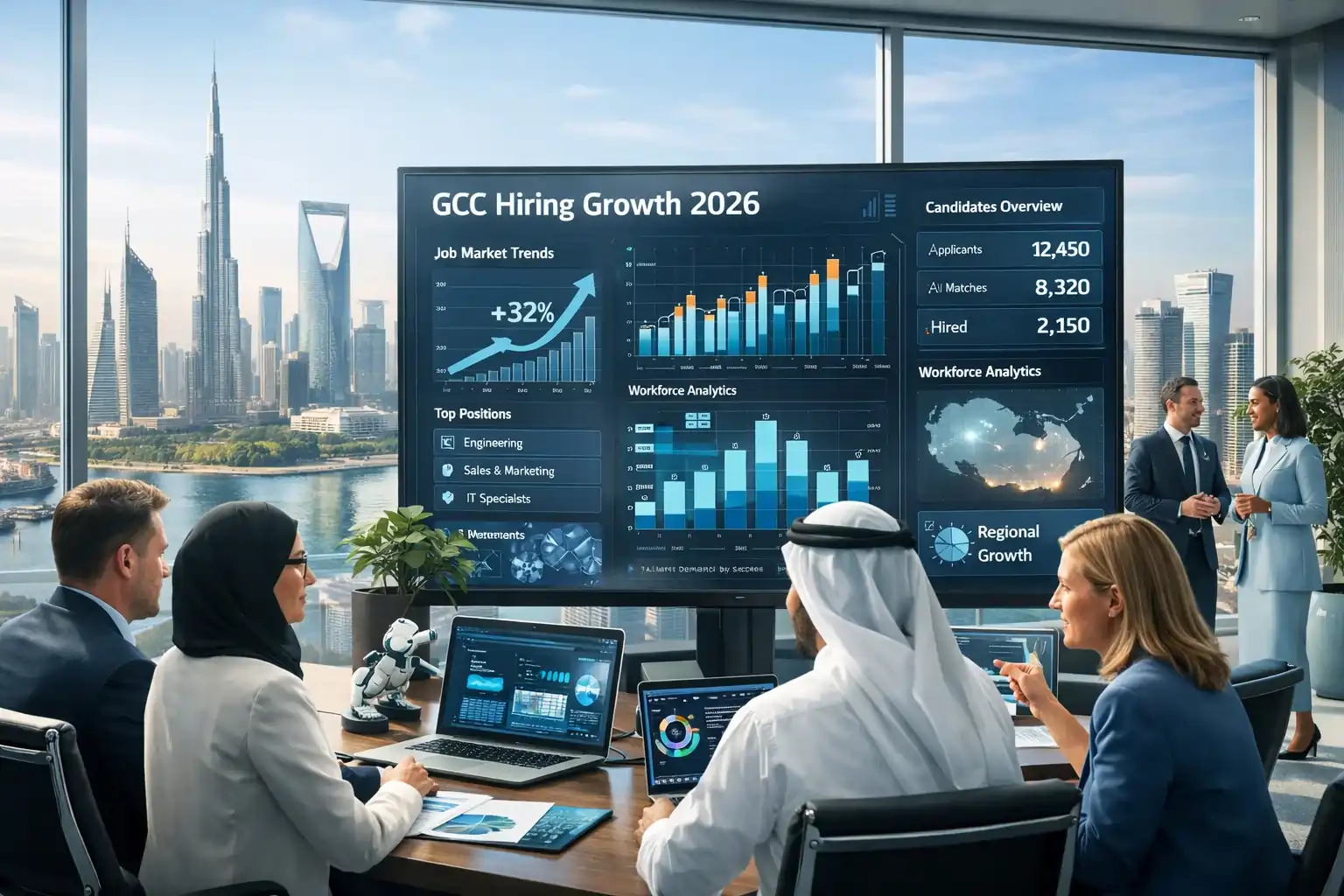
The Gulf Cooperation Council job market is going through something it has not experienced before: genuine decoupling from oil prices. In 2026, the hiring momentum across the UAE, Saudi Arabia, and Qatar is being driven by non-oil sectors — technology, financial services, advanced manufacturing, healthcare, and tourism — not by commodity cycles. For employers planning workforce expansion and for professionals weighing career moves, understanding which GCC markets are growing fastest in 2026 is the difference between moving early and being behind the curve.
This is a data-driven overview of where the real hiring activity is, what is driving it, and what employers and HR leaders need to act on. As a GCC recruitment partner with active operations across the region, ReapHR tracks this market in real time. The data points referenced throughout draw on 2026 projections from the World Bank Global Economic Prospects, IMF country reports, and the UAE and GCC hiring outlook research from People Connect Global.
|
Which GCC country has the fastest-growing job market in 2026? |
|
The UAE leads the GCC with a +48% Net Employment Outlook, ranking first globally ahead of India and the US. Saudi Arabia follows with +35%, driven by Vision 2030 megaproject execution. Qatar maintains one of the lowest unemployment rates in the world at approximately 0.1%, with focused growth in energy, engineering, and finance. Taken together, the GCC is expected to create more than 5 million new private-sector jobs by 2030. |
The Macro Picture: Why 2026 Is Different
For most of the past decade, GCC hiring moved in lockstep with oil prices. When Brent rose, project pipelines expanded; when it fell, hiring froze. That dependency is measurably weakening. Non-oil sectors now account for more than 56% of Abu Dhabi's GDP — a historic milestone. In Saudi Arabia, non-oil activities contributed 2.8 percentage points to overall real GDP growth in 2025. The World Bank projects MENA growth strengthening to 3.6% in 2026, with the Gulf's diversified economies outpacing the regional average.
GCC economies as a group are forecast to grow at 4.1% to 4.4% in 2026, significantly above the projected global average. Importantly, this growth is concentrated in sectors with high skill demand: technology, financial services, tourism, and industrial manufacturing. The result is a labour market where the competition for qualified professionals has intensified, talent shortages are acute in specialist roles, and employers who move quickly and strategically have a structural advantage.
GCC Hiring Outlook by Country: A Side-by-Side Comparison
|
Country |
Net Employment Outlook |
Non-Oil GDP Growth |
Hiring Momentum |
Key Driver |
|
UAE |
#1 globally; +48% |
5.9% (2025 est.) |
Very strong — broad-based across sectors |
Economic diversification + AI Strategy 2031 + Expo legacy investment |
|
Saudi Arabia |
+35% |
4.5-4.6% (2025 actuals / 2026 projection) |
Strong — concentrated in megaprojects and service economy |
Vision 2030 Phase 3 execution; PIF investment pipeline |
|
Qatar |
N/A (unemployment ~0.1%) |
GDP growth 3.2% Jan-Sep 2025 |
Selective — project-led, tight market |
North Field LNG expansion; post-World Cup operations and asset management |
|
Bahrain |
+20% to +28% |
Moderate; financial services and tourism |
Stable — smaller market |
DIFC-adjacent financial services; aluminium and manufacturing |
|
Kuwait |
+20% to +28% |
Limited; oil-linked |
Stable — conservative hiring |
Government infrastructure projects; limited private sector diversification |
|
Oman |
+20% to +28% |
Tourism and logistics growing |
Stable — improving |
Oman Vision 2040; port and logistics expansion |
Context: The outlook figures are drawn from ManpowerGroup's Net Employment Outlook surveys and supplementary research as cited in the People Connect Global GCC analysis. They represent employer hiring intentions, not GDP forecasts.
UAE: Global Leader in Hiring Optimism
The UAE's dominance in global hiring tables is not a data anomaly. It reflects a genuinely broad-based labour market expansion driven by multiple converging forces. The country's non-oil economy is growing at close to 6% annually. The financial services sector in DIFC and ADGM is attracting global institutions. The technology sector is seeing 20% year-on-year increases in posted roles. Healthcare is expanding as the government accelerates its healthcare infrastructure programme.
The UAE's We the UAE 2031 vision — targeting a doubling of GDP to AED 3 trillion — is creating hiring demand across every professional tier. For employers, the practical implication is a competitive talent market where the gap between good and great candidates is narrowing. For HR leaders, this means faster time-to-offer processes, stronger employer branding, and up-to-date salary benchmarking are non-negotiable, not optional.
The UAE is also navigating the continued rollout of Emiratisation targets. With the 10% skilled workforce quota now active for companies with 50 or more employees, Emiratisation 2026 compliance is a material cost and operational factor for any employer expanding in the UAE this year. Companies that treat this as a strategic hiring objective rather than a compliance burden consistently perform better in both talent attraction and regulatory standing.
Saudi Arabia: The Fastest-Growing Opportunity for Specialist Talent
Saudi Arabia is undergoing transformation at a scale that has no modern parallel. Non-oil sectors now account for more than 50% of GDP, the non-oil economy grew 4.5% in 2025, and the Public Investment Fund holds assets exceeding $1.15 trillion deploying capital into AI, renewable energy, entertainment, tourism, and advanced manufacturing. For employers and professionals with the right specialist profiles, Saudi Arabia in 2026 represents the highest-growth opportunity in the GCC. Our guide to recruiting in Saudi Arabia covers the practical process in detail.
What is driving Saudi hiring demand:
• NEOM and the giga-projects: NEOM, Red Sea Project, Diriyah, and EXPO Riyadh 2030 are collectively the largest coordinated construction programme in modern history, sustaining demand for engineering, project management, and technical talent at scale
• Technology and AI: Saudi Arabia's National Strategy for Data and Artificial Intelligence is generating acute demand for data engineers, AI specialists, cybersecurity professionals, and cloud architects across both government entities and the private sector
• Tourism: Saudi welcomed 122 million visitors in 2025, having exceeded its original 100 million target seven years early. The hospitality, entertainment, and travel sectors are expanding their workforces continuously
• Female workforce participation: Rising from 17.4% in 2017 to 36.3% in early 2025, female labour force participation is unlocking new talent pipelines and enabling companies to hire from a wider pool than was available even three years ago
The nuance employers must understand is Saudisation (Nitaqat). Sector-specific localisation targets require a minimum percentage of Saudi national employees in the workforce. For specialist, senior, and technical roles, Saudisation creates less friction — these are the categories where expat talent is most needed and most easily accommodated. For administrative, HR, and mid-level service roles, hiring strategies need to build in Saudisation compliance from the planning stage, not as an afterthought.
Qatar: Tight, Selective, and Engineering-Led
Qatar's labour market is the most distinct in the GCC. Unemployment sits at approximately 0.1% — essentially full employment — which means the market is not growing through large-scale expansion but through targeted replacement and project-specific demand. For employers entering Qatar, this means the competition for talent is intense and candidates have strong leverage in negotiations.
The North Field expansion — Qatar Energy's programme to increase LNG output from 77 to 126 million tonnes per annum — continues to drive demand across upstream engineering, operations, project management, and associated services. Post-World Cup, the shift is from construction to operations: asset management, facility management, hospitality operations, and maintenance engineering are among the most active hiring categories.
Qatar's Qatarisation policy (Law No. 12/2024) is expanding the sectors and roles subject to nationalisation targets. Employers planning to hire in Qatar should map their planned roles against the current Qatarisation schedule before confirming headcount plans.
Bahrain, Kuwait, and Oman: Stable Growth With Specific Opportunities
The three smaller GCC economies show net employment outlooks in the +20% to +28% range — positive, but more conservative than the headline markets.
|
Market |
Strongest Hiring Sectors |
Key Consideration for Employers |
|
Bahrain |
Financial services (ADGM-adjacent), fintech, aluminium, tourism |
Low cost base; growing as a regional financial hub; talent often serves wider GCC markets remotely |
|
Kuwait |
Government infrastructure, oil and gas operations, retail expansion |
Private sector diversification is limited; most hiring linked to government projects or state entities |
|
Oman |
Logistics and ports, tourism (Oman Vision 2040), oil and gas services |
Omanisation targets are actively enforced; significant opportunities in Port of Salalah and Duqm SEZ |
Cross-GCC: The Sectors Hiring Hardest Right Now
|
Sector |
UAE |
Saudi Arabia |
Qatar |
|
Technology and AI |
Very high — AI Strategy 2031; ADGM fintech hub |
High — national AI strategy; over 250 new regulations creating compliance tech demand |
Moderate — ICT sector growing at approximately 8% annually |
|
Construction and engineering |
High — Aldar, Emaar mega-development pipeline |
Very high — NEOM, Red Sea, Diriyah, Expo Riyadh 2030 |
High — North Field and post-World Cup asset operations |
|
Financial services |
Very high — DIFC and ADGM expansion |
High — banking reform; Vision 2030 capital markets development |
Moderate — QNB and financial services expanding |
|
Healthcare |
High — DOH expansion; UAE genomics initiative |
High — healthcare privatisation; specialist demand |
High — Hamad Medical Corporation and private sector growth |
|
Tourism and hospitality |
High — UAE Tourism Strategy 2031 |
Very high — 122M visitors in 2025; new destinations opening |
Moderate — shift from event-driven to steady tourism |
|
Renewable energy |
High — clean energy targets |
High — NEOM solar; Saudi Green Initiative |
Moderate — LNG still dominant but renewables emerging |
What GCC Employers Should Do Right Now
The GCC hiring market in 2026 rewards preparation over reaction. Here is what the current data signals for employers:
• Move faster on offers: Time-to-offer has become a competitive differentiator. In the UAE's +48% outlook environment, the best candidates receive multiple offers simultaneously. Processes that take four or more weeks to reach offer stage are losing talent to faster-moving competitors.
• Benchmark salaries against 2026 data, not 2023 benchmarks: Salary expectations across the GCC have shifted. Using outdated benchmark data at offer stage is the leading cause of post-interview drop-off. Ensure your compensation data reflects the current Gulf market.
• Build nationalisation strategy into workforce planning, not compliance review: Whether it is Emiratisation in the UAE, Saudisation in Saudi, or Qatarisation in Qatar, localisation policies now affect hiring timelines, candidate pools, and budget. Integrate them into quarterly workforce planning rather than treating them as an annual HR audit item.
• Source for Saudi roles differently: The Saudi talent market requires dedicated sourcing channels, cultural alignment considerations, and in-country presence or a partner network to be effective. General Gulf sourcing strategies consistently underperform for Saudi-specific roles.
• Prioritise retention as highly as acquisition: In a +48% employment outlook environment, the cost of losing a strong hire to a competitor 12 months after onboarding is significant. Total compensation packages, career development, and leadership culture are retention levers that carry as much weight as base salary in 2026.
For employers ready to build hiring pipelines across the UAE, Saudi Arabia, Qatar, or the wider GCC, connect with the ReapHR team to discuss your 2026 workforce strategy.
Conclusion
The GCC is in a hiring cycle unlike anything the region has seen before. The macroeconomic foundation — non-oil GDP growth, government investment pipelines, and structural diversification — is the strongest it has ever been. The UAE leads globally in hiring optimism. Saudi Arabia is executing the largest national economic transformation in modern history. Qatar is running a tight, project-led market with significant specialist demand. Even the smaller GCC economies are posting positive employment outlooks.
For employers and professionals, 2026 is the year to move strategically, not reactively. The markets are growing. The talent competition is intensifying. The employers who win in this environment are those who treat hiring as a strategic function with the same discipline they bring to commercial planning.
Frequently Asked Questions
Which GCC country has the best job market for expat professionals in 2026?
The UAE offers the broadest and most accessible job market for expat professionals, with a +48% Net Employment Outlook that ranks first globally. It has the most developed financial, technology, and professional services ecosystems and the highest volume of open roles across all experience levels. Saudi Arabia offers the highest-growth opportunities for specialist talent in energy, construction, and technology, but requires more targeted sourcing and Saudisation compliance planning.
Is Saudi Arabia's job market growing in 2026?
Yes, significantly. Saudi Arabia's non-oil economy grew 4.5% in 2025, driven by Vision 2030 megaprojects, tourism (122 million visitors in 2025), and a rapidly expanding technology sector. The Public Investment Fund with assets exceeding $1.15 trillion is actively deploying capital across sectors creating sustained hiring demand. Saudi Arabia holds a +35% Net Employment Outlook, second in the GCC behind the UAE.
What sectors are hiring most in the GCC in 2026?
Technology and AI, construction and engineering, financial services, healthcare, and tourism and hospitality are the strongest hiring sectors across the GCC. In the UAE, technology roles are up 20% year-on-year. In Saudi Arabia, construction for megaprojects like NEOM and engineering for Vision 2030 infrastructure dominate. Qatar's North Field LNG expansion continues to drive upstream engineering and operations demand.
How does Emiratisation affect hiring in the UAE in 2026?
Companies with 50 or more mainland UAE employees must have 10% of their skilled workforce as Emirati nationals by 31 December 2026. Monthly fines for non-compliance are AED 9,000 per unfilled slot. This affects hiring strategy, budget planning, and Nafis platform engagement for all qualifying employers. See our full Emiratisation 2026 guide for the complete details.
Will the GCC job market keep growing beyond 2026?
Industry projections indicate the GCC is expected to create more than 5 million new private-sector jobs by 2030. Saudi Arabia's Vision 2030 targets, UAE's AI Strategy 2031, and Qatar's LNG expansion extend hiring demand well beyond the current year. However, the pace of growth will depend on oil prices, geopolitical stability, and the continued execution of national diversification agendas.