



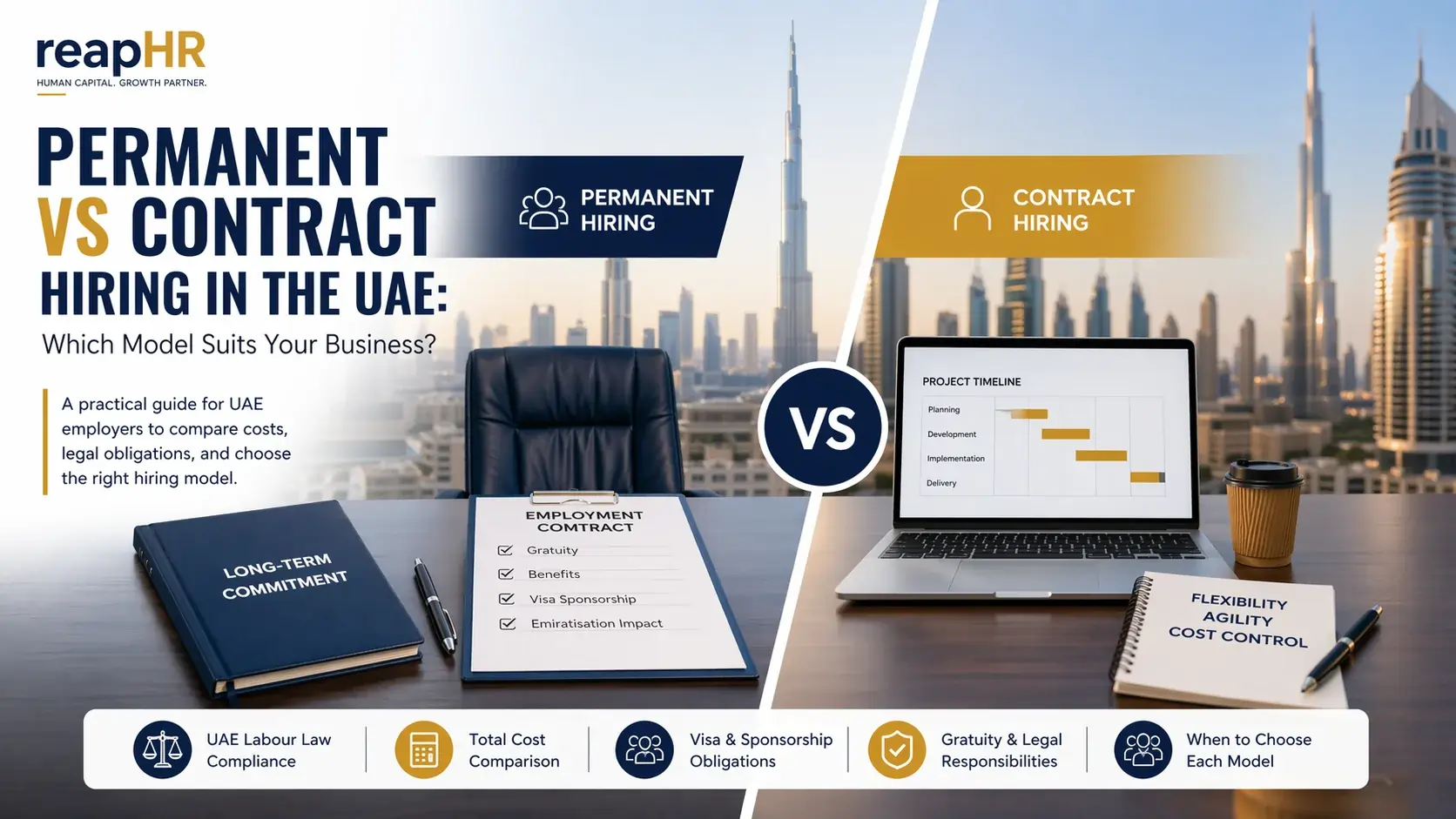
When a UAE business needs to hire, the first decision is rarely the role or the salary. The first decision is: permanent or contract? And in the UAE, that choice carries more weight than it does in most markets. Different cost profiles, different visa obligations, different legal frameworks, and different implications for your Emiratisation position all flow from which model you choose.
This guide gives you the clear, practical comparison that most UAE employer resources fail to provide. Whether you are a founder hiring your fifth employee or an HR director managing a 200-person workforce, understanding the real difference between permanent and contract hiring in the UAE is the foundation of building a team that is both effective and compliant.
As a trusted recruitment partner in the UAE, ReapHR supports businesses with permanent recruitment and HR support across Dubai, Abu Dhabi, and the wider UAE. Here is the honest breakdown of how these two models compare.
|
What is the difference between permanent and contract hiring in the UAE? |
|
Permanent hiring means directly employing a candidate under your company's visa sponsorship with full UAE Labour Law entitlements — gratuity, annual leave, health insurance, and notice periods. Contract hiring means engaging a professional for a defined period or project, typically via a third-party staffing agency that handles visa sponsorship and employment obligations. Both models are legal and widely used in the UAE. |
The Legal Context: What UAE Law Says About Employment Models
Since Federal Decree-Law No. 33 of 2021 came into force on 2 February 2022, all UAE private sector employment contracts must be fixed-term, with a maximum duration of three years, renewable upon mutual agreement. The concept of 'unlimited' or open-ended employment contracts has been phased out. This change applies to both models — permanent and contract —, but it reshapes the framing of 'permanent' hiring in the UAE.
In practice, what UAE employers call 'permanent' hiring is now a fixed-term full-time contract that is expected to renew continuously, building the employee's service record and entitlements accordingly. What they call 'contract' hiring typically refers to engaging staff through a third-party manpower supply agency on a project or defined-period basis, where the agency holds the visa sponsorship and employment obligations.
Employers handling contracts directly should ensure their documents are MOHRE-registered and compliant with current templates. ReapHR's employment contract drafting service supports UAE businesses in getting this right from day one.
Important: Free zone companies follow their respective free zone authority's employment regulations rather than MOHRE. DIFC and ADGM operate under entirely separate employment frameworks. Employers in these zones should verify the applicable rules with their legal advisors.
The Real Cost Comparison: Permanent vs Contract
This is where most employer comparisons fall short. The visible cost of a permanent hire is the salary. The total cost of a permanent hire is significantly higher. Understanding the full employer obligation on both sides of this comparison is essential for accurate budgeting.
Total cost of a permanent hire in the UAE:
|
Cost Element |
Notes |
Who Bears It |
|
Basic salary + allowances |
Housing, transport, and utilities allowances vary by company. Basic salary is the base for gratuity calculation. |
Employer — paid monthly via WPS |
|
End-of-service gratuity (EOSB) |
21 days of basic salary per year for the first 5 years; 30 days per year thereafter. Capped at 2 years' basic salary. Accrues from day 1 after 12 months of minimum service (Article 51). |
Employer — accrues monthly, paid on exit. |
|
Health insurance |
Mandatory for all employees across the UAE. Abu Dhabi requires coverage for dependents, too. Cost: AED 600 to AED 5,000 per employee annually, depending on plan. |
Employer |
|
Visa and work permit fees |
Entry permit, medical test, Emirates ID, residency visa. Approximately AED 3,000 to AED 5,000 per hire. Cannot be passed to an employee under UAE law. |
Employer |
|
Annual leave |
Minimum 30 calendar days per year after one year of service. Leave pay is calculated on the basic salary. |
Employer |
|
Annual flight ticket |
Not legally mandatory but standard in many packages, particularly for non-resident expats. |
Employer (if offered in contract) |
|
Recruitment fee (if via agency) |
One-time placement fee: typically 12–20% of first-year salary for permanent roles. |
Employer |
To estimate your gratuity exposure accurately, use the Dubai Development Authority's official gratuity calculator or the Gulf News UAE gratuity calculator. Both apply the current Article 51 formula. Note: from April 2026, employers can also enrol in the voluntary Alternative End-of-Service Savings Scheme (Cabinet Resolution No. 96 of 2023), which replaces the traditional gratuity accrual model with a monthly contribution to an approved investment fund.
Total cost of a contract hire through a staffing agency:
|
Cost Element |
Notes |
Who Bears It |
|
Hourly or monthly billing rate |
Includes candidate's salary plus agency margin (typically 15–25% markup on base salary). |
Employer — single invoice to agency |
|
No direct gratuity exposure |
The staffing agency is the legal employer; gratuity accrues with the agency, not the client. |
Agency (included in billing rate) |
|
No visa and permit costs |
The agency manages and bears visa sponsorship costs. |
Agency (included in billing rate) |
|
No recruitment placement fee |
Agency charges a service retainer or margin, not a one-off placement fee. |
Employer — within billing rate |
|
Flexibility premium |
The billing rate is higher than equivalent direct employment cost per month for good reason: it includes agency margin plus absorbed employer obligations. |
Employer |
Rule of thumb: Contract staffing typically costs 15–25% more per month than equivalent direct employment. However, it eliminates visa risk, gratuity exposure, and long-term commitment — making it genuinely cheaper for short-term or uncertain engagements.
Visa Sponsorship: A Key Practical Difference
In permanent hiring, your company sponsors the employee's work permit and residency visa through MOHRE (for mainland companies) or your free zone authority. This means: your company is the legal employer of record, visa cancellation must be processed when employment ends, and you manage the employee's legal right to remain in the UAE throughout their tenure.
In contract staffing through a licensed manpower supply agency, the agency holds the visa sponsorship. Your business benefits from the candidate's work without taking on the legal obligations of an employer. This distinction matters most in three scenarios:
• Project-based work with an uncertain end date — avoiding visa cancellation logistics is a real operational benefit
• Hiring during a period of rapid growth or market uncertainty — contract gives you room to scale without long-term commitment
• Roles where the candidate's availability may change — the agency absorbs the risk of re-deploying the professional if the engagement ends early
Ensure any contract staffing agency you engage holds a valid MOHRE manpower supply licence. Using an unlicensed intermediary creates direct liability for your business under the UAE Labour Law.
When to Choose Permanent Hiring
|
Situation |
Why Permanent Makes Sense |
|
Core team roles where continuity matters |
Finance director, HR manager, technical leads — these roles require institutional knowledge that builds over time and cannot be refreshed every project. |
|
Roles requiring deep culture and brand alignment |
Client-facing, leadership, and customer success positions benefit from employees who are invested long-term in the company's mission. |
|
Where Emiratisation targets apply |
Permanent Emirati hires count toward your MOHRE quota. Contract hires through external agencies typically do not count toward your Emiratisation rate. |
|
Roles where confidentiality is critical |
Legal, finance, and strategy functions — permanent employees carry stronger contractual confidentiality and non-compete protections under UAE law. |
|
When building a long-term employer brand |
High-quality permanent teams attract better candidates, reduce future recruitment costs, and strengthen your company's reputation in the market. |
If your role falls into these categories and you have Emiratisation obligations, note that hiring Emirati nationals permanently counts toward your 10% quota target. See the Emiratisation 2026 guide for the full breakdown of quotas and penalties.
When to Choose Contract Hiring
|
Situation |
Why Contract Makes Sense |
|
Project-based or time-limited work |
IT system implementations, construction projects, marketing campaigns, event staffing — defined scope with defined end date |
|
Specialist skills for a short engagement |
A data science specialist for a 6-month AI project, a compliance consultant for a regulatory transition — high skills, limited need window |
|
Business scaling under uncertainty |
New market entries, rapid headcount growth, pilot programmes — contract lets you test before committing to permanent employment overhead |
|
Seasonal volume hiring |
Retail peak seasons, hospitality events, Ramadan, and Eid surge staffing — flexible headcount without fixed employment obligations |
|
Filling a gap during a permanent search |
Contract professionals can cover a critical function while the right permanent candidate is being sourced — no productivity loss. |
|
Testing a candidate before a permanent offer |
A contract-to-permanent arrangement lets both parties evaluate fit before the longer-term commitment is made. |
The Blended Workforce: The Model Most UAE Businesses Actually Use
The permanent vs contract framing presents a false binary. The most effective workforce strategies in the UAE combine both models deliberately. Core functions — finance, HR, legal, leadership, and client management — are staffed permanently to build institutional knowledge and cultural continuity. Project-specific and variable-demand functions are staffed contractually to maintain cost flexibility and operational agility.
In practice, this means most UAE businesses of any meaningful size run a permanent headcount of stable core employees alongside a rotating pool of contract professionals for project delivery, seasonal peaks, and specialist expertise. The key is designing the blend intentionally rather than letting it evolve reactively.
If you are unsure whether your current workforce structure is optimised or whether your mix of contracts is fully compliant with current UAE law, ReapHR's HR audit service can identify gaps and give you a clear action plan. And if you are making permanent hires in competitive specialist markets, salary benchmarking against current UAE data ensures your packages are competitive enough to close the right candidates.
Key Takeaways: Permanent vs Contract at a Glance
|
Factor |
Permanent Hire |
Contract Hire (via Agency) |
|
Legal employer |
Your company |
Staffing agency |
|
Visa sponsorship |
Your company |
Staffing agency |
|
Gratuity obligation |
Yes — accrues with your company under Article 51 |
No — accrues with the agency |
|
Monthly cost |
Salary + allowances + accrued EOSB + insurance |
Higher monthly rate; no separate accruals |
|
Best for |
Core roles, leadership, long-term functions |
Projects, specialist gaps, volume, seasonal |
|
Emiratisation credit |
Yes (for UAE nationals on your payroll) |
Generally, no (visa held by agency) |
|
Commitment level |
Fixed-term renewable — typically long-term |
Project or defined period — ends cleanly |
|
Compliance management |
Your HR team manages all MOHRE obligations |
The agency manages visas, permits, and EOSB |
Conclusion
There is no universally correct answer to the permanent vs contract question in the UAE. Both models are legal, both are widely used, and both carry distinct cost and compliance profiles. The right choice depends on the role, your business stage, your Emiratisation position, and how long you genuinely need the professional.
The employers who consistently make the best hiring decisions are those who understand both options clearly, build a workforce strategy that uses each model for what it does best, and maintain the compliance discipline that the UAE's regulatory environment requires.
Ready to build the right team? Whether you need permanent placement, contract staffing, or a blended strategy, ReapHR supports UAE employers across every hiring model with full compliance expertise.
Speak to the ReapHR team to discuss which hiring model is right for your next hire.
Frequently Asked Questions
Is contract hiring legal in the UAE?
Yes. Contract staffing is fully legal in the UAE when the staffing agency holds a valid MOHRE manpower supply licence. The agency acts as the legal employer of the contract professional, managing visa sponsorship, payroll through WPS, health insurance, and end-of-service gratuity. The client company directs the day-to-day work but does not hold the employment obligations.
Do UAE employers have to pay gratuity for contract staff?
Not directly. When a professional is hired through a licensed contract staffing agency, the agency is the legal employer and bears the gratuity obligation under Article 51 of Federal Decree-Law No. 33 of 2021. This cost is typically factored into the agency's billing rate. If you hire a contractor directly without going through an agency, you are the employer, and gratuity obligations apply after one year of service.
Does contract staffing count toward Emiratisation quotas?
Generally no. Emiratisation quotas under MOHRE are based on Emirati nationals on your company's own payroll and work permits. Contract professionals whose visas are held by a third-party staffing agency typically do not count toward your company's Emiratisation rate. To build your Emiratisation quota, permanent or direct-hire arrangements for Emirati nationals are the standard approach.
Can a contract employee be converted to permanent in the UAE?
Yes. A common arrangement is a contract-to-permanent transition where a professional works on contract for 3 to 6 months and then transfers to direct employment with the client company. This requires terminating the agency agreement, cancelling the professional's existing visa sponsorship with the agency, and the client company initiating a new work permit and residency visa. The process typically takes 4 to 8 weeks.
What is the total cost of hiring a permanent employee in the UAE?
Beyond base salary, the key additional costs are: end-of-service gratuity (accruing at 21 days of basic salary per year for the first five years), mandatory health insurance (AED 600 to AED 5,000 per year), visa and work permit fees (approximately AED 3,000 to AED 5,000 per hire), and annual leave (minimum 30 days per year). Use the Dubai Development Authority's official gratuity calculator to model your specific exposure.