



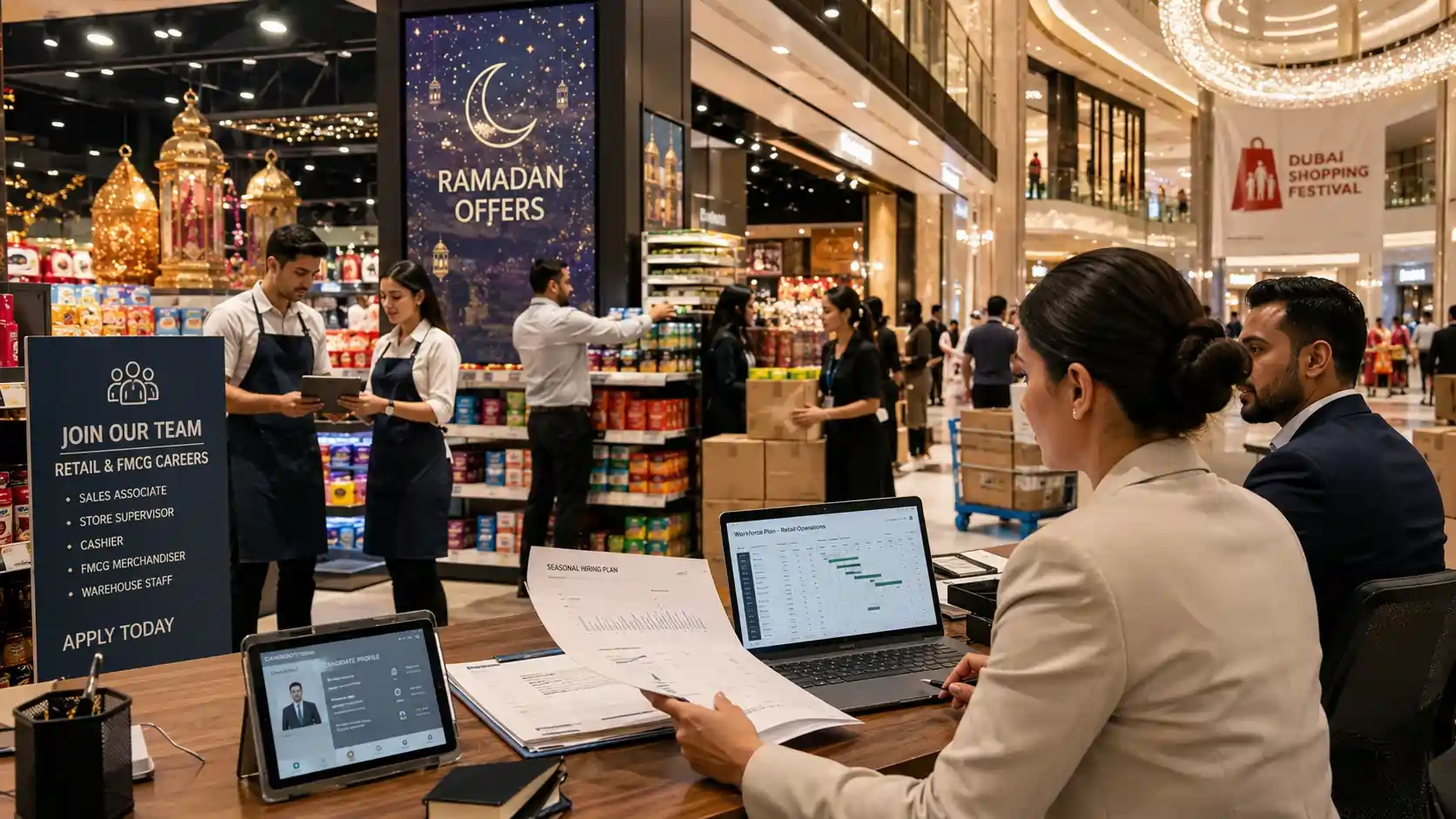
A 320-person UAE retail group operating 18 stores across Dubai Mall, Mall of the Emirates, and Yas Mall left their DSF hiring until 6 weeks before the festival opened. By the time MOHRE work permit approvals came through for the 85 additional hires needed, the first 11 days of the Dubai Shopping Festival had passed, understaffed. The estimated revenue shortfall across those 11 days was AED 1.4 million. Starting the workforce planning process 10 to 12 weeks earlier -- the standard lead time for retail and FMCG hiring in the UAE -- would have prevented the entire problem.
The UAE's retail and FMCG sector operates on a hiring rhythm that has no equivalent in other markets. The combination of world-scale retail festivals, a calendar packed with consumer spending events, and a regulatory framework that requires a valid MOHRE work permit for every worker -- temporary or permanent -- creates a workforce planning environment where late starts carry real financial consequences. According to the UAE and GCC hiring outlook research, consumer goods is one of the top three sectors driving the UAE's exceptional hiring momentum heading into 2026.
This guide covers the full picture: the seasonal spikes that define UAE retail staffing, the permanent role structures that anchor FMCG operations, the salary benchmarks that attract and retain talent, and the compliance framework that applies to every hire regardless of contract length. For employers who want specialist support building either a seasonal surge team or a permanent commercial workforce, ReapHR's retail and FMCG recruitment service operates across all major UAE retail markets.
|
How does retail and FMCG hiring work in the UAE? UAE retail and FMCG hiring operates across two distinct tracks: seasonal staffing for festival and event-driven demand spikes (DSF, Ramadan, DSS, Diwali, Back-to-School), and permanent headcount for commercial, supply chain, and management roles. All hires -- including temporary and seasonal workers -- require a valid UAE work permit through MOHRE. Planning for seasonal peaks must begin 10-12 weeks before the event. FMCG permanent hiring is strongest for modern trade, category management, and digital shopper marketing. |
The UAE Retail and FMCG Hiring Landscape in 2026
The UAE retail and FMCG market in 2026 is operating at an exceptional pace. ManpowerGroup's Q3 2025 Employment Outlook Survey recorded a Net Employment Outlook of +48% for the UAE -- the highest recorded globally at that point -- with transport and consumer goods explicitly cited as the leading drivers. The retail sector specifically is expected to see above-average pay increases in 2026, according to the Korn Ferry UAE Salary Forecast, reflecting both strong demand and intensifying competition for experienced retail talent.
Two structural forces shape the market in 2026. First, the ongoing expansion of Dubai and Abu Dhabi's premium and luxury retail footprint -- Dubai Mall, City Walk, Global Village, Yas Mall, and Al Maryah Island are all growing their brand mix, creating demand for experienced store management and luxury retail specialists. Second, FMCG companies are actively restructuring their UAE commercial teams to prioritise modern trade, e-commerce distribution, and digital shopper marketing -- skills that now command a 15-20% salary premium over traditional FMCG roles.
The UAE Seasonal Hiring Calendar: Planning by Event
Effective retail and FMCG workforce planning in the UAE starts with the seasonal calendar. The Dubai Festivals and Retail Establishment's 2026 Retail Calendar features 18 citywide events. Each creates a distinct hiring requirement that must be anticipated and resourced weeks in advance.
|
Event / Season |
2026 Dates |
Typical Workforce Surge |
Roles Most Affected |
|
Dubai Shopping Festival (DSF) |
Dec 5, 2025 -- Jan 11, 2026 (38 days) |
30-50% additional headcount; 85-150 hires per large multi-store operator |
Sales associates, cashiers, stockroom staff, visual merchandisers, and customer service |
|
Chinese New Year |
Feb 13-22, 2026 |
10-15% surge; luxury and jewellery segments most affected |
Luxury retail associates, Mandarin-speaking customer service |
|
Ramadan and Eid al-Fitr |
Feb 16 -- Mar 22, 2026 (approximately) |
40-60% surge in F&B; 25-40% in retail; consumer spending up 30-40% overall |
Retail floor staff, F&B service, logistics and delivery, FMCG field sales promoters |
|
Diwali / Festival of Lights |
October 2026 |
15-25% surge; gold and jewellery, electronics, fashion, the strongest |
Gold and jewellery retail, electronics sales associates |
|
Dubai Summer Surprises (DSS) |
June -- August 2026 |
DSS 2025 drove 110% increase in seasonal spending, a significant indoor retail surge |
Indoor retail associates, mall customer service, and FMCG promoters |
|
Back-to-School |
August -- September 2026 |
15-20% surge; FMCG household goods, stationery, electronics |
FMCG field reps, retail floor staff, promoters |
|
Eid al-Adha |
June 2026 (estimated) |
20-30% surge in food retail, gifting, and FMCG categories |
FMCG sales promoters, food retail staff, logistics |
|
Workforce planning lead times: UAE-specific reality • 10-12 weeks before the event: Confirm headcount numbers with store operations; begin recruitment process. • 8-9 weeks before: Shortlist candidates; prepare offer letters and employment contracts for MOHRE registration. • 6-7 weeks before: Submit work permit applications for new hires -- MOHRE processing takes 2-4 weeks in peak periods. • 3-4 weeks before: Work permits confirmed; induction and training programme begins. • 1 week before: All staff deployed, trained, and rostered. WPS salary structure is registered and operational. |
Permanent Role Structures in UAE Retail and FMCG
Beyond seasonal surges, the UAE retail and FMCG market has a stable layer of permanent headcount that forms the commercial and operational backbone of every major employer. These roles are not driven by the event calendar -- they are driven by market expansion, brand portfolio growth, and the ongoing restructuring of commercial functions toward digital and omnichannel capability.
FMCG Permanent Roles: What the Market Needs in 2026
The FMCG commercial structure in the UAE is centred on five permanent function areas. Key account management (managing relationships with Carrefour, Lulu, Spinneys, Choithrams, and the major UAE modern trade chains) remains the highest-volume hiring category. Trade marketing and shopper marketing have grown significantly as FMCG companies compete for shelf visibility in a crowded UAE market. Supply chain and demand planning roles are consistently in demand, particularly as FMCG companies manage the UAE's dual pressure of regional distribution complexity and last-mile e-commerce delivery.
Category management and commercial finance roles complete the permanent FMCG structure. For FMCG companies restructuring their UAE teams around digital commerce, roles with experience in Noon, Amazon.ae, and Carrefour's UAE e-commerce platform are commanding material salary premiums.
Retail Permanent Roles: Store Management and Commercial Functions
In permanent UAE retail hiring, three tiers dominate the demand picture: store management (Store Manager, Assistant Store Manager, Department Manager), commercial and buying functions (Buyer, Merchandise Planner, Category Manager), and visual merchandising and brand experience roles. All three are in demand across Dubai and Abu Dhabi in 2026.
Luxury retail is a distinct sub-market within the UAE permanent hiring. Dubai Mall, City Walk, and Dubai Hills Mall luxury tenants consistently pay 20-30% above standard retail benchmarks and have specific requirements around bilingual capability (English plus Arabic, French, or Mandarin) and prior luxury brand experience. For a detailed view of current UAE market compensation, ReapHR's UAE salary benchmarking service provides role-specific data across the retail and FMCG spectrum.
UAE Retail and FMCG Salary Benchmarks 2026
Salary data below is drawn from current UAE market benchmarks, including the Korn Ferry UAE Salary Forecast 2026 and GulfWorkforce's UAE Salary Guide 2026. All figures are monthly gross in AED. UAE salaries carry no personal income tax -- gross salary equals net salary.
|
Role |
Sector |
Monthly AED (Mid) |
Market Notes |
|
Store Manager (mid-size chain) |
Retail |
AED 18,000 - 28,000 |
Dubai Mall and premium mall locations pay a 20-30% premium |
|
Key Account Manager (modern trade) |
FMCG |
AED 22,000 - 35,000 |
E-commerce KAM (Noon, Amazon.ae) commanding 15-20% premium |
|
Trade Marketing Manager |
FMCG |
AED 25,000 - 40,000 |
Digital shopper marketing skills attract premium |
|
Supply Chain / Demand Planner |
FMCG |
AED 20,000 - 32,000 |
SAP experience standard requirement in the UAE FMCG |
|
Category Manager |
Retail / FMCG |
AED 28,000 - 45,000 |
Strong demand from both retail groups and FMCG suppliers |
|
Visual Merchandiser |
Retail |
AED 8,000 - 15,000 |
Luxury VM roles pay significantly above this range |
|
Seasonal Sales Associate |
Retail |
AED 3,000 - 6,000 |
Plus, accommodation was provided; WPS-registered from Day 1 |
|
FMCG Field Sales Representative |
FMCG |
AED 6,000 - 12,000 |
Commission structure often adds AED 2,000-5,000 per month |
Contracts, Compliance, and Work Permits for UAE Retail and FMCG Hiring
Every worker in UAE retail and FMCG -- whether a full-time permanent category manager or a six-week DSF sales associate -- requires a valid UAE work permit issued through MOHRE and registered under the employing company's MOHRE establishment number. There is no legal mechanism for informal or cash-in-hand seasonal employment in the UAE. This is the single most important compliance reality for retail and FMCG employers to understand before any seasonal hiring campaign.
Contract Types for Seasonal and Permanent UAE Retail Staff
|
Contract Type |
When to Use |
Key UAE Compliance Requirements |
|
Fixed-term (short duration: 3-6 months) |
Seasonal event-driven hires: DSF, Ramadan, DSS. Defined end date aligned with event period. |
Must be registered with MOHRE; work permit required; WPS salary registration from Day 1; probation rules apply; gratuity not payable unless the end date passes 1 year. |
|
Fixed-term (standard: 1-3 years) |
Permanent and semi-permanent roles. All UAE private sector contracts must be fixed-term since Feb 2022. |
Full Federal Decree-Law No. 33 of 2021 applies. MOHRE-registered contract mandatory. Gratuity calculated on basic salary per Article 51. |
|
Outsourced/third-party staffing |
High-volume seasonal surge where the employer does not want to hold work permits. Staff employed by a staffing agency, deployed to a retail employer. |
Staffing agency holds the work permit and MOHRE registration. A retail employer is liable for WPS if the salary passes through them. Service level agreement with the agency must define compliance responsibilities. |
Employers using third-party staffing for seasonal peaks should ensure their contracts with staffing partners clearly define which party is responsible for MOHRE registration, WPS filing, visa cancellation at contract end, and compliance under Federal Decree-Law No. 9 of 2024's AED 1 million penalty framework. Our employment contract review service covers both direct employment and outsourced staffing agreements. For a full audit of your retail or FMCG workforce compliance position, the ReapHR HR audit service is the most efficient starting point.
WPS and Pay Compliance During Peak Periods
The UAE government Wage Protection System guidance confirms that WPS applies to all employees from the first pay period. During DSF and Ramadan -- when payroll volumes surge by 30-50% and administrative capacity is stretched -- late or incorrect WPS submissions are among the most common compliance failures in UAE retail. Under Federal Decree-Law No. 9 of 2024, a WPS violation during a period of elevated headcount carries the same AED 1 million per-violation ceiling as any other payroll failure.
Emiratisation in UAE Retail and FMCG
Retail and FMCG employers with 50 or more employees on the UAE mainland are subject to Emiratisation quotas under the UAE government's Emiratisation obligations. In 2026, the mandatory minimum Emirati salary is AED 6,000 per month, and the fine for each unfilled Emirati slot is AED 9,000 per month -- meaning a five-person shortfall generates AED 45,000 in monthly penalties. Seasonal headcount increases also affect the employer's total headcount calculation, which can push a company over the 50-employee threshold and activate Emiratisation obligations mid-year.
For retail and FMCG companies with Emirati employees already on their MOHRE establishment file, the Nafis programme provides wage subsidies and training support that can meaningfully reduce the net cost of Emiratisation compliance. For a practical framework for building Emirati hiring into your commercial structure, ReapHR's Emiratisation recruitment guide covers both the compliance obligations and the practical sourcing approach.
Conclusion
Effective retail and FMCG hiring in the UAE requires two capabilities that most employers underweight: a seasonal workforce planning process that starts 10-12 weeks ahead of each event peak, and a permanent role strategy that tracks the market's shift toward modern trade, digital shopper marketing, and e-commerce distribution capability. The regulatory framework -- MOHRE work permits for every hire, WPS compliance from Day 1, Emiratisation obligations triggered by total headcount -- applies equally to a 4-week seasonal associate and a permanent Category Manager. Getting that framework right before the hiring starts, not after it finishes, is what separates the employers who capitalise on UAE retail peaks from those who pay for the planning gap in revenue and compliance exposure.
Whether you are building a DSF seasonal team, recruiting a permanent FMCG commercial function, or reviewing your workforce compliance position ahead of an MOHRE audit, ReapHR's retail and FMCG recruitment service provides specialist sourcing, compliance review, and onboarding support across the full hiring lifecycle.
|
Ready to plan your retail or FMCG hiring for the next seasonal peak? ReapHR specialises in seasonal surge staffing and permanent commercial recruitment for UAE retail and FMCG employers. Contact ReapHR's retail hiring team to start planning your next seasonal or permanent hire -- before the 10-week window closes. |
Frequently Asked Questions
When should UAE retailers start hiring for DSF?
Workforce planning for DSF (December 5 -- January 11) should begin by mid-September at the latest -- 10 to 12 weeks before the festival opens. This lead time accounts for recruitment, offer letters, MOHRE contract registration, and work permit processing. MOHRE permit approvals in the October-November period can take 3 to 4 weeks as multiple retailers submit applications simultaneously. Employers who begin in November consistently face understaffing in the opening days of DSF.
Do seasonal workers in UAE retail need a work permit?
Yes, without exception. Every worker deployed in UAE retail -- regardless of contract duration -- requires a valid UAE work permit issued through MOHRE and registered under the employer's establishment number. There is no temporary, informal, or visa-on-arrival work category for employed roles. Seasonal hires on 3-month fixed-term contracts carry the same MOHRE registration, WPS, and work permit requirements as permanent employees.
What are the most in-demand permanent FMCG roles in the UAE in 2026?
The highest-demand permanent FMCG roles in the UAE in 2026 are Key Account Manager (modern trade), Trade Marketing Manager, and Supply Chain/Demand Planner. GulfWorkforce's 2026 data confirms FMCG companies are actively hiring for e-commerce distribution and digital shopper marketing -- skills that now attract a 15-20% salary premium. Category management and commercial finance roles are also consistently active across multinational FMCG employers in Dubai and Abu Dhabi.
Does Emiratisation apply to retail companies in the UAE?
Yes. Mainland UAE retail and FMCG employers with 50 or more employees are subject to Emiratisation quotas. The fine for each unfilled Emirati role is AED 9,000 per month in 2026. Seasonal headcount increases can push companies over the 50-employee threshold mid-year, activating obligations that were not in play at the start of the financial year. Employers should calculate their Emiratisation position against peak, not average, headcount.
What is the difference between outsourced and direct seasonal hiring in the UAE retail?
In direct seasonal hiring, the retail employer holds the work permit and MOHRE registration for each seasonal worker, carries full WPS and compliance liability, and manages visa cancellation at contract end. In outsourced staffing, a licensed staffing agency holds the permits and registration and deploys staff to the retailer under a service agreement. Outsourced models reduce administrative burden but require careful contract drafting to define which party carries compliance liability under the AED 1 million penalty framework.