



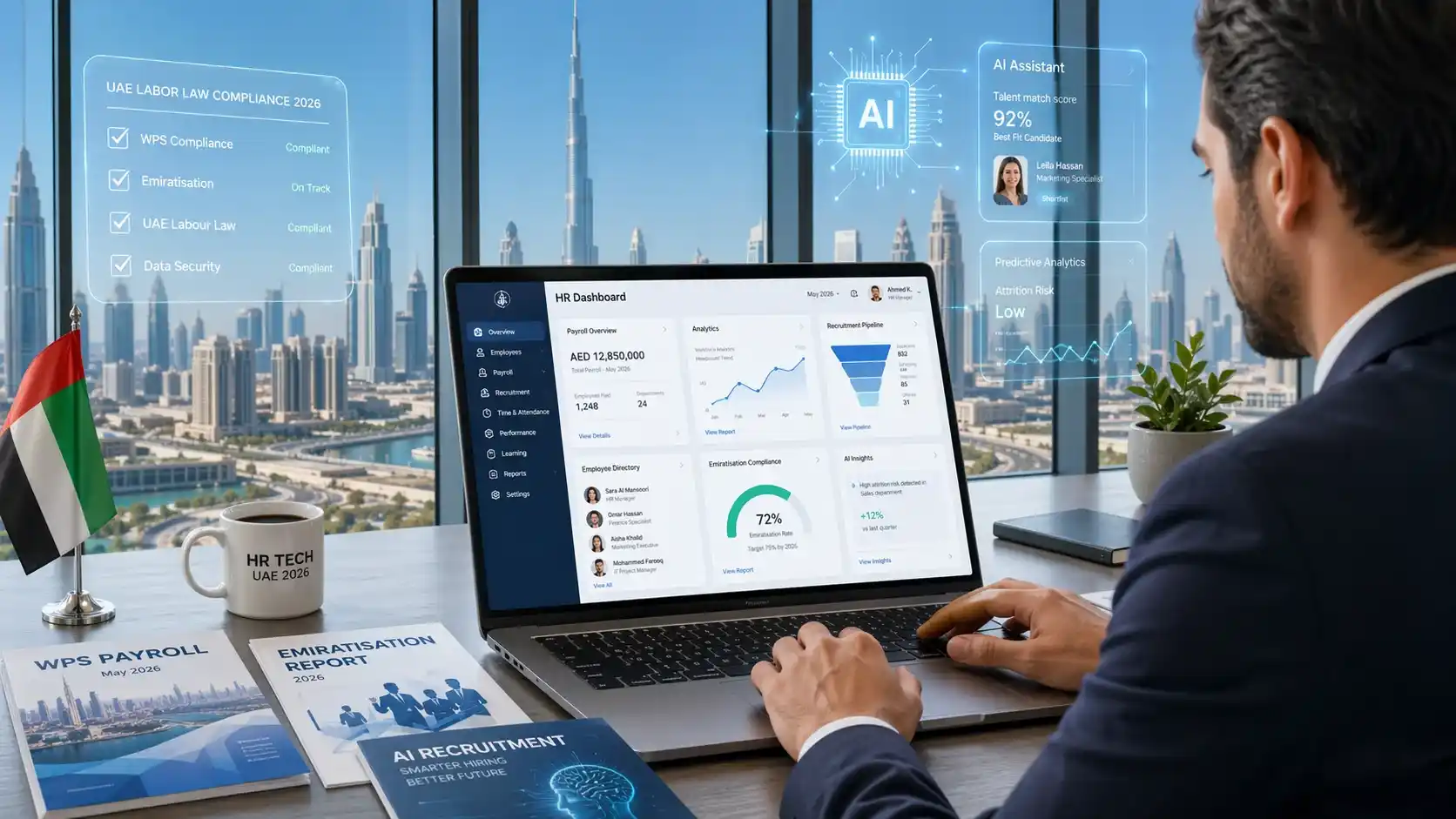
Reviewed by ReapHR’s HR Technology and Workforce Consulting Team, supporting UAE employers with HR system selection, compliance audits, and workforce strategy across Dubai, Abu Dhabi, and the wider UAE.
The UAE is not just an early adopter of HR technology — it is the fastest-growing market for it in the world. With 64% of the UAE’s working-age population using AI — ranking the country first globally according to the Microsoft AI Economy Institute — and 92% of UAE CEOs expressing confidence in their AI usage, well above the global average, the business environment here has moved from HR tech experimentation to full operational deployment faster than any comparable market. In 2026, that acceleration is entering a new phase: the tools that were “emerging” eighteen months ago are now being selected, implemented, and embedded into daily HR operations.
The HR technology trends in the UAE that are actually driving investment in 2026 are not the same as the global list. UAE companies are selecting and implementing tools through a compliance-first lens — starting with whether a platform natively generates WPS-compliant payroll files and integrates with MOHRE systems, not with which interface looks the most modern. The GCC HR technology market, estimated at approximately $2.5 billion in 2023, is projected to reach $5.5 billion by 2032, with 70% of GCC companies planning to increase their HR tech budgets. The tools being prioritised reflect the specific pressures of operating in this market.
If your current HR systems have not been reviewed against UAE compliance requirements, ReapHR’s HR compliance audit identifies gaps before they generate MOHRE violations or payroll exposure. For organisations evaluating a new HR platform, our employment contract review service ensures any system-generated documentation aligns with UAE Labour Law changes and Federal Decree-Law No. 33 of 2021.
|
What are the main HR technology trends in the UAE in 2026? UAE companies are adopting six core HR technology categories in 2026: (1) WPS-compliant cloud HRIS platforms, (2) AI-powered ATS for faster, bias-reduced hiring, (3) Emiratisation tracking and reporting tools, (4) people analytics for attrition forecasting and skill gap identification, (5) employee self-service portals and mobile-first HR apps, and (6) learning management systems (LMS) for skills-based development. The unifying driver is compliance automation — every category is being evaluated first on its ability to satisfy UAE-specific regulatory requirements, particularly WPS payroll processing, MOHRE data formats, and Emiratisation quota reporting. |
What the HR Technology Trends in the UAE Actually Mean for Employers
Understanding the six primary HR technology categories that UAE companies are adopting in 2026 — and, critically, the UAE-specific compliance requirements that determine whether a platform is viable in this market — gives HR leaders and business owners a practical framework for evaluating and upgrading their systems.
|
Tool Category |
Core Function |
UAE Compliance Requirements |
Adoption Priority |
|
Cloud HRIS / HRMS platforms |
Centralised employee data, payroll, compliance, leave, documents |
WPS SIF file generation, gratuity calculation under Federal Decree-Law No. 33 of 2021, MOHRE-aligned record formats, Arabic/English bilingual support |
High — foundational investment for most UAE companies with 50+ employees |
|
AI-powered ATS |
Automated CV screening, candidate ranking, interview scheduling, skills matching |
Emiratisation compliance filtering (nationality tracking for MOHRE reporting), PDPL-compliant data handling |
Growing fast — particularly in banking, tech, and retail sectors, with high volume hiring |
|
Emiratisation tracking tools |
MOHRE quota monitoring, Nafis programme integration, UAE national recruitment pipelines |
Direct MOHRE reporting compatibility, Nafis API connectivity |
Mandatory context — any company with 50+ employees operating in the mainland UAE private sector |
|
People analytics platforms |
Attrition risk forecasting, skill gap analysis, engagement scoring, and workforce planning |
Data residency compliance under UAE PDPL; employee data sovereignty if hosted offshore |
Growing — larger enterprises and regulated sectors are leading adoption |
|
Employee self-service (ESS) portals and mobile apps |
Leave requests, payslip access, document submission, HR queries |
Digital signature validity under UAE Electronic Transactions Law; multilingual UX for diverse workforce |
High — 99% mobile penetration in the UAE makes mobile-first ESS a baseline requirement |
|
Learning management systems (LMS) |
Digital upskilling, microlearning, skills certification, and onboarding e-modules |
Skills-based development aligned with the UAE Vision 2031 knowledge economy targets |
Increasing — driven by Emiratisation development mandates and rapid tech sector growth |
Cloud HRIS Platforms: The Compliance-First Selection Criteria
The cloud HRIS platform is the foundational HR technology investment for any UAE company with more than 50 employees. The challenge is that the global market for HRIS platforms is saturated with products built for US and European employment law that have been adapted — with varying degrees of success — for the UAE market. The most common mistake UAE companies make during HRIS selection is evaluating feature richness before evaluating compliance architecture. A platform with an outstanding user interface and strong analytics capability that cannot generate a valid WPS SIF file natively is not a viable primary system for UAE private sector employment.
The official UAE government guide to the Wage Protection System clarifies the mandatory requirements that any employer and any payroll software in the UAE must satisfy. For a detailed breakdown of how WPS violations generate operational disruption and financial exposure, our guide to payroll management in the UAE covers the compliance architecture in full.
A UAE-viable HRIS must satisfy the following requirements before any other evaluation criteria are applied:
|
Requirement |
What It Means in Practice |
Risk If Absent |
2026 Status |
|
WPS SIF file generation |
Must generate MOHRE/Central Bank-approved Salary Information File natively — not via third-party export |
Make-or-break |
Non-negotiable |
|
Gratuity calculation |
Must apply Article 51 formula (21 days/year for the first 5 years; 30 days/year thereafter) based on last basic salary, tenure, contract type, and termination reason |
Required |
Non-negotiable |
|
MOHRE-compatible employee records |
Must produce data exports in MOHRE-required formats for labour inspections and reporting |
Required |
Non-negotiable |
|
Alternative EOSB support |
Must accommodate Cabinet Resolution No. 96 of 2023 savings scheme alongside traditional gratuity |
Increasingly required |
Now standard for larger employers |
|
Arabic/English bilingual interface |
Must support bilingual operation — UAE workforce is over 88%, expatriate |
Required |
Non-negotiable |
|
PDPL-compliant data hosting |
Employee data hosting must comply with UAE PDPL — confirm in-country vs offshore hosting and cross-border transfer safeguards. |
High risk if absent |
Vendors updating certifications in 2026 |
|
Free zone compatibility |
Must handle different employment law frameworks across the mainland, DIFC, and ADGM entities |
Required for multi-entity companies |
Growing requirement as firms expand |
|
Leave and notice calculation |
Must calculate statutory leave entitlements and notice period obligations correctly under Federal Decree-Law No. 33 of 2021 |
Required |
Non-negotiable |
UAE-built or UAE-localised platforms, including ZenHR, Bayzat, greytHR, ConnectHR, and Cercli, have been designed from the ground up with these requirements. Global platforms, including SAP SuccessFactors, Workday, and Oracle HCM, are deployed by larger UAE enterprises but typically require significant configuration and certified local implementation partners to achieve full compliance. For growing mid-market companies in the UAE, purpose-built regional platforms often represent a more cost-effective and lower-risk path to compliance.
|
✔ Key Takeaway: Cloud HRIS Never start an HRIS evaluation with the feature list. Begin with compliance architecture: native WPS SIF generation, Article 51 gratuity calculation, and PDPL-compliant data hosting. Platforms that cannot demonstrate these three capabilities natively should be removed from the UAE shortlist before any other evaluation begins. |
AI-Powered ATS and Intelligent Recruitment: What UAE Companies Are Actually Deploying
AI is reshaping recruitment across every UAE industry sector in 2026. The transition from traditional CV-review processes to AI-powered applicant tracking systems reflects both commercial pressure — the UAE ranks first globally for hiring optimism with a Net Employment Outlook of +48%, and 56% of UAE employers plan to increase hiring — and compliance necessity. In a market where time-to-hire often determines whether a company secures or loses a candidate to a competing offer, manual screening processes are a structural disadvantage.
|
AI Recruitment Capability |
How It Works in the UAE Context |
Business Impact |
2026 Deployment Level |
|
CV screening and ranking |
AI reads thousands of CVs against a structured skills profile and ranks candidates by match score. In the UAE context, screening must accommodate English and Arabic CVs and a highly multinational applicant pool. |
Reduces time-to-hire by up to 50% — critical in a market where high-demand candidates often have offers from multiple employers within 72 hours of interview. |
Mainstream — majority of high-volume UAE recruiters using in 2026 |
|
Emiratisation compliance filtering |
ATS platforms in the UAE include nationality tracking and automated flagging to help companies evidence their Emiratisation quota compliance. Non-compliance costs AED 6,000 per unfilled position per month. |
Companies using AI-driven Emiratisation tracking report 25-30% higher Emirati employee retention rates because AI-supported matching moves beyond quota-filling to genuine skills alignment. |
Required — any ATS without this module creates compliance exposure |
|
Interview scheduling automation |
AI chatbots and calendar integration tools automate interview slot coordination, candidate communications, and reminder sequences across time zones. |
Particularly valuable in the UAE, where HR teams manage high volumes of multinational candidates across significant time zones and language variables. |
Widely adopted — standard in enterprise ATS platforms |
|
Agentic AI in recruiting |
Agentic AI takes autonomous, multi-step action across the full recruiting workflow: writing job descriptions, sourcing candidates via LinkedIn and job boards, conducting initial AI-video screenings, scoring sentiment and communication quality, and generating ranked candidate reports — without a recruiter touching each step. In 2026, UAE firms in banking, tech, and consulting are running pilots where agentic AI handles the entire pre-shortlist process. |
UAE companies with 92% CEO confidence in AI are early movers globally. MOHRE’s own “Eye” AI system for work permit processing — launched at GITEX Global 2025 — signals that autonomous AI decision-making in HR compliance is now a government-endorsed direction. Private sector AI tools will need to interface with this infrastructure. |
Emerging — active pilots in UAE enterprises; mainstream deployment expected by 2027 |
Emiratisation compliance is inseparable from the AI recruitment story in the UAE. With Emiratisation quotas and compliance requiring companies with 50 or more employees to achieve annual 2% increases in UAE national hires (reaching 10% by 2026), ATS platforms that cannot track nationality data in MOHRE-compatible formats create both reporting gaps and compliance exposure.
|
✔ Key Takeaway: AI-Powered ATS When evaluating ATS platforms in 2026, treat Emiratisation tracking as a non-negotiable module, not an optional add-on. ATS platforms without reliable nationality tracking and MOHRE-compatible reporting are not UAE-viable regardless of their AI screening capabilities. |
People Analytics: From Reporting to Predictive Workforce Management
People analytics has moved from a large-enterprise capability to a mainstream expectation across the UAE market. The shift has been accelerated by the scale of the talent challenge: in a market where replacing a mid-level professional can cost the equivalent of 6-9 months of salary when recruitment, onboarding, and productivity ramp-up costs are factored in, the ability to predict attrition before it happens is a direct financial benefit, not a strategic luxury.
|
Analytics Capability |
What It Does |
UAE Market Context |
ROI Signal |
|
Attrition prediction |
Models analyse engagement survey results, performance data, absenteeism patterns, and compensation positioning to calculate a retention risk score for each employee, flagging flight risks before they hand in notice. |
A high expatriate workforce creates significant voluntary attrition risk as visa transitions create natural exit points. Predictive analytics allows HR to intervene before resignation. |
Retention of one mid-level professional saves AED 50,000–150,000 in replacement costs. |
|
Skills gap analysis |
Continuous mapping of existing workforce skills against business requirements and market benchmarks — identifying training priorities and informing hiring decisions. |
UAE Vision 2031 knowledge economy targets driving demand for digital and technical upskilling. HR analytics linked to LMS creates a closed loop for workforce development. |
Reduces unnecessary external hiring by identifying internal mobility opportunities |
|
Workforce planning and scenario modelling |
Forward-looking headcount modelling under different growth or restructuring scenarios — informing budget decisions and succession planning. |
Particularly relevant for UAE companies navigating Emiratisation ramp-up targets alongside commercial growth plans. |
Avoids reactive overhiring and MOHRE quota shortfalls simultaneously |
|
Engagement and sentiment analysis |
Pulse surveys, voice-enabled feedback tools, and sentiment analytics provide real-time visibility of workforce morale. |
Approximately AED 3.9 billion is lost annually in the UAE due to productivity impacts of disengagement (greytHR UAE data). Early signals are a financial priority. |
Early intervention reduces turnover at a low cost compared with post-resignation replacement. |
Platforms with embedded people analytics include Darwinbox, SAP SuccessFactors, Workday, and several UAE-native HRIS platforms that have added analytics modules to their core payroll and employee management functions. For most companies below 500 employees, people analytics functionality delivered within a unified HRIS platform provides a more accessible entry point than standalone analytics tools.
|
✔ Key Takeaway: People Analytics For UAE companies, attrition prediction is the highest-priority analytics use case. The combination of a highly mobile expatriate workforce, visa-linked employment, and high replacement costs means predictive attrition modelling delivers measurable financial return within 12 months of deployment. |
Employee Self-Service Portals: The Baseline Has Shifted
The UAE has the world’s highest mobile penetration — 99% internet connectivity and 75% of web traffic originating from mobile devices. In this environment, an employee self-service (ESS) portal that is not mobile-first is not an ESS portal in any meaningful sense. Across the UAE market, expectations for HR self-service have shifted from ‘available via browser’ to ‘app-native, bilingual, and real-time’.
What UAE employees now expect from a self-service portal: the ability to request leave with instant approval visibility; pay slip access on the day salary is processed; document submission for visa renewals, insurance claims, and contract queries; and the ability to raise HR requests without depending on an email chain. Platforms that deliver this for both English and Arabic-speaking workforces — reflecting the UAE’s over 88% expatriate population — are displacing legacy HR systems that require employees to wait for HR team responses.
Digital signature validity under the UAE Electronic Transactions and Trust Services Law means that employment contracts, policy acknowledgments, and HR documentation can be executed entirely within an ESS platform with full legal standing. Companies that have not integrated digital signatures into their HR workflows are creating unnecessary friction. For implications on employment contract design and UAE termination rules and gratuity obligations, ensuring that digitally signed documents meet the format requirements of UAE labour law is a connected and important consideration.
|
✔ Key Takeaway: Employee Self-Service Any ESS portal that is not mobile-first, bilingual (Arabic/English), and integrated with digital signature capability is no longer fit for purpose in the UAE market in 2026. Evaluate ESS platforms on these three criteria before assessing any other features. |
UAE-Specific HR Technology Compliance Considerations
The four compliance areas below are specific to the UAE market and must be evaluated for any HR technology deployment. They are not always addressed in vendor marketing material — particularly from platforms not originally built for this region — and represent the most common source of post-implementation compliance gaps.
|
Compliance Area |
What It Requires from HR Technology |
Employer Implication |
2026 Update |
|
WPS integration |
Payroll software must generate and submit SIF files natively via approved UAE banking channels. Manual SIF file creation via spreadsheet export creates structural compliance risk. |
Any HRIS or payroll platform lacking native WPS integration is not a viable primary HR system for mainland UAE private sector employment. |
Enforcement remains active; MOHRE's digital auditing capabilities are expanding. |
|
PDPL (Personal Data Protection Law) |
UAE’s PDPL establishes requirements for processing employee personal data, data subject rights, and conditions for cross-border data transfers. Companies must confirm where their HR platform hosts data. |
Employers in DIFC and ADGM are subject to separate data protection frameworks. HR tech across multiple jurisdictions must comply with each applicable regime. |
Vendor data residency certification is still in progress for some global platforms in 2026 — verify before signing. |
|
Emiratisation quota reporting |
Companies with 50 or more mainland employees must achieve annual 2% increases in the Emirati workforce. MOHRE monitors compliance. HR systems must generate reliable Emiratisation reports on demand. |
Monthly fines of AED 6,000 per unfilled Emiratisation position. HR platforms without robust Emiratisation tracking create direct financial exposure. |
10% target year for many companies in 2026 — Emiratisation tracking accuracy now mission-critical |
|
MOHRE “Eye” AI system |
MOHRE launched the “Eye” AI system at GITEX Global 2025, automating work permit application handling and document verification. HR teams processing work permits should verify whether their HRIS or visa management module is compatible. |
The system reduces human intervention in permit processing and accelerates issuance timelines. Companies relying on manual permit management processes will experience delays as MOHRE systems automate further. |
Active in 2026 — compatibility verification now a priority for HR tech selection |
The government context here matters. The UAE National AI Strategy signals that AI integration into public sector HR and compliance systems — including MOHRE’s own “Eye” AI work permit system — is a deliberate policy direction. Companies that have not yet integrated AI-aware HR platforms into their technology stack should expect that the pace of government-driven automation will accelerate, not slow down. The Ministry of Human Resources and Emiratisation (MOHRE) is publishing updated guidance as these systems are rolled out.
Conclusion
The HR technology decisions UAE companies make in 2026 will determine their compliance posture, talent acquisition speed, and workforce insight capability for the next three to five years. The market has moved decisively away from manual HR administration and fragmented point tools. The companies building a durable advantage are those choosing platforms through a compliance-first evaluation — beginning with WPS integration, MOHRE-compatibility, Emiratisation reporting, and PDPL-aligned data architecture — before moving to feature differentiation.
HR technology is not a back-office function in the UAE. It sits at the intersection of operational continuity, legal compliance, and workforce strategy. A WPS failure that delays payroll for 300 employees is not an IT incident. It is a MOHRE violation, a potential visa processing block, and a workforce trust crisis in a single event. The platforms that prevent that outcome — and that give HR teams the analytics, automation, and self-service capability to manage a complex, multinational workforce — are the ones worth investing in.
|
Expert Insight: Where UAE HR Tech Is Heading in 2026–2027 The next frontier for UAE HR technology is not a new tool category — it is integration depth. Companies that have deployed best-of-breed point solutions (a separate ATS, a separate HRIS, a separate payroll platform) are now paying the integration tax: duplicate data entry, compliance gaps at the seams between systems, and analytics that cannot draw on a unified employee record. In 2026, the HR technology decisions that deliver the most value are platform consolidations that bring HRIS, payroll, ATS, analytics, and ESS into a single compliance-first ecosystem. UAE-native platforms that have been building toward this unified architecture since launch have a meaningful structural advantage over globally-built platforms that are patching together UAE compliance as an afterthought. |
Need help evaluating HR technology for your UAE business? ReapHR’s team helps companies assess HR systems, identify compliance gaps, and build a workforce technology strategy aligned to UAE labour law requirements.
Partner with ReapHR to discuss your HR technology review.
Frequently Asked Questions
What HR software do UAE companies commonly use?
UAE companies commonly use HRIS and payroll platforms, including Bayzat, ZenHR, greytHR, ConnectHR, and Cercli — all built or fully localised for UAE requirements, including native WPS SIF file generation, gratuity calculation under Federal Decree-Law No. 33 of 2021, and MOHRE-compatible reporting. Larger enterprises deploy SAP SuccessFactors, Workday, or Oracle HCM with UAE-specific configuration. The critical selection criterion is compliance architecture first: native WPS SIF generation is non-negotiable for any primary HR system in the mainland UAE private sector.
Is AI-powered recruitment legal in the UAE?
Yes. AI-powered recruitment is legally permissible in the UAE and actively encouraged under the UAE National AI Strategy 2031. Key considerations are UAE PDPL compliance for candidate data processing and storage, and Emiratisation compliance — AI recruitment tools must support rather than circumvent MOHRE nationality tracking and quota reporting requirements.
Does HR software in the UAE need to integrate with MOHRE?
Yes, in practical terms. Any HRIS or payroll platform used by a mainland UAE private sector employer must produce MOHRE-compatible outputs, including WPS Salary Information Files, MOHRE-aligned labour contract data, and Emiratisation tracking reports. MOHRE's systems are increasingly automated in 2026 — HR platforms should be reviewed for compatibility with the 'Eye' AI work permit system.
What is the best HRIS for a small business in the UAE?
For businesses under 100 employees, UAE-native platforms such as ConnectHR, ZenHR, and Bayzat are the most commonly evaluated options because they handle WPS-compliant payroll, gratuity calculation, leave management, and MOHRE-aligned record keeping without requiring a dedicated IT team. Confirm native WPS SIF generation and bilingual (Arabic/English) employee access before shortlisting any platform.
How does HR technology support Emiratisation compliance?
HR technology supports Emiratisation compliance through: (1) ATS platforms with nationality tracking for MOHRE reporting, (2) HRIS platforms that track UAE national headcount against total headcount and generate compliance reports, and (3) people analytics tools that monitor Emirati employee engagement and attrition risk. Non-compliance costs AED 6,000 per unfilled position per month. See our guide to Emiratisation quotas and compliance for the full breakdown.
What UAE data protection requirements apply to HR software?
The UAE PDPL governs employee data processing, data subject rights (including access and correction), and conditions for cross-border data transfer. Confirm with any HR platform vendor where employee data is hosted and what transfer safeguards apply. Companies in DIFC or ADGM are subject to separate data protection frameworks — the DIFC Data Protection Law and ADGM Data Protection Regulations, respectively — and a platform deployed across both mainland and free zone entities must comply with each applicable regime.
How is agentic AI being used in UAE recruitment in 2026?
Agentic AI — systems that take autonomous, multi-step actions — is being piloted in UAE recruitment in 2026. Early applications include autonomous candidate sourcing, AI-led first-round screening conversations, automated interview scheduling, and AI-generated candidate assessment reports. UAE companies in banking, technology, and professional services are the earliest adopters. Key compliance consideration: PDPL compliance for data collected autonomously — vendor data processing agreements must be reviewed before go-live.