



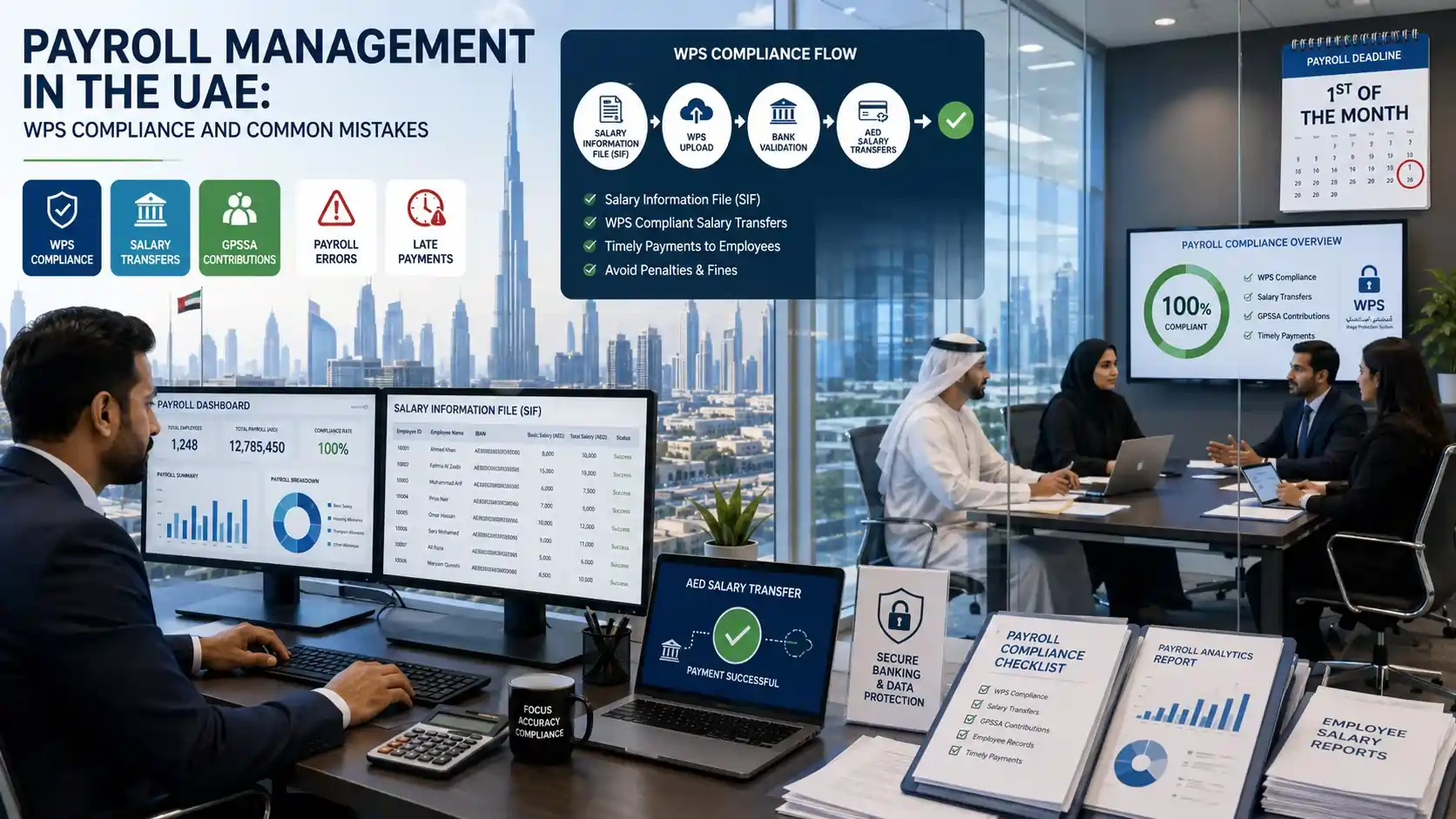
A Dubai SME finance director ran June 2026 payroll on the 10th, the same schedule the company had used for years. What she did not know was that Ministerial Resolution No. 340 of 2026 had moved the mandatory payment deadline to the 1st of every calendar month, with no grace period. MOHRE's system flagged five late payments automatically. Two work permit applications were suspended the same week. The fines totalled AED 12,000 before the issue was resolved.
Payroll management in the UAE is not simply a matter of calculating salaries and transferring funds. The Wage Protection System (WPS), governed by MOHRE in partnership with the Central Bank, imposes specific file formats, approved payment channels, strict deadlines and an increasingly automated enforcement framework. The December 2025 WPS 2.0 upgrade and the June 2026 deadline change have materially raised the compliance bar.
This guide covers everything UAE employers need to know about WPS compliance in 2026, what changed and when, how the Salary Information File works, the full penalty structure, the most common mistakes, and what additional obligations apply for free zone companies, UAE nationals, and GCC employees. For a compliance health check, ReapHR's HR audit service includes a payroll compliance review as a standard component.
|
Quick Answer: UAE WPS Payroll Compliance |
|
The Wage Protection System (WPS) requires all MOHRE-registered private sector employers to pay salaries through approved banks or exchange houses via a Salary Information File (SIF) submitted before the 1st of each month. From June 2026, under Ministerial Resolution No. 340, the deadline is fixed, with no grace period. Late payment triggers fines of AED 1,000 per employee (up to 15 days) or AED 5,000 per employee (after 17 days), plus suspension of new work permit processing. |
What Is the Wage Protection System and Why Does It Matter
The Wage Protection System was introduced in 2009 under Ministerial Decree No. 788 as the UAE's mandatory electronic salary transfer framework. It requires private sector employers registered with MOHRE to pay all employee salaries through approved banks, exchange houses, or Central Bank-authorised financial institutions, routing every payment through a monitored data trail that MOHRE can audit in real time.
The system today covers more than 99% of UAE private sector workers and processes over AED 35 billion in salary transfers every month. It is one of the largest payroll compliance systems in the MENA region. For employers, WPS compliance is not optional; it is a licence condition. A sustained WPS violation can result in suspension of all new work permit applications across every entity under the same ownership group.
WPS 2.0 and the 2026 Rule Changes: What Is New
Two significant changes have taken effect since late 2025 that every UAE employer must know about, and many currently do not.
WPS 2.0 - December 2025
The December 2025 WPS upgrade connected MOHRE, the Central Bank, and the country's licensed banking network into a single live data environment. Salary Information Files are now validated in real time against MOHRE's contract database via the Aani instant payment platform. This means that errors that previously took days to surface, and could be corrected before enforcement was triggered, now cause immediate file rejection.
The WPS 2.0 validation engine uses AI-assisted checking that scans each SIF for: salary amounts that do not match the contracted basic pay held in MOHRE's records; Labour IDs that have been updated but not refreshed in the employer's payroll system; IBANs that have changed following a bank transfer; leave deduction codes that have been applied incorrectly; and basic salary figures that have drifted from what MOHRE holds on file for the employee.
Ministerial Resolution No. 340 of 2026 - Fixed Deadline
From 1 June 2026, all private sector employees in the UAE must be paid on the 1st of every calendar month. There is no grace period, no carryover provision, and no exception for companies whose internal month-end close process runs on a different schedule. Employers operating on a mid-month or 10th-of-month payroll cycle must restructure their payroll schedule to meet this deadline.
|
2026 WPS Deadline Rule |
|
Payment deadline: 1st of every calendar month. |
|
Authority: Ministerial Resolution No. 340 of 2026. |
|
Effective: 1 June 2026. |
|
Grace period: None. |
|
Applies to: All MOHRE-registered private sector employers. |
|
Action required: Restructure payroll schedule if currently running after the 1st. |
How the Salary Information File (SIF) Works
The SIF is the data file that initiates every WPS payroll run. It must be generated, validated, and submitted to your WPS agent, an approved bank or exchange house, before salaries are transferred. Under WPS 2.0, the file is validated by both MOHRE and the Central Bank before any payment is authorised.
|
SIF Field |
Required Content |
Common Error |
|
Employee Labour ID |
Unique MOHRE identifier for each employee |
Outdated ID following visa renewal or labour card reissuance |
|
Employee IBAN |
Current UAE bank account IBAN |
Old IBAN after employee changes banks; rejected at validation |
|
Basic Salary |
Contracted basic pay as held in MOHRE records |
Total package submitted instead of basic only |
|
Total Salary |
Full monthly payment including allowances |
Transposed with the basic salary field |
|
Salary Start / End Dates |
Pay period covered by this transfer |
Wrong period dates are causing duplicate or gap detection |
|
Deductions |
Lawful deductions with correct code |
Absence deduction applied without the required deduction code |
|
Employer Establishment ID |
MOHRE-registered establishment code |
Group companies submitting under the wrong entity's establishment ID |
Once the SIF passes MOHRE validation, it is sent to the Central Bank for authentication. The Central Bank then authorises the WPS agent, your bank or exchange house, to release the salary payments. The entire process, under WPS 2.0 with Aani integration, can be completed in seconds for a clean file. A file with errors is rejected at the first validation stage, requiring correction and resubmission, which can push the payment past the 1st-of-month deadline.
Cash salary payments are illegal in the UAE regardless of the employee's consent. This applies even when the employee requests payment in cash, even for domestic workers, and even for one-off payments. Every employee must have a UAE bank account or an MOHRE-approved prepaid wage card before their first payroll run. For new hires without an account, the employer must facilitate account opening before processing the salary.
The WPS Penalty Structure: What Non-Compliance Actually Costs
The penalties for WPS violations under the 2026 framework are graduated, but they escalate quickly, and the secondary consequences can be more disruptive than the fines themselves.
|
Violation |
Fine |
Additional Consequence |
|
Payment is delayed up to 15 days |
AED 1,000 per employee |
Formal MOHRE warning issued |
|
Payment not made after 17 days |
Up to AED 5,000 per employee (max AED 50,000 per case) |
Immediate suspension of new work permit processing |
|
False information in SIF |
AED 1,000 per affected employee |
Risk of full trade licence suspension for repeat violations |
|
Repeated violations |
Cumulative fines plus red-list status |
All entities under the same ownership are affected; government procurement access is lost |
|
Cash salary payment |
AED 1,000 per instance (minimum) |
Documented MOHRE violation; potential criminal referral |
|
Emirati underpayment below AED 6,000 |
WPS violation + Emiratisation fine simultaneously |
Both penalty regimes apply; AED 6,000 minimum from January 2026 |
Red-list status is the most operationally damaging outcome. Once an employer is red-listed, all new work permit applications for all entities under the same commercial ownership are blocked, not just the entity that triggered the violation. For businesses dependent on a licensed workforce, this can halt hiring across the entire group while the violation is resolved. MOHRE's official portal provides the process for resolving violations and applying for red-list removal.
The Most Common UAE Payroll Mistakes - and How to Avoid Them
The following mistakes appear consistently in UAE payroll compliance failures. Each one is preventable with the right internal process.
Mistake 1, Running payroll after the 1st of the month |
|
From June 2026, the 1st of the month is a hard deadline with no grace period. Companies whose finance teams run payroll on the 10th, 15th, or at month-end are now automatically non-compliant. Fix: restructure your payroll calendar so SIF submission and bank transfer are complete by the 1st. |
Mistake 2, Using an outdated IBAN |
|
When an employee changes banks to get a better account, for a mortgage, or because their previous bank closes, the IBAN in your payroll system becomes invalid. WPS 2.0 rejects the SIF immediately. Fix: create a standing request for employees to notify HR of any bank account change before the next payroll run, and verify IBANs as part of onboarding. |
Mistake 3, Submitting total package instead of basic salary |
|
The basic salary field in the SIF must match the contracted basic pay registered with MOHRE exactly, not the total package including allowances. A one-dirham discrepancy causes rejection under WPS 2.0. Fix: align your payroll system's basic salary field to the figure in your MOHRE-registered employment contracts. |
Mistake 4, Failing to update Labour IDs after visa renewals |
|
An employee's Labour ID changes when their residency visa is renewed or when their labour card is reissued. If the employer's payroll system still holds the old ID, the SIF fails validation. Fix: build a Labour ID refresh check into your visa renewal workflow; payroll and PRO teams must communicate proactively. |
Mistake 5, Missing the Emirati minimum wage cross-reference |
|
From January 2026, the WPS system cross-references basic salary against MOHRE's Emirati minimum wage floor of AED 6,000 per month. If any UAE national employee is paid below this threshold, the system automatically triggers both a WPS violation and an Emiratisation penalty simultaneously. Fix: verify that all UAE national employees are paid at or above AED 6,000 basic per month before each payroll run. |
Additional Obligations: GPSSA, Free Zones, and Emirati Employees
GPSSA Contributions for UAE and GCC Nationals
Employers with UAE national or GCC national employees must register them with the General Pension and Social Security Authority (GPSSA) and make monthly pension contributions. The total contribution rate is 20% of the employee's pensionable wage for private sector employees, split between employer (12.5%) and employee (7.5%). These contributions are processed separately from WPS salary transfers but must be completed monthly.
GPSSA contributions are calculated on the pensionable wage, which may differ from the basic salary depending on the employee's contract structure. Employers should verify their contribution base with GPSSA directly, particularly for senior employees with complex package structures. The GPSSA official portal provides employer registration and contribution guidance.
Free Zone Payroll Rules
Most UAE free zone companies are not subject to MOHRE's WPS framework; their payroll obligations are governed by their specific free zone authority. JAFZA, TECOM, KEZAD, RAKEZ, KIZAD, and other mainland-adjacent free zones each have their own payroll compliance rules. DIFC operates under the DIFC Employment Law with its own salary payment framework; ADGM operates under FSRA rules.
The critical exception: companies that hold both a mainland MOHRE licence and a free zone licence must comply with WPS for all employees registered under the mainland licence. Group structures that mix mainland and free zone entities must track which employment contracts fall under which regulatory framework, a common source of compliance errors for fast-growing UAE businesses.
For employers managing complex payroll structures across multiple entities or licences, a UAE HR audit from ReapHR can confirm which obligations apply to which entities and identify any payroll compliance gaps before an MOHRE inspection.
Monthly WPS Compliance Checklist
The following eight steps should be completed in sequence before every monthly payroll run.
|
Step |
Action |
Owner |
Timing |
|
1 |
Verify all employee IBANs are current, check for any bank changes since the last payroll |
HR / Payroll |
By the 25th of the prior month |
|
2 |
Confirm all Labour IDs are current, check for visa renewals or labour card reissuance |
PRO / HR |
By the 25th of the prior month |
|
3 |
Reconcile basic salary fields against MOHRE-registered employment contract amounts |
Payroll / Finance |
By 27th |
|
4 |
Apply any lawful deductions with correct deduction codes per the UAE Labour Law |
Payroll |
By 28th |
|
5 |
Verify that all UAE national employees are paid at least AED 6,000 basic per month |
Payroll / HR |
By 28th |
|
6 |
Generate and validate the SIF file; submit to the WPS agent for MOHRE and CBUAE validation |
Payroll |
By 30th |
|
7 |
Confirm salary transfer completion and obtain bank confirmation for records |
Finance |
By 1st |
|
8 |
File GPSSA contributions for UAE and GCC national employees (separate process) |
Finance / HR |
By the 15th of the following month |
Key Takeaways
UAE payroll management under WPS 2.0 and Ministerial Resolution No. 340 of 2026 is a business continuity variable, not a back-office admin function. Real-time SIF validation means errors surface instantly. The fixed 1st-of-month deadline removes the discretion that many employers previously relied on. And red-list status cascades to every entity under the same ownership group.
The five most common mistakes, wrong deadline, outdated IBAN, basic/total confusion, stale Labour IDs, and Emirati minimum wage gaps, are all fully preventable with a disciplined monthly checklist and clear ownership between HR, payroll, finance, and the PRO team. Employers that treat WPS compliance as a structured process rather than a last-minute task consistently avoid the fines, blocks, and disputes that catch others out.
|
Need a UAE Payroll Compliance Review? |
|
ReapHR's HR audit service includes a payroll compliance review covering WPS structure, SIF accuracy, employment contract alignment, GPSSA registration, and Emiratisation wage obligations. |
Frequently Asked Questions
What is the UAE Wage Protection System (WPS)?
WPS, the Wage Protection System, is the UAE's mandatory electronic salary transfer framework, introduced in 2009 and updated by Ministerial Resolution No. 340 of 2026. All MOHRE-registered private sector employers must pay salaries through approved banks via a Salary Information File (SIF). The system now covers over 99% of UAE private sector workers and uses real-time monitoring.
What are the deadlines and penalties for late WPS salary payment?
Under Ministerial Resolution No. 340 of 2026, all private sector employees must be paid on the 1st of every calendar month. Delays up to 15 days trigger AED 1,000 per employee plus a MOHRE warning. Non-payment after 17 days carries up to AED 5,000 per employee, suspension of new work permit processing, and potential red-list status affecting all entities under the same ownership.
What is a Salary Information File (SIF), and what causes rejection?
A Salary Information File (SIF) is submitted to MOHRE and the WPS agent before each payroll run. It lists each employee's Labour ID, IBAN, basic salary, and total salary. Under WPS 2.0, SIF files are validated in real time; a wrong IBAN, a Labour ID mismatch, or a one-dirham discrepancy causes rejection before the bank processes the payment.
What are the most common WPS payroll mistakes in the UAE?
The most common WPS mistakes are: submitting the SIF after the 1st-of-month deadline; using an outdated IBAN after an employee changes banks; listing total package instead of basic salary in the basic pay field; and paying cash outside the WPS system. Under WPS 2.0, these trigger automated rejection or a formal violation, previously discretionary, now enforced in real time.
Do UAE free zone companies need to comply with WPS?
Most free zone companies are not subject to MOHRE's WPS; payroll obligations are governed by the relevant free zone authority, such as JAFZA, TECOM, ADGM, or DIFC. However, companies with both a mainland MOHRE licence and a free zone licence must comply with WPS for all MOHRE-registered employees. Employers should confirm their specific obligations with their licensing authority.