



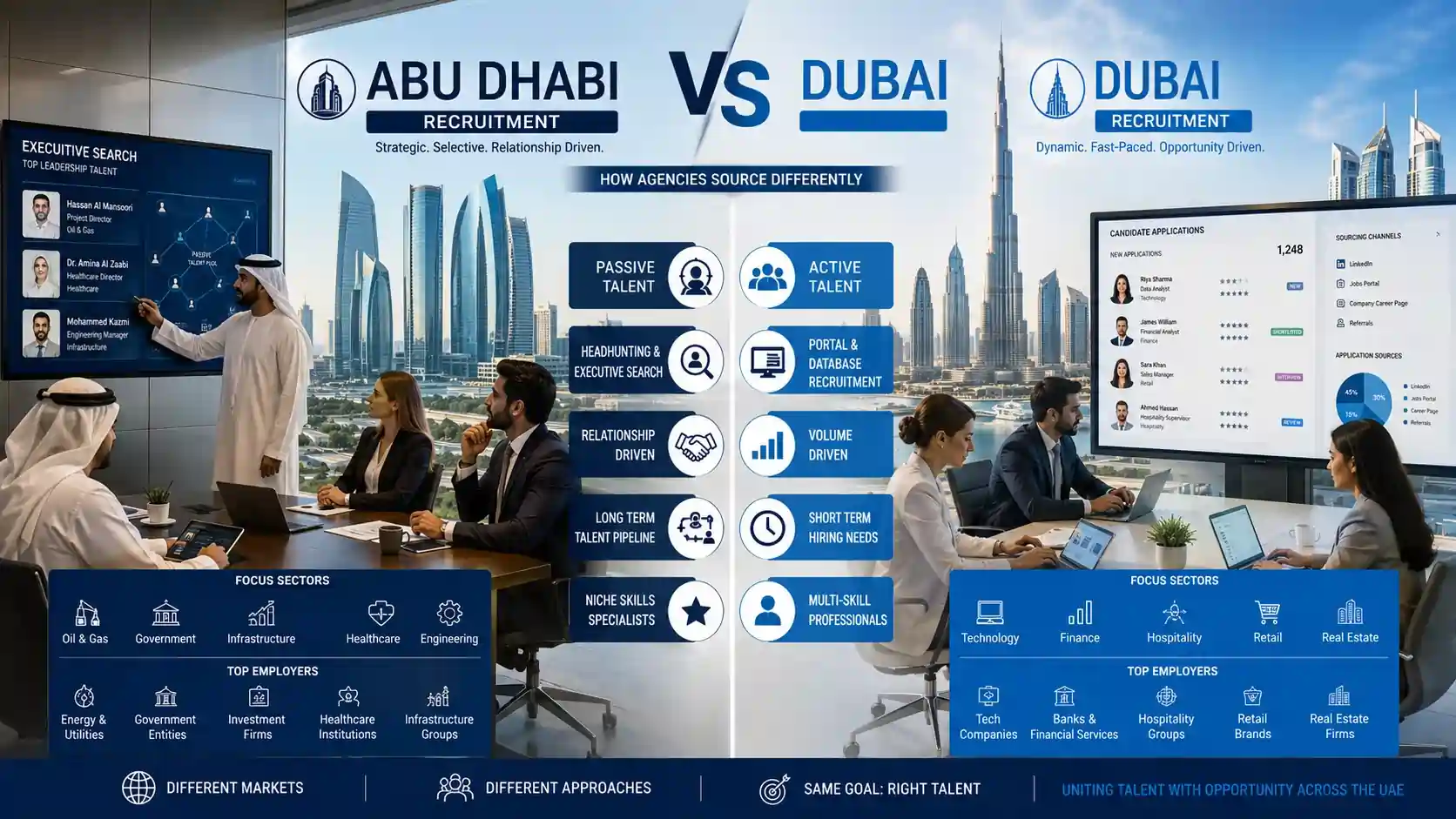
A Dubai-based HR director engaged a generalist UAE recruitment agency for a senior engineering role at an ADNOC contractor in Abu Dhabi. The agency delivered six candidates within two weeks. All six were Dubai residents, all were found through active job portals, and none passed ADNOC's technical prequalification screening. Four months later, and AED 25,000 in agency fees, the role was still unfilled.
Recruitment agencies in Abu Dhabi operate in a fundamentally different market from Dubai. The employer base is dominated by government-linked entities rather than commercial businesses. The best candidates are passive, employed in stable, well-paid roles with little reason to browse Bayt. The portals that matter are TAMM and FAHR, not LinkedIn active applications. And the Emiratisation obligations stack in ways that do not apply on the same scale in Dubai.
This guide explains the structural differences between Abu Dhabi and Dubai recruitment, the sector composition, the candidate sourcing methods, the portal landscape, the Emiratisation framework, and what to look for when selecting a recruitment agency that actually knows both markets. ReapHR is based in Abu Dhabi and works across both emirates; the observations below reflect direct market experience updated through 2026.
|
Quick Answer: Abu Dhabi vs Dubai Recruitment Agencies |
|
Abu Dhabi agencies source from a smaller, more passive talent pool concentrated in government-linked entities, ADNOC, Mubadala, ADIA, and semi-government authorities. Effective sourcing requires direct headhunting, retained search mandates, and sector-specific networks, not portal-first approaches. Dubai has a larger, more commercially diverse active job seeker market. Agencies covering both markets must operate fundamentally different sourcing methods for each; a single approach will underperform in one market or the other. |
The Two Markets: How Abu Dhabi and Dubai Differ Structurally
Dubai's job market is defined by commercial diversity, financial services, technology, retail, hospitality, logistics, and a large population of SMEs across its 28-plus free zones. The candidate pool is large, international, and highly mobile. Turnover is higher, and the active job seeker proportion, people currently looking for work and registered on portals, is significantly larger than Abu Dhabi's.
Abu Dhabi's professional job market is anchored by a different kind of employer. Government-linked entities (GLEs), ADNOC, Mubadala, ADIA, Masdar, Abu Dhabi Ports (AD Ports Group), Emirates Nuclear Energy Corporation, and a wide network of semi-government authorities, account for an estimated 40-50% of professional hiring volume in the emirate. These employers offer stable, competitive packages that significantly reduce voluntary turnover among their senior staff.
|
Dimension |
Abu Dhabi |
Dubai |
|
Dominant employer type |
Government-linked entities (GLEs), energy contractors, and government authorities |
Commercial companies, financial services, free zone SMEs, hospitality |
|
Candidate pool size |
Smaller, fewer total professionals than in Dubai |
Larger, major expat employment hub, higher throughput |
|
Active job seeker ratio |
Lower, stable GLE roles reduce voluntary turnover |
Higher, commercial market has greater mobility and turnover |
|
Primary sourcing method |
Direct headhunting, retained search, professional networks |
Portal-led, LinkedIn, direct applications, referrals |
|
Key sectors |
Oil and gas, defence, healthcare, government, utilities |
Financial services, technology, trade, retail, hospitality |
|
Emiratisation complexity |
MOHRE + DOH (healthcare) + ICV (ADNOC contractors) |
MOHRE standard framework; CBUAE for banking |
|
Average time-to-hire (senior) |
6-12 weeks, headhunting and passive outreach take longer |
4-8 weeks, a larger active pool allows faster movement |
Sector Depth in Abu Dhabi: Why Specialist Knowledge Matters More
In Dubai, a generalist recruiter with a strong portal presence and LinkedIn sourcing capability can fill a significant proportion of mid-market roles across multiple sectors. In Abu Dhabi, this approach fails for the majority of roles that matter commercially.
Placing a data engineer at an ADNOC subsidiary requires understanding the organisation's technical prequalification criteria, its ICV requirements, and its specific portal submission process, none of which are standard. Placing a clinical director at a DOH-licensed Abu Dhabi hospital requires knowledge of the DOH licensing system, the specific Emiratisation stacking that applies to Abu Dhabi healthcare employers, and the passive candidate market among senior clinicians who are typically not job-seeking at any given time.
The major Abu Dhabi GLE employment ecosystem includes: ADNOC and its 14 subsidiaries (upstream, downstream, drilling, gas, distribution); Mubadala's portfolio companies (M42 healthcare, G42 technology, Masdar energy, MGX AI); ADIA (Abu Dhabi Investment Authority) and its affiliated vehicles; and a wide network of Abu Dhabi government authorities, ADNOC, ADJD, ADEK, DCT Abu Dhabi, DHAM, ADDED, and others.
For employers hiring into this ecosystem, using a recruitment partner with demonstrated Abu Dhabi sector coverage, rather than a Dubai-centred agency applying generic UAE methodology, consistently produces better shortlists, lower drop-out rates, and faster time-to-acceptance.
Passive Candidate Sourcing: The Core Abu Dhabi Difference
The most significant practical difference between Abu Dhabi and Dubai recruitment is the proportion of passive candidates, employed, not actively looking, and only reachable through direct outreach or trusted professional networks.
An ADNOC reservoir engineer with seven years of experience and a competitive total package has very little incentive to register on Bayt or actively monitor GulfTalent. The same applies to a senior compliance officer at an Abu Dhabi bank, a chief medical officer at a DOH-licensed hospital, or a finance director at a Mubadala portfolio company. These candidates exist, but they will not be found through portal-first sourcing.
How Effective Abu Dhabi Agencies Source Differently
Agencies that consistently place senior professionals in Abu Dhabi typically operate on retained or exclusive mandates rather than contingency arrangements. Retained search gives the recruiter the time and commercial incentive to do proper headhunting, direct LinkedIn outreach, professional community engagement, referral networks, and sector-specific events like the Abu Dhabi International Petroleum Exhibition (ADIPEC) and the Abu Dhabi Finance Week.
The sourcing process for a senior Abu Dhabi passive candidate typically includes: initial market mapping (identifying 20-40 qualified professionals in the target role profile); direct outreach to the top fifteen; qualifying conversations to assess interest, package expectations, and timeline; and a shortlist of three to five candidates who are genuinely open to moving. This takes four to eight weeks for a senior role, not the one- to two-week portal response cycle that Dubai employers are accustomed to.
Time-to-Hire: Setting the Right Expectations
One of the most common friction points between Abu Dhabi employers and their recruitment partners is misaligned expectations on time-to-hire. Employers who have previously hired in Dubai or are used to fast-turnaround contingency recruitment often expect a shortlist within two weeks. In Abu Dhabi, for senior or specialist roles, this is rarely realistic.
|
Role Level |
Dubai Typical Timeline |
Abu Dhabi Typical Timeline |
Key Reason for Difference |
|
Entry-level / Junior |
1-2 weeks |
2-3 weeks |
Abu Dhabi's active pool is smaller |
|
Mid-level professional |
2-4 weeks |
4-6 weeks |
Passive proportion is higher; direct outreach is needed |
|
Senior / specialist |
4-8 weeks |
6-12 weeks |
GLE portal submission + passive headhunting process |
|
C-suite / Director |
6-12 weeks |
8-16 weeks |
Small active market; retained search required |
|
Emirati national (any level) |
4-8 weeks |
4-8 weeks |
Nafis pipeline is similar; TAMM adds complexity in AD |
These timelines are averages; specific roles in high-demand sectors (AI, cybersecurity, CCUS engineering) can take longer due to supply constraints, regardless of emirate. Employers who plan hiring timelines with these realistic windows consistently have better hiring outcomes than those who pressure agencies toward an artificial two-week deadline.
The Portal Landscape: What Channels Work in Each Market
Job portals are not equivalent across the two markets. In Dubai, LinkedIn remains the primary professional sourcing channel for mid-to-senior roles, with Bayt and GulfTalent covering high-volume mid-market hiring. Active applications through these platforms produce meaningful candidate flow for most Dubai commercial roles.
Abu Dhabi-Specific Channels
Abu Dhabi government-linked entities use proprietary portals for the majority of their external hiring. TAMM (tamm.abudhabi) is the primary submission channel for Abu Dhabi government authority roles, covering entities including ADNOC, Mubadala-linked authorities, ADEK, DCT Abu Dhabi, and the Abu Dhabi Department of Health. FAHR (Federal Authority for Human Resources) covers federal entity roles, including CBUAE, SCA, and ministry-level positions.
For UAE national candidates specifically, Nafis (nafis.gov.ae) registration is mandatory before applying for Emiratisation-track roles in the Abu Dhabi private sector. Male UAE nationals must also confirm National Service completion status on their CVs, omitting this is a documented rejection filter on multiple Abu Dhabi GLE portals.
|
Abu Dhabi Sourcing Channel Summary |
|
TAMM portal: Abu Dhabi government authorities and GLE entities. |
|
FAHR: Federal entities, CBUAE, SCA, ministry-level roles. |
|
Nafis: Emiratisation-track roles for UAE nationals (mandatory registration). |
|
LinkedIn: Senior passive professional outreach (primary headhunting channel). |
|
ADIPEC / Abu Dhabi Finance Week: In-person sector networking for energy and finance. |
|
Entity careers pages: ADNOC, Mubadala, Masdar, AD Ports Group, direct submission. |
ADGM vs DIFC: The Free Zone Difference
Abu Dhabi Global Market (ADGM) on Al Maryah Island is Abu Dhabi's financial free zone, regulated by the FSRA rather than MOHRE. Firms licensed solely by ADGM are not subject to standard MOHRE Emiratisation quotas. The talent pool in ADGM is internationally oriented, similar in character to DIFC Dubai, and sourcing follows a more traditional professional financial services model. Recruiters need to distinguish clearly between ADGM-licensed clients and Abu Dhabi mainland clients, as the obligations and portal requirements are entirely different.
Emiratisation: How Abu Dhabi's Obligations Stack
Both Abu Dhabi and Dubai mainland employers are subject to the same MOHRE Emiratisation framework under Cabinet Resolution No. 18 of 2022, requiring companies with 50 or more employees to increase Emirati headcount by 2% of skilled roles annually. The penalty for non-compliance is AED 6,000 per month per unfilled Emirati position.
Abu Dhabi employers face two additional layers that Dubai employers typically do not:
|
Abu Dhabi Emiratisation: Two Additional Layers |
|
Layer 1, DOH Healthcare Targets: The Abu Dhabi Department of Health sets separate Emiratisation targets for licensed healthcare employers in Abu Dhabi. These targets apply to both clinical and administrative roles and stack on top of MOHRE obligations. Dubai healthcare employers are not subject to an equivalent secondary target. |
|
Layer 2, ADNOC ICV Programme: Companies working in ADNOC's supply chain must maintain In-Country Value certification. ICV requirements include local employment targets that are evaluated as part of tender scoring. An ADNOC contractor that fails its ICV employment targets faces commercial consequences, reduced tender score, and not just MOHRE fines. |
Recruitment agencies working with Abu Dhabi contractors and healthcare employers need to understand both of these layers to advise clients correctly. An agency that treats Abu Dhabi Emiratisation as identical to Dubai will consistently underestimate the compliance burden for these client types. ReapHR's Emiratisation recruitment advisory is designed around both mainland MOHRE obligations and Abu Dhabi's sector-specific frameworks.
How to Choose a Recruitment Agency That Covers Both Markets
The majority of UAE recruitment agencies have their operational centre of gravity in Dubai, where the market is larger, the active candidate pool is more accessible, and the commercial cycle is faster. An agency with a Dubai office and an Abu Dhabi client should not be assumed to have genuine Abu Dhabi sourcing capability.
|
Evaluation Criterion |
What Good Looks Like |
Red Flag |
|
MOHRE licence coverage |
Valid MOHRE licence with Abu Dhabi authorisation |
Only licensed for Dubai operations |
|
Sector depth (Abu Dhabi) |
Named placements in oil and gas, GLE entities, or healthcare |
Generic 'all sectors UAE' claims with no Abu Dhabi case studies |
|
Passive candidate capability |
Retained search model; LinkedIn sourcing; sector event presence |
Contingency-only; portal-first methodology described as standard |
|
Portal knowledge |
Can explain TAMM, FAHR, and Nafis submission requirements |
Unaware of TAMM or treats Bayt as the primary Abu Dhabi channel |
|
Emiratisation advisory |
Understands DOH secondary targets and ICV obligations |
Describes Emiratisation as the same in both emirates' |
|
Physical presence |
Abu Dhabi office or regular consultant presence in the emirate |
Dubai, with Abu Dhabi listed as the coverage territory |
ReapHR is headquartered in Abu Dhabi and places professionals across government-linked entities, ADNOC supply chain companies, healthcare organisations, and financial services firms across both emirates. For employers with hiring needs in both markets, see our UAE employer services, or use our salary benchmarking tool to check current Abu Dhabi and Dubai rates before briefing a recruiter.
Key Takeaways
The differences between Abu Dhabi and Dubai recruitment are not cosmetic. Sector composition, candidate pool depth, passive talent proportion, portal landscape, and Emiratisation obligation complexity are all materially different, and all affect how a competent agency should approach sourcing in each market.
Employers who brief a Dubai-model agency for an Abu Dhabi role will consistently receive the wrong candidates, active job seekers sourced from portals, with no experience of GLE technical screening and no understanding of Abu Dhabi's Emiratisation layering. Getting the right recruitment partner is not a process question; it is a market knowledge question.
|
Recruiting in Abu Dhabi or Across Both Emirates? |
|
ReapHR has operated in Abu Dhabi since 2012, placing professionals in ADNOC supply chain companies, government-linked entities, healthcare organisations, and professional services firms across the emirate. |
Frequently Asked Questions
How does Abu Dhabi's job market differ from Dubai's for recruitment agencies?
Abu Dhabi's job market centres on government-linked entities, ADNOC, Mubadala, ADIA, and semi-government authorities, plus large engineering and energy contractors. Dubai's market is more commercially diverse: financial services, technology, retail, hospitality, and a large free zone SME sector. Abu Dhabi's active job seeker pool is smaller; most senior candidates are employed and require headhunting rather than reactive sourcing.
Why are Abu Dhabi candidates harder to source than Dubai candidates?
Abu Dhabi candidates tend to be passive, employed in stable government-linked roles with strong packages. Effective sourcing relies on direct headhunting via LinkedIn, professional networks, and retained search. Dubai has a larger active job seeker pool with higher turnover, enabling more reactive portal-based sourcing. Each market requires fundamentally different agency methods.
Which portals do Abu Dhabi recruitment agencies use that Dubai agencies do not?
Abu Dhabi employers, particularly ADNOC subsidiaries, Mubadala entities, and government authorities, use TAMM, FAHR, and proprietary portals rather than standard job boards. Nafis is mandatory for Emiratisation-track roles. Dubai employers use LinkedIn, Bayt, GulfTalent, and DIFC-specific channels. A recruitment agency covering both markets needs simultaneous access to all of these sourcing channels.
Are Emiratisation obligations different for Abu Dhabi employers compared to Dubai?
Emiratisation obligations apply identically to mainland private sector employers in both emirates under Cabinet Resolution No. 18 of 2022. Abu Dhabi adds a second layer: DOH sets separate Emiratisation targets for healthcare employers, stacking on MOHRE obligations. ADNOC and its subsidiaries also operate the ICV programme, adding supply-chain employment requirements on top of the statutory framework.
What should I look for when choosing a recruitment agency for Abu Dhabi roles?
Look for an agency with MOHRE licensing, demonstrated placements in your target sector, oil and gas, government-linked entities or healthcare, and direct headhunting capability. Avoid agencies relying solely on portals for Abu Dhabi senior roles; the best candidates are rarely active. Ask for sector-specific placement examples and evidence of pipeline depth.