



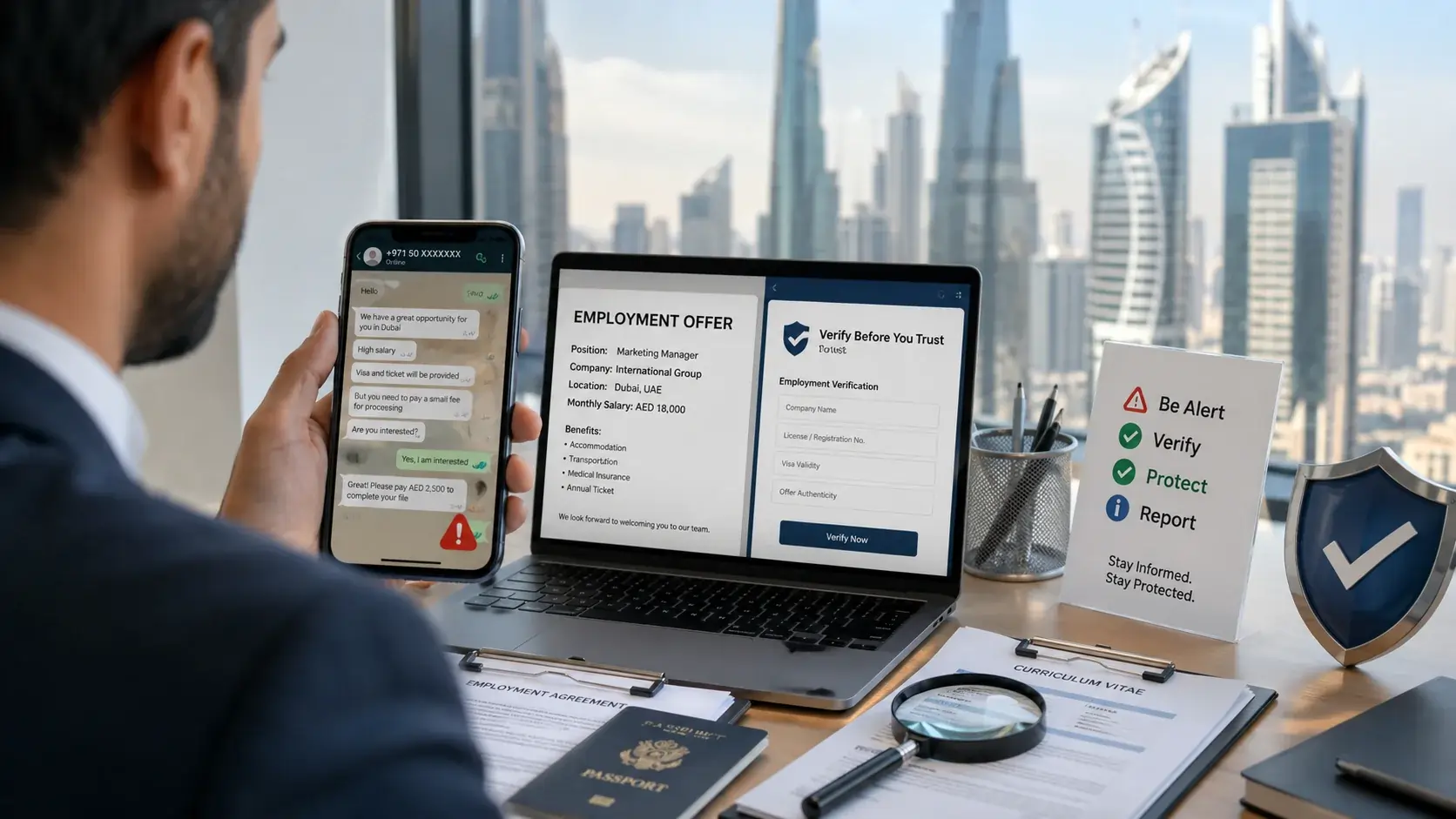
A marketing graduate in Manila got a WhatsApp message from a UAE number late one night. The sender knew her name, referenced her LinkedIn profile, and offered a tax-free salary that would have changed her life. Two days into the conversation, she was asked to pay a small fee to process her visa documents. She paid. The recruiter went quiet the next morning.
That pattern repeats thousands of times a year across the UAE job market, and it works precisely because the underlying opportunity is real. Genuine tax-free salaries, genuine visa sponsorship, and genuine WhatsApp recruiting all exist here, which gives fraudulent versions of the same thing room to hide in plain sight.
This guide walks through how recruitment agency scams targeting UAE jobseekers actually operate, the specific steps to verify any offer before you act on it, and what to do if you think you have already been targeted. Browse genuine roles on ReapHR's jobseeker page once you know what to look for.
|
Quick Answer Under UAE law, no recruitment agency or employer can legally charge a jobseeker any fee for placement, processing, or visa costs. Any request for payment before a signed, MOHRE-verified offer is the clearest sign of fraud. Verify every offer through MOHRE's inquiry service, the National Economic Register, and GDRFA or ICP eChannels before sharing documents or money. |
Why the UAE Job Market Attracts These Scams
The UAE genuinely does offer many of the things scammers promise, which is exactly why the fraudulent version is so convincing. Tax-free salaries that sound life-changing to someone in South Asia, East Africa, or the Philippines are a real feature of this market, not an exaggerated hook, so ambition alone is not a warning sign.
WhatsApp recruiting is also completely normal here in a way it is not in many Western markets, so a recruiter messaging a stranger directly does not automatically signal fraud. Scammers rely on that familiarity, borrowing the exact communication style genuine recruiters use to make a fake approach feel routine.
Visa sponsorship adds a further layer of confusion for anyone applying from abroad who does not already know which fees are legitimate. That uncertainty is precisely the gap fraudulent recruiters fill with invented processing charges, deposit requests, or "fast-track" fees that have no basis in actual UAE immigration procedure.
Scammers also benefit from the sheer scale of genuine demand. Millions of people apply for UAE roles every year, and a fraud operation only needs a small fraction of targets to pay for the scheme to be profitable. That volume, combined with cross-border reporting being genuinely harder to coordinate, is part of why this fraud persists despite repeated government warnings.
The Fee-Upfront Scam: The Single Biggest Red Flag
If you are asked to pay anything before receiving and verifying a signed offer letter, you are dealing with either an unlicensed operator or outright fraud. There is no legitimate scenario where a jobseeker pays for recruitment, visa processing, medical testing, or "administrative fees." This single fact undercuts nearly every scam pattern in this guide, regardless of how the request is framed.
Every recruitment and visa-related cost is legally the employer's responsibility, full stop. A fee framed as refundable, a "deposit," or paid to a personal account rather than a registered company account does not change the underlying fact: a genuine UAE job offer never requires payment from the candidate at any stage.
A Newer Variation Worth Knowing
A more recent version of this fraud dresses the fee up as something technical rather than transactional. A fake recruiter claims your CV was run through an applicant tracking system, quotes a specific low score, and offers a paid "optimisation" service to fix it before resubmission. Applicant tracking systems are a real part of UAE hiring, which is exactly what makes this version convincing.
The mechanic is identical to any other upfront-fee scam, only relabelled. No legitimate employer or recruiter charges a candidate to improve a CV score as a condition of being considered for a role, and a request framed this way deserves the same scepticism as a bare visa-processing fee.
The lesson generalises beyond this one variation. Scammers regularly repackage the same core request, payment before any verified offer, using whatever technical or cultural detail is currently plausible. Recognising the underlying pattern matters more than memorising any single version of the story, since new framings will keep appearing as fraudsters adapt to what jobseekers have already learned to spot.
Common Scam Patterns to Recognise
Fee-upfront fraud is the most common pattern, but it shows up wrapped in several different disguises. Recognising the variation matters as much as recognising the core mechanic.
|
Pattern |
How It Works |
Key Tell |
|
Fee-upfront fraud |
Payment requested for visa, training, or processing before any signed offer |
Any payment request at all, regardless of framing |
|
Phishing job offers |
Requests for passport, bank, or ID copies early, with no formal offer |
Personal document requests before an official process begins |
|
Overseas employment scam |
High-paying role abroad, advance payment for travel or medical tests |
Payment tied to travel logistics rather than the employer |
|
Work-from-home scam |
Easy remote work, registration fee or "training material" purchase required |
Payment required before any actual work is assigned |
|
Visa fast-track scam |
Claims of guaranteed visas or expedited approval for a fee |
Promises no licensed authority can actually make |
How to Verify a Job Offer Is Genuine
Verification takes minutes and should happen before any document or payment changes hands, no matter how credible the conversation feels. Start with the offer itself: a genuine UAE job offer must be issued through MOHRE and accompanied by an official work entry permit, not simply an email or PDF from the employer.
Check that reference number through MOHRE's own inquiry service to confirm the offer's status directly from the source rather than trusting the document alone. Separately, search the employer's name on the UAE National Economic Register to confirm it holds an active trade licence under that exact name.
If a visa or entry permit has already been issued, verify it through GDRFA for Dubai-issued visas, or the ICP eChannels platform for visas issued in any other emirate. A permit number that does not resolve on either platform is not a paperwork glitch; it is a clear signal to stop.
None of these checks cost anything, and all three can typically be completed within minutes using only the reference numbers already on the documents you were sent. If a recruiter discourages you from checking, or claims payment now will speed up a process that is "too slow," treat that pressure itself as a red flag.
Red Flags Beyond the Fee Request
Unsolicited contact from a personal mobile number or a generic email address, rather than a corporate one, is a meaningful signal on its own. A real recruiter working for a real company almost always has a company email address, and resistance to sharing one when asked is worth noting.
An offer with no interview, vague job responsibilities, or a salary that feels disconnected from the role described should slow you down rather than speed you up. Genuine employers evaluate candidates before extending an offer; skipping that step entirely is unusual enough to warrant extra scrutiny.
Be equally cautious about document requests that arrive early in a conversation. Sharing a CV is normal. Being asked for passport scans, bank account details, or Emirates ID copies before any formal offer exists is not, and that information can be misused well beyond the immediate scam, including for identity fraud unrelated to the job itself.
What to Do If You Think You Have Been Scammed
Stop paying and stop responding the moment something feels wrong, even if the conversation has gone on for weeks. Continuing to engage rarely resolves the situation and gives a scammer more opportunity to extract further payments or personal information.
Collect every piece of evidence available: screenshots of messages, the offer letter itself, and any payment confirmations. Report the incident to Dubai Police's eCrime platform, or the equivalent cybercrime reporting channel in your emirate, and separately notify MOHRE's hotline so the ministry can investigate the individual or agency involved.
Recovering money already sent is not guaranteed, but reporting still matters. It builds the evidence base authorities use to track repeat offenders, and documented cases help other jobseekers recognise the same pattern before they lose money to it.
If the scam involved a specific individual's name, phone number, or company impersonation, include those details in your report even if you are unsure whether they are real. Investigators piece together patterns across many reports, and a single detail that seems minor to you may be the one that connects your case to others already under review.
Before accepting any offer, it is also worth understanding how to verify MOHRE Permit 64, since a licensed agency's own paperwork should hold up to the same scrutiny you are applying to the job offer itself. Knowing who actually pays recruitment fees under UAE law is the single fact that undercuts almost every scam pattern in this guide.
Verification Takes Minutes; Recovering Money Rarely Does
Recruitment scams succeed in the UAE because the genuine version of every element they imitate- high salaries, WhatsApp recruiting, visa sponsorship- actually exists here. That familiarity is exactly what a five-minute verification habit is designed to cut through.
No legitimate UAE job offer will ever ask you to pay first. Verify through MOHRE, the National Economic Register, and GDRFA or ICP eChannels before sharing documents or money, and report anything that does not check out rather than assuming it was a one-off mistake or bad luck.
|
Looking for a Genuine Role in the UAE? ReapHR connects jobseekers directly with verified employers, never the other way around. |
Browse current opportunities on our jobseeker page, or apply directly through quick apply to skip the uncertainty entirely. For more on presenting yourself well once an offer is genuine, our career advice section covers CV and cover letter guidance in detail.
Frequently Asked Questions
Can a recruitment agency legally ask a jobseeker for money in the UAE?
No. Under Federal Decree-Law No. 33 of 2021, licensed recruitment agencies and employers are prohibited from charging jobseekers for placement, processing, or visa costs. Every recruitment and visa expense is legally the employer's responsibility. Any request for payment before a signed, verified offer is a clear sign of fraud, not a legitimate fee.
How do I verify a UAE job offer is genuine?
Confirm the offer was issued through MOHRE and check its reference number on the ministry's inquiry service. Search the employer's name on the UAE National Economic Register to confirm an active trade licence, and verify any visa or entry permit through GDRFA for Dubai or the ICP eChannels platform for other emirates before accepting anything.
What are the most common job scam tactics used in the UAE?
The most frequent patterns are upfront fee requests disguised as visa or processing charges, unsolicited WhatsApp messages from personal numbers claiming to represent known companies, unrealistic salary offers with no interview required, and fake work-from-home listings that ask for a registration payment before any work begins.
What should I do if I already paid a suspected scammer?
Stop all further payments and communication immediately, and collect every screenshot of messages, offer letters, and payment records as evidence. Report the incident to Dubai Police's eCrime platform or the equivalent cybercrime channel in your emirate, and separately notify MOHRE's hotline so the agency or individual can be investigated.
Is it safe to apply for jobs through WhatsApp in the UAE?
WhatsApp recruiting itself is common and not inherently unsafe, since many legitimate UAE recruiters do use it. The risk lies in who is messaging you, not the platform. Verify the sender's identity, employer, and any offer independently before sharing documents or paying anything, regardless of how professional the conversation looks.