



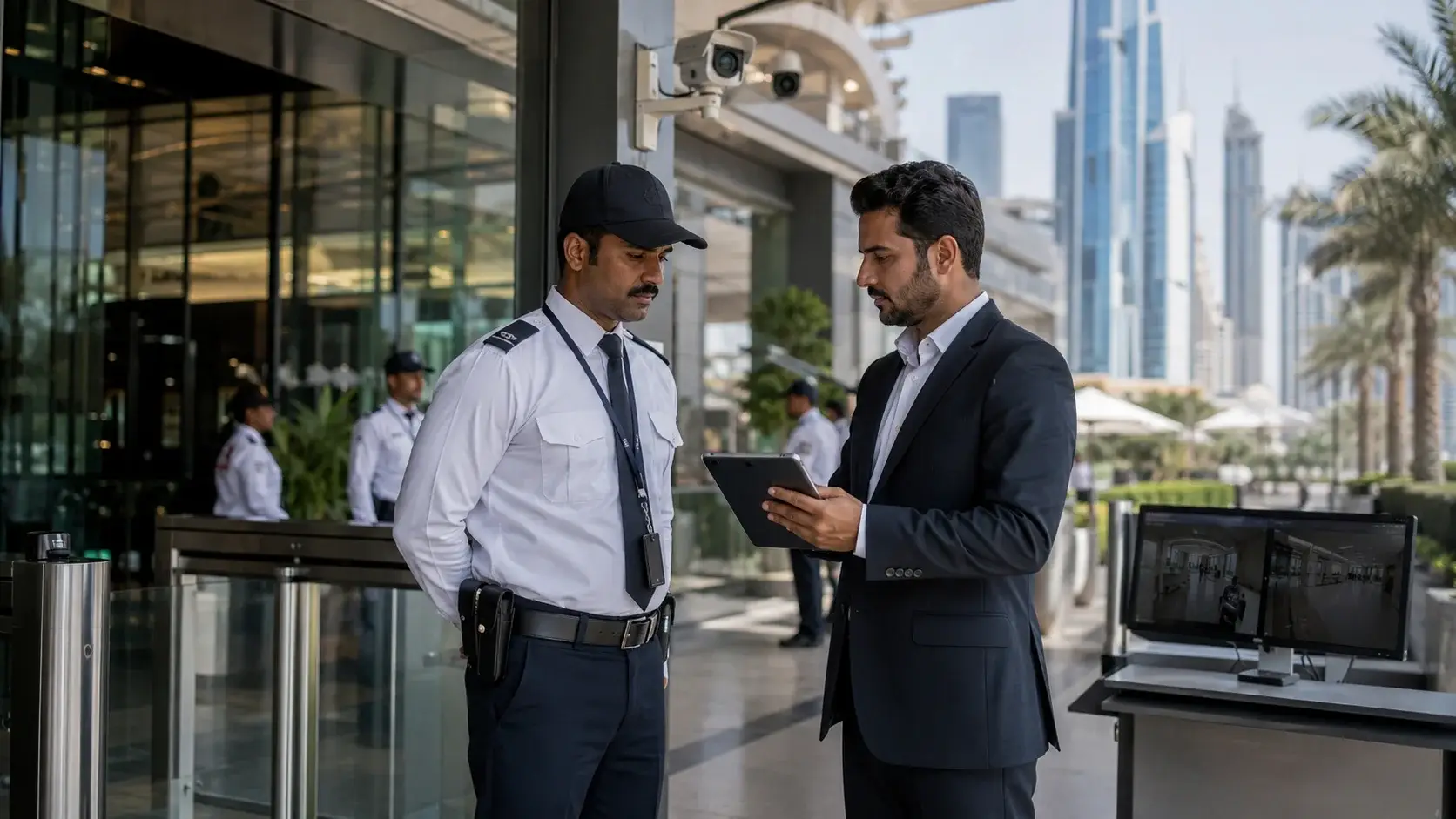
A mall operator in Dubai runs a routine facilities audit and discovers that one of its contracted security guards has been working for three weeks on a SIRA licence that quietly expired. Nobody caught it, including the security provider supposedly managing compliance, and the mall now faces the fallout from deploying an unlicensed guard on its own property.
That gap between assuming a provider handles compliance and actually verifying it is where most security guard recruitment problems in the UAE originate. Before signing any security contract or hiring directly, it is worth having HR confirm the visa job title matches the security role alongside the SIRA licence checks covered below.
This guide sets out exactly what SIRA licensing requires, the difference between a company licence and an individual guard card, where SIRA's jurisdiction actually ends, and a practical checklist for vetting a security provider before signing.
|
Quick Answer SIRA, the Security Industry Regulatory Agency, requires two separate licences: a company licence authorizing a business to provide security services, and an individual card certifying each specific guard. Both must be valid and matching for a compliant deployment. SIRA covers Dubai specifically, not the entire UAE; other emirates use their own frameworks. Employers should verify both licence levels before hiring directly or signing a provider contract. |
The Two Licences That Must Both Be Valid
SIRA, operating under Dubai Police, requires a company-level licence authorizing a business to legally provide specific security services such as manned guarding, CCTV monitoring, or cash-in-transit. This company licence alone does not certify any individual working for that company.
Separately, each individual guard must hold their own valid SIRA card certifying them for their specific role, such as guard, supervisor, or specialized cash-in-transit personnel. A compliant deployment requires both licences to be valid simultaneously: a licensed company employing an unlicensed individual, or vice versa, is equally non-compliant.
This dual-licence structure exists because a company's overall compliance history says little about any single guard's current status on a given day. A company can hold an impeccable licence record while an individual guard's card has quietly lapsed due to a missed renewal, which is precisely why checking both levels, not just the company's reputation, is the actual compliance requirement.
Company Licence vs Individual Card
|
Dimension |
Company SIRA licence |
Individual SIRA card |
|
What it certifies |
The business itself, authorized service categories |
A specific person for a specific role |
|
Who holds it |
The security services provider |
Each individual guard or supervisor |
|
Renewal responsibility |
The company |
The employer deploying that individual |
|
Consequence if invalid |
Provider cannot legally operate at all |
That specific guard cannot be legally deployed |
|
What to verify before hiring |
Current company licence status and covered service categories |
Current individual card status for each named guard |
Different SIRA Categories for Different Services
SIRA licensing is not a single, uniform category covering all security work equally. Manned guarding, CCTV monitoring and control room operation, and cash-in-transit services each sit under their own licence category with distinct training and vetting requirements, and a company licensed for one category is not automatically authorized for another.
Cash-in-transit carries particularly demanding requirements given the obvious risk profile, typically involving additional background screening, specialized training, and often armed or vehicle-based operational standards well beyond what a standard guarding licence requires. A provider licensed only for manned guarding cannot legally take on a cash-in-transit contract without the separate, specific authorization.
Employers procuring more than one type of security service, such as a mall needing both static guards and cash-in-transit for retail tenants, should verify the provider's licence explicitly covers every service category being contracted, not just confirm the provider is 'SIRA licensed' in a general sense.
CCTV monitoring and control room operation sit as their own category too, distinct from physical guarding, and a provider strong in one area is not automatically equally capable in another. Asking a provider to name the exact SIRA categories their company licence actually covers, rather than accepting a general assurance, closes this gap during the vetting conversation itself.
How Long Licensing Actually Takes
Basic security guard training typically runs five to seven days, covering the fundamentals required before certification. Once training completes, the individual SIRA card generally takes a further two to three weeks to issue, accounting for background verification and biometric processing, which means a new guard is rarely ready to deploy in under a month from a standing start.
Employers planning for a new site opening or contract start date should build this multi-week timeline into hiring plans explicitly, rather than assuming a guard candidate can begin work immediately after accepting an offer. Underestimating this lead time is one of the more common causes of an under-licensed or entirely unlicensed guard being deployed under schedule pressure.
Renewal timelines deserve the same attention as initial issuance. A guard's card does not renew automatically, and providers managing large deployed teams sometimes let a renewal slip through simply due to volume, which is exactly the kind of gap that surfaces during a routine site audit rather than through any deliberate oversight on either side.
SIRA Covers Dubai, Not the Whole UAE
A common and consequential misconception is assuming SIRA governs security licensing across the entire UAE. It does not. SIRA, the Dubai private security regulator, operates specifically within Dubai under Dubai Police. Other emirates, including Abu Dhabi, run their own separate private security regulatory frameworks with different licensing bodies and requirements.
Employers operating security staffing across multiple emirates are managing multiple distinct compliance regimes, not one unified national standard. Confirming the correct regulator and licensing pathway for each specific emirate before hiring or contracting is essential, since applying Dubai's SIRA framework by default to an Abu Dhabi site is a genuine compliance gap.
This matters most for businesses with operations spanning both emirates, such as a retail chain with locations in both Dubai and Abu Dhabi. A single national security vendor relationship does not automatically mean uniform compliance across every site, and asking the provider to confirm licensing separately for each emirate's specific regulatory framework avoids assuming coverage that was never actually verified.
Hiring Directly vs Through a Security Provider
Many businesses outsource security staffing entirely, similar to sourcing security guards through a manpower supply arrangement, relying on the provider to handle recruitment, training, and licence management. This works well when the provider is genuinely compliant, but the client business remains exposed to disruption and reputational risk if the provider is not, exactly as the mall operator in the opening scenario discovered.
Deploying an unlicensed or lapsed-licence guard, whether hired directly or through a provider, exposes the deploying business to fines and potential operational shutdown, since SIRA compliance is actively enforced through site inspections. Confirming a provider actively tracks individual licence expiry dates, not just its own company-level status, is a specific question worth asking directly.
Businesses hiring guards directly, rather than through an outsourced provider, take on full responsibility for the entire licensing lifecycle, from initial training coordination to ongoing renewal tracking. This can work well for a single site with a small, stable guard team, but scales poorly for multi-site operations without a dedicated system for tracking dozens of individual licence expiry dates simultaneously.
A Provider Due Diligence Checklist
Request current, verifiable evidence of the provider's company SIRA licence, confirm it covers the specific services required for the contract, and ask directly how the provider tracks individual guard licence expiry across its full deployed workforce. A provider unwilling to share this documentation up front is a significant red flag before any contract is signed.
An audit of your current security staffing compliance before renewing or signing a new provider contract catches gaps like the expired licence scenario before they surface during an actual SIRA inspection rather than after.
Building a recurring check into the contract itself, such as a quarterly written confirmation from the provider listing every currently deployed guard alongside their individual licence expiry date, turns due diligence from a one-time signing exercise into an ongoing compliance safeguard that catches lapses while there is still time to fix them.
Security staffing carries its own retention pressures worth understanding alongside licensing. How retention affects licence continuity for security staff is worth reviewing, since replacing a departing guard mid-contract carries the same multi-week licensing lead time as an entirely new hire.
Verify Both Licences, Every Time
Security guard recruitment in the UAE, specifically in Dubai, rests on two separate licences that must both be current and matching: the company licence and the individual guard card. Treating these as one combined check, and confirming the correct regulator for any site outside Dubai, prevents the kind of quietly expired licence that surfaces at the worst possible moment during an inspection.
For UAE and GCC employers who want their security staffing and provider contracts reviewed for compliance, reaphr.com/companies outlines how ReapHR supports employer-side hiring compliance.
|
Work With ReapHR ReapHR supports UAE and GCC employers on specialist and blue-collar hiring, compliance auditing, and vendor due diligence. |
For the underlying regulatory frameworks, see SIRA, the Dubai private security regulator, and MOHRE, the federal authority overseeing labour compliance. General guidance on private sector employment is also available via the official UAE government portal u.ae.
Frequently Asked Questions
What is the difference between a company SIRA licence and an individual SIRA card?
A company SIRA licence authorizes a business to legally provide security services such as guarding, CCTV monitoring, or cash-in-transit. An individual SIRA card certifies a specific person to work in a defined security role, such as guard or supervisor. A compliant deployment requires both the company and the individual to hold valid, matching licences.
Does SIRA apply across the whole UAE or just Dubai?
SIRA, the Security Industry Regulatory Agency, regulates private security specifically within Dubai under the jurisdiction of Dubai Police. Other emirates operate their own separate private security regulatory frameworks, so employers hiring security personnel outside Dubai should confirm the correct regulator and licensing requirements for that specific emirate.
How long does it take a security guard to obtain a SIRA licence?
Basic security guard training typically takes five to seven days, after which the individual SIRA certificate generally takes two to three weeks to issue, accounting for background verification and biometric processing. Employers should factor this multi-week timeline into hiring plans rather than assuming a guard can start immediately after applying.
Can an employer legally deploy a security guard whose SIRA licence has expired?
No. Deploying an unlicensed or lapsed-licence guard exposes the employer to fines and potential contract or operational shutdown, since SIRA compliance is actively enforced through inspections. Employers using an outsourced security provider should confirm the provider tracks individual licence expiry dates, not only its own company-level licence status.
What should a business verify before signing a contract with a security provider?
Confirm the provider holds a valid, current SIRA company licence covering the specific services required, request evidence that deployed guards hold valid individual SIRA cards, and check for a clean compliance history. A provider unwilling to share this documentation upfront is a meaningful red flag before any contract is signed.