



In a recent review of over 200 CVs submitted through Bayt.com for a senior finance role in Dubai, fewer than one in three included a visa status, over 60% listed job responsibilities with no measurable outcomes, and 40% used two-column or graphic-heavy layouts that broke ATS parsing entirely. All of those CVs were rejected before a human recruiter read a single line. That is the reality of the UAE CV format 2026 landscape: the market is competitive, the screening is automated, and the rules are different from what most candidates expect.
This guide is written from the hiring side. It explains what UAE employers and recruiters actually see when a CV lands in front of them, what makes them look twice, and what causes instant rejection. Whether you are applying for roles in Dubai, Abu Dhabi, or Sharjah, or uploading to LinkedIn or NaukriGulf, these expectations apply. If you want professional support building a CV that meets these standards, ReapHR offers CV writing and career advisory support as part of our broader role as an HR and recruitment partner in the UAE.
|
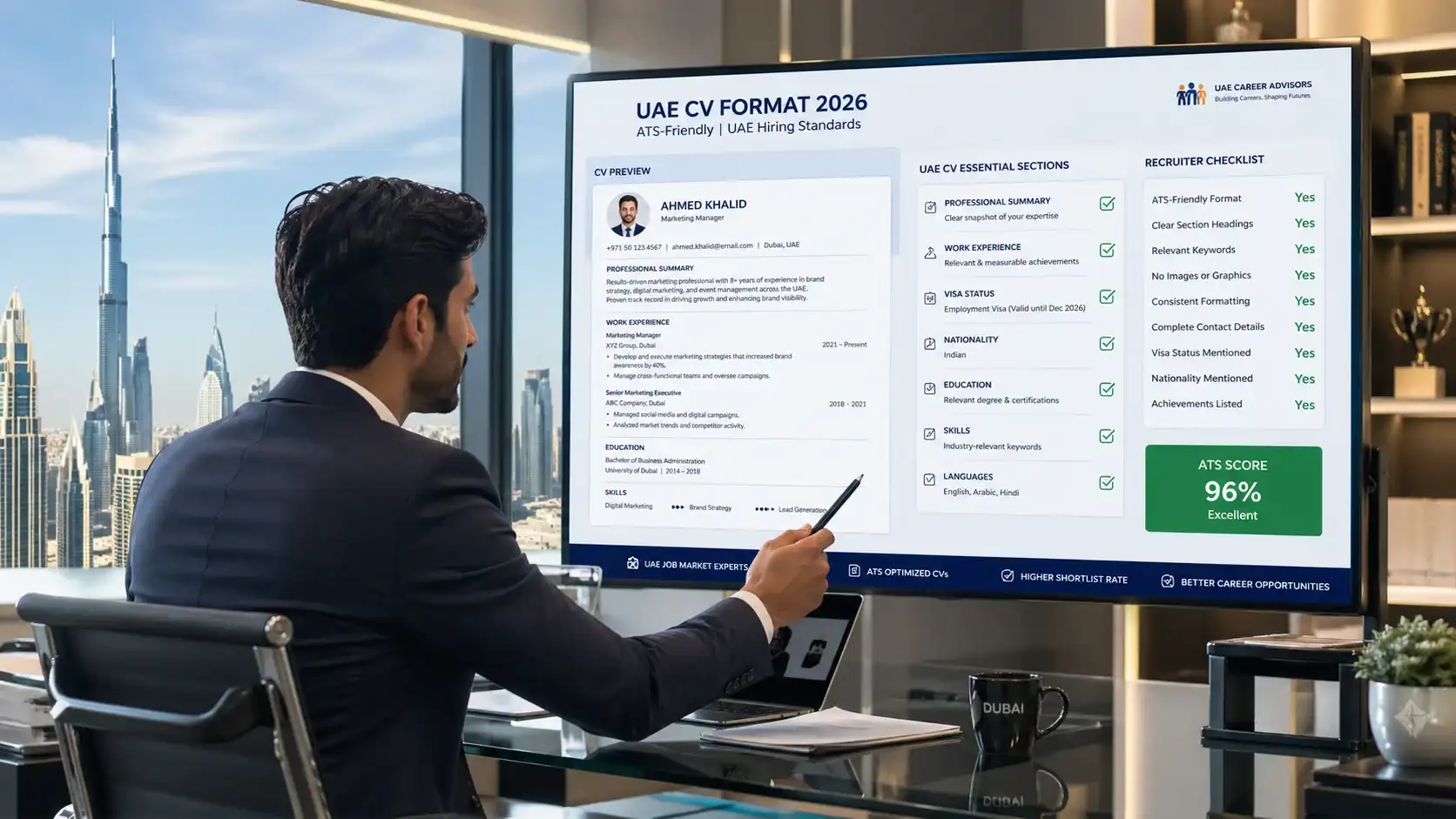
What is the UAE CV format in 2026? A UAE CV in 2026 is a reverse-chronological or hybrid-format document of 2 pages (experienced candidates) or 1 page (fresh graduates), written in English, that includes a personal details section with visa status, nationality, and availability near the header. It uses a single-column ATS-friendly layout, quantified achievements in the work experience section, and a 3-4 sentence professional summary. It is submitted in PDF format for most roles, and must include a UAE contact number (+971) where available. |
How the UAE CV Format 2026 Differs from Western CV Standards
Most candidates who apply to UAE roles arrive with CVs built for the US, UK, or European market. Those formats leave out information that UAE recruiters look for immediately, and include design choices that destroy ATS readability. The differences are not subtle -- they are structural.
|
Factor |
Western CV Standard |
UAE CV Standard 2026 |
|
Visa/work eligibility |
Not included -- assumed for domestic applicants |
Mandatory -- visa status, transferability, and availability are expected near the header. |
|
Nationality |
Not included -- considered discriminatory in most Western markets |
Expected -- serves Emiratisation quota compliance context in the UAE private and government sector |
|
Date of birth |
Never included -- age discrimination laws prohibit it |
Common and generally accepted; not mandatory but widely used |
|
Photo |
Never included in the US/UK; optional in Europe |
Optional but widely used for customer-facing and senior roles; not expected for technical roles |
|
CV length |
1 page (US) / 2 pages maximum (UK/Europe) |
1 page for fresh graduates; 2 pages for experienced; up to 3 pages for senior executives |
|
Layout |
Two-column and creative layouts common in design roles |
Single-column only for ATS compatibility; two-column layouts break Bayt.com and portal parsing |
|
Work experience focus |
Task and responsibility lists acceptable in many markets |
Quantified achievements expected -- task lists without metrics are the most common rejection signal |
|
Language |
Native language or bilingual |
English mandatory for the private sector; bilingual English/Arabic advantage for government roles |
|
Marital status |
Never included |
Not required in 2026 unless specifically requested; it was historically included but declining in practice. |
|
Attachments |
Portfolio links are common; passport copies with the application in some markets |
Passport copies, degree attestations not sent with CV -- submitted only at offer stage in the UAE |
The UAE CV Structure: Section by Section
A UAE-format CV in 2026 follows a predictable structure that hiring managers process quickly because they recognise it immediately. Deviating from this structure adds friction and reduces the chance of your CV clearing both ATS and human review.
1. Header: Your Most Valuable Real Estate
The header of a UAE CV carries more critical information than in any other market. Recruiters in the UAE need to determine visa eligibility, location, and availability before they consider the rest of the document. A header that omits these details forces the recruiter to email you for clarification -- and in a high-volume shortlisting process, most will not bother.
Your header must include: full name in a clear, larger font; a UAE phone number with country code (+971) where you have one, or your active international number if you are applying from outside the UAE; a professional email address; your current city and country; your LinkedIn profile URL if it is complete and aligned with your CV; your visa status (e.g. Employment Visa -- Transferable, Visit Visa, Spouse Visa -- NOC Available, Outside UAE); your nationality; and your availability (Immediate, 30 Days, or a specific date).
Visa status is the single most screened field by UAE recruiters. It tells the hiring manager whether you need sponsorship, whether you can start immediately, and whether a permit transfer is involved. Omitting it does not protect you -- it removes you from contention. For context on why visa status matters in the regulatory framework, our UAE Labour Law 2024 changes guide explains how work permit requirements work for UAE private sector employers.
2. Professional Summary: The Section That Gets You Read
UAE recruiters spend 6 to 10 seconds on the first pass of a CV. The professional summary is the section that determines whether those seconds lead to a longer read. It is not an objective statement ('I am seeking a challenging role where I can grow'). It is a 3-4 sentence evidence-led pitch that answers: who are you professionally, what is your most relevant experience, what have you delivered, and what are you looking for.
A strong UAE professional summary includes your seniority and function, the number of years of experience and in which sector, one or two specific, quantified achievements, and a brief signal of the type of role you are targeting. For Dubai private sector roles in particular, any mention of UAE or GCC experience in the summary is a significant signal -- it tells the hiring manager that you understand the market.
If you are uncertain whether your professional summary is positioned correctly for the UAE market, ReapHR's CV writing and career advisory support includes a review of how your summary reads from the employer's perspective.
3. Work Experience: Where Most CVs Fail
The work experience section is where the largest gap between candidate expectations and recruiter expectations sits. Most CVs list responsibilities. UAE recruiters want achievements. The difference is material: a list of responsibilities tells the recruiter what your job description said. A list of achievements tells them what you actually did with it.
Every role entry should include: company name with a brief one-line context if the company is not well known outside your home market (e.g., 'ABC Corp -- largest consumer goods firm in Malaysia, AED 500M annual revenue'); your job title; dates of employment; and 4-6 bullet points that lead with a strong action verb and include a measurable result wherever possible. 'Managed the sales team' is a task. 'Led a 12-person sales team to 140% of annual target in FY2025, generating AED 8.2M in new revenue' is an achievement.
As GulfTalent's Dubai CV guide notes, many candidates make the mistake of copying responsibilities directly from their job description. What UAE employers want to know is what you achieved in the role, and quantification is the clearest signal of that.
4. ATS Compatibility: The Filter Before the Human
Most UAE employers of more than 30 people use Applicant Tracking Systems to filter CVs before any human review takes place. Bayt.com, NaukriGulf, and LinkedIn all apply their own ATS-style screening on upload. A CV that is not ATS-compatible will not reach a recruiter, regardless of how strong its content is.
The ATS rules for the UAE market are specific. Use a single-column layout -- two-column formats split text across cells that ATS reads in the wrong order. Use standard section headings ('Work Experience', 'Education', 'Skills'), not creative alternatives ('My Journey', 'What I Know'). Avoid text boxes, tables within the CV body, headers, and footers that contain contact details, images, logos, or graphics. Save and submit as PDF for most private sector roles, but note that some government portals require Word format and file sizes under 300 KB.
Keywords are how ATS shortlists. Before submitting, review the job description and incorporate the exact terminology used -- if the job posting says 'Salesforce CRM', your CV should say 'Salesforce CRM', not 'CRM software'. UAE job descriptions frequently use sector-specific terms: 'UAE VAT filing', 'MOHRE work permit processing', 'SAP FICO', 'AutoCAD 2D/3D', 'HACCP compliance'. If those skills are genuine, use the exact phrasing the employer used.
5. Personal Details: What to Include and What to Leave Out in 2026
The personal details section is one of the most misunderstood parts of the UAE CV format. Candidates from Western markets omit fields that UAE recruiters actively look for. Candidates from South Asian markets include fields (biodata-style formats with height, weight, religion) that UAE recruiters in the private sector now actively reject.
Include in your personal details section: nationality, visa status and transferability, UAE driving licence if relevant to the role, and languages with proficiency levels. Arabic language skills, even at a conversational level, are a significant advantage for Abu Dhabi roles, government-adjacent positions, and any client-facing role where Arabic-speaking clients are involved.
Do not include: religion, height, weight, or a full passport number with the CV submission. These fields were common in older GCC CV formats but are declining in the UAE private sector in 2026. Including them does not disqualify you, but it signals an outdated format to experienced UAE recruiters.
6. Education, Certifications, and UAE-Specific Additions
Education follows work experience in most UAE CVs for experienced candidates. Fresh graduates should lead with education when their work experience is limited. List degrees in reverse chronological order with institution, country, qualification, and graduation year. If your university or institution is not internationally recognised, add a brief one-line descriptor -- just as you would for a less well-known employer.
Professional certifications carry significant weight in the UAE, particularly those from internationally recognised bodies: ACCA, CPA, PMP, CIPS, CIPD, AWS, Microsoft, Cisco, and RICS. If your certification is from a national body in your home market that is not widely known in the UAE, include it, but add the full name and the awarding body rather than relying on the acronym alone.
|
A note for employers reading this guide Understanding what a strong CV looks like is directly relevant to how you structure your job postings, your ATS keyword requirements, and what you ask for in the application process. If your current job descriptions are not generating quality CV submissions, the issue is often on the posting side as much as the candidate side. ReapHR's HR audit in the UAE guide covers how recruitment process gaps surface during compliance reviews. For a full review of your hiring and onboarding process, our employment contract review service and ReapHR recruitment service address the full hiring lifecycle. |
The Most Common UAE CV Mistakes -- and Why They Lead to Rejection
Based on regular review of CV submissions across sectors in the UAE market, these are the patterns that most frequently result in a CV being rejected before it reaches a hiring manager:
|
# |
Mistake |
Why It Causes Rejection |
|
1 |
No visa status in the header |
Recruiters cannot confirm work eligibility; CVs are deprioritised in favour of candidates whose status is clear |
|
2 |
Two-column or graphic-heavy layout |
ATS on Bayt.com, NaukriGulf, and corporate portals read columns in the wrong order, producing garbled output that fails keyword matching |
|
3 |
Responsibilities listed without measurable outcomes |
UAE private sector recruiters expect quantified achievements; a task list signals a candidate who has not thought about their actual impact |
|
4 |
Generic professional summary or no summary at all |
The summary is the 6-10 second hook; a generic 'I am seeking a challenging role' statement is invisible to a recruiter reviewing 200 CVs |
|
5 |
No UAE or GCC experience signal |
Recruiters use regional familiarity as a proxy for cultural fit and reduced onboarding time; candidates who do not flag any GCC exposure lose out to those who do |
|
6 |
CV longer than 2 pages for non-executive roles |
Hiring managers will not read past page 2 for mid-level roles; content buried on page 3 is effectively invisible |
|
7 |
Contact details in header/footer or inside text boxes |
ATS systems do not read document headers, footers, or text boxes; contact details placed there are invisible to the screening system |
|
8 |
Biodata-style personal section with religion, height, and weight |
Signals an outdated CV format to experienced UAE private sector recruiters; not disqualifying, but creates a negative first impression |
Conclusion
The UAE CV format 2026 is not more demanding than other markets -- it is differently demanding. The standards are concrete, the ATS rules are specific, and the employer expectations are well-defined once you understand them from the hiring side. A CV that includes the right personal details, leads with a strong quantified-achievement summary, uses a single-column ATS-safe layout, and is submitted in the correct format for the platform will outperform a technically stronger candidate whose CV does not meet these structural expectations.
The candidates who consistently get shortlisted in the UAE market are not always the most qualified in absolute terms. They are the ones whose CVs make it easiest for a recruiter to say yes quickly. That is the standard to aim for.
Want your CV reviewed against current UAE recruiter standards? ReapHR's CV writing and career advisory support includes a structured review from an employer's perspective. And if you are an employer looking to improve the quality of applications you receive, connect with the ReapHR recruitment service to discuss how the process looks from both sides.
Frequently Asked Questions
What personal details should I include in a UAE CV in 2026?
Include nationality, visa status with transferability (e.g., Employment Visa -- Transferable), availability or notice period, and UAE driving licence if relevant. Arabic language proficiency is worth adding for government or Abu Dhabi roles. Religion, height, weight, and full passport numbers should not be included in a 2026 UAE private sector CV submission -- these fields were common in older formats but are now considered outdated by most UAE hiring managers.
How long should a UAE CV be?
One page for fresh graduates with limited work experience. Two pages for candidates with five or more years of experience -- this is the standard length expected by most UAE private sector recruiters. Three pages are acceptable for senior executives, C-suite candidates, or academic and medical roles where publications, research, or extensive project history must be documented. Anything beyond three pages is not read, regardless of seniority.
Do I need a photo on my UAE CV?
A professional photo is optional in 2026 for most UAE private sector roles. It is more commonly expected for customer-facing positions in hospitality, retail, banking, and HR. It is not expected for technical, finance, or back-office roles. If you include a photo, it must be a professional headshot on a plain background. Avoid casual photos, selfies, or images with distracting backgrounds -- these create a strongly negative first impression with UAE hiring managers.
What CV format works best for UAE ATS systems?
A single-column reverse-chronological or hybrid layout saved as PDF. Avoid two-column formats, text boxes, tables embedded within the CV body, decorative fonts, and headers or footers containing contact details -- these elements break ATS parsing on Bayt.com, NaukriGulf, and corporate portal systems. Name your file clearly using a simple format such as FirstLast_CV_2026.pdf. File size should be under 300 KB for government portal submissions.
Should I tailor my CV for each UAE job application?
Yes, and specifically at the keyword level. Review the job description and incorporate the exact terminology the employer used -- ATS systems match keywords precisely. If the posting specifies 'SAP FICO', your CV should say 'SAP FICO', not 'ERP systems'. Beyond keywords, adjust your professional summary to reflect the specific seniority, sector, and role type for each application. A generic CV submitted across 50 roles will consistently underperform a targeted CV submitted to 15.