



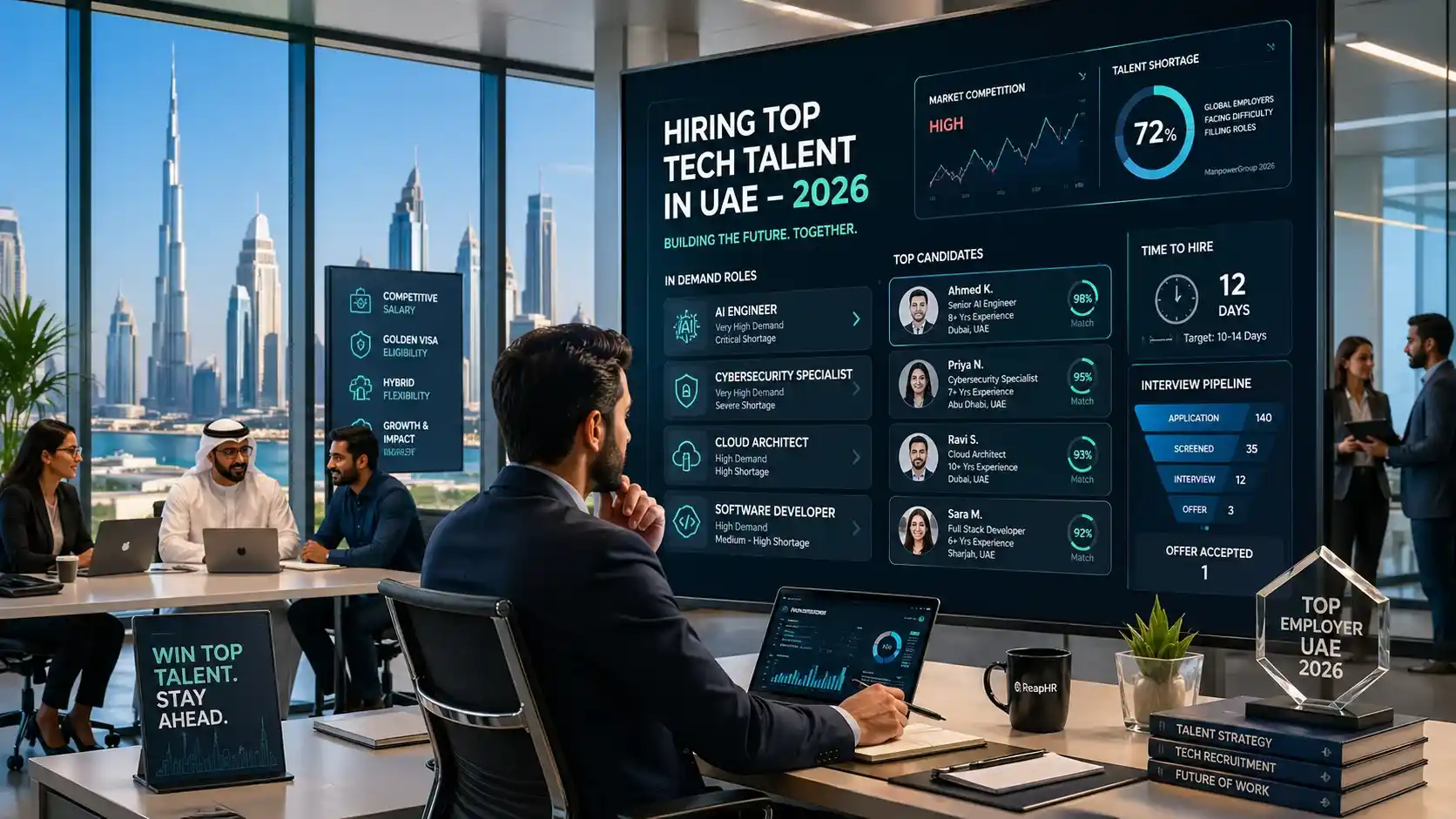
A Dubai fintech company ran a software engineering role open for 90 days. They received 140 applications. Three candidates made it to the final stage. All three accepted competing offers before the company could make a decision. The role was still vacant when the fourth round of interviews started. The problem was not the salary, not the job description, and not the company. The problem was a 28-day average interview process in a market where the best candidates are off the table in under two weeks.
Hiring tech talent in the UAE is genuinely one of the hardest talent acquisition challenges in the region right now. According to the ManpowerGroup 2026 Talent Shortage Survey — covering 39,000 employers across 41 countries, including the UAE — 72% of employers globally report difficulty filling roles, and AI skills have overtaken traditional engineering to become the single hardest skill set to source worldwide. In the UAE, where the AI Strategy 2031 and rapid digital transformation across every sector are creating simultaneous demand spikes, the supply shortfall is particularly acute.
This guide gives UAE employers a practical, specific framework for winning in this market. As a specialist tech recruitment partner in the UAE, ReapHR works with companies across fintech, software, AI, and digital transformation. The strategies here reflect what consistently works in the UAE market in 2026 — and what consistently fails. For a broader context on the regional hiring environment, see our GCC hiring outlook 2026 guide.
|
How do you hire tech talent in the UAE when competition is high? |
|
Hiring tech talent successfully in a competitive UAE market requires four things: salary packages benchmarked to 2026 market rates, an interview process completed in 10 days or fewer, a clear employer value proposition that goes beyond compensation, and sourcing through specialist tech networks rather than general job boards. Companies that get all four right fill roles in under 30 days. Those who miss any one of them typically lose the best candidates to faster-moving competitors. |
Why Hiring Tech Talent in the UAE Is So Competitive Right Now
The UAE technology hiring market in 2026 is shaped by three converging pressures that are unlikely to ease in the near term.
First, demand is accelerating faster than supply. The UAE AI Strategy 2031 has unlocked government and private sector investment in AI, cloud infrastructure, and digital platforms simultaneously. Every financial institution, energy company, healthcare system, and government entity is building or expanding a technology function at the same time. The result is a demand spike across AI/ML, cybersecurity, cloud architecture, and data engineering that the existing UAE talent pool cannot satisfy.
Second, supply is structurally constrained. The global tech talent shortage is projected to reach 85 million workers by 2030. While the UAE's zero-income-tax environment, world-class infrastructure, and Golden Visa programme make it attractive to international professionals, interest does not immediately translate into available candidates. The pipeline takes time to fill.
Third, the competition within the UAE has intensified. When ADNOC, FAB, Mubadala, and DIFC-registered global banks are all sourcing the same AI engineers and cloud architects, smaller companies are competing not just for talent but for attention. Tech salaries grew 6% in 2025 and are projected to grow a further 6% in 2026. The employers who ignore this data at the offer stage lose candidates they have spent weeks recruiting.
Market data: According to the ManpowerGroup 2026 Talent Shortage Survey, 72% of employers globally report hiring difficulty. AI skills are now the single hardest skill set to find — surpassing traditional engineering for the first time in the survey's history. The UAE is among the 41 countries included in the survey sample.
The Tech Roles Most in Demand in the UAE in 2026
|
Role |
UAE Demand Level |
Shortage Severity |
Key Hiring Challenge |
|
AI / ML Engineer |
Very High |
Critical — AI skills now #1 globally (ManpowerGroup 2026) |
Salary expectations 25-40% above 2024 benchmarks; most candidates have multiple active offers |
|
Cybersecurity Engineer |
Very High |
Severe — global gap of 4 million professionals (ISC2 2025) |
Certified professionals (CISSP, CISM, CEH) command high premiums; very low unemployment |
|
Cloud Architect (AWS / Azure / GCP) |
High |
High — cloud migration across all sectors |
Multi-cloud experience required; candidates with a UAE banking/fintech background are especially scarce |
|
Data Engineer / Data Scientist |
High |
High |
77% of companies globally lack sufficient data talent (McKinsey); the UAE reflects this pattern |
|
Full-Stack Developer |
High |
Medium-High |
Volume is high, but quality is uneven; senior full-stack with React/Node and banking or fintech sector knowledge is rare. |
|
DevOps / Platform Engineer |
Medium-High |
Medium-High |
Growing with cloud adoption, CI/CD, Kubernetes, and Terraform skills are in short supply. |
|
Product Manager (Technical) |
Medium-High |
Medium |
Rare combination of technical depth and product delivery experience; often poached from established UAE tech companies |
UAE Tech Salary Benchmarks 2026: What Candidates Actually Expect
Losing candidates at the offer stage almost always comes back to one of two factors: the salary is below market, or the offer comes too late. Accurate UAE tech salary benchmarking is the single most cost-effective investment a UAE tech employer can make before opening a role. The table below reflects current market ranges for active UAE tech professionals in 2026.
|
Role |
UAE Monthly Salary Range (AED) |
Package Inclusions Common at Market Rate |
Notes |
|
AI / ML Engineer (mid-level) |
25,000 - 45,000 |
Health insurance, hybrid flexibility, learning budget, potential equity |
Top end for UAE-experienced candidates with production ML deployments |
|
AI / ML Engineer (senior / lead) |
45,000 - 80,000 |
Full package + signing bonus in competitive cases |
ADNOC, Mubadala, UAE banks paying at the top; startups competing on equity and mission |
|
Cybersecurity Engineer (certified) |
22,000 - 40,000 |
Health insurance, certification budget, flexible hours |
CISSP/CISM holders can command the top band, the defence and banking sectors' highest pay |
|
Cloud Architect |
25,000 - 50,000 |
Hybrid, certification support, performance bonus |
GCP/Azure with a financial sector background at a premium |
|
Data Engineer |
18,000 - 35,000 |
Health, hybrid, training budget |
Senior data engineers with pipeline and ML-ops experience scarce |
|
Full-Stack Developer (senior) |
18,000 - 32,000 |
Health, hybrid, tech stack autonomy |
React + Node + TypeScript is the most in demand; PHP/legacy stack candidates are priced lower. |
|
DevOps / Platform Engineer |
20,000 - 38,000 |
Hybrid strongly expected; on-call compensation where applicable |
Kubernetes and Terraform experience at a significant premium |
Remember: All UAE salaries are tax-free. An AED 25,000 per month package is equivalent to approximately GBP 62,000 gross per year in the UK or AED equivalent in take-home, with no income tax deduction. Benchmark against gross-equivalent international salaries, not net-equivalent, when assessing your competitiveness.
Where to Source Tech Talent in the UAE: Channels That Actually Work
The channel mix for UAE tech hiring in 2026 is specific and quite different from general professional hiring. Using the wrong sourcing approach is the second most common reason tech roles stay open.
|
Channel |
Best For |
Practical Tip |
|
Specialist tech recruitment agencies |
Senior, specialist, and time-sensitive roles; passive candidates not on job boards |
Agencies with UAE-specific tech desks have warm pipelines of pre-vetted candidates; generalist agencies do not. |
|
LinkedIn (active sourcing) |
Mid to senior-level engineers, architects, and product managers |
Set company HQ as UAE; post content about tech stack and projects — inbound interest from relevant candidates increases measurably |
|
Naukri Gulf / Bayt |
Mid-level roles, 3 to 8 years experience, South Asian and MENA tech talent |
High volume; requires rigorous screening — but salary expectations are often more aligned with UAE market reality |
|
University partnerships (Khalifa, HCT, UAE University) |
Graduate pipeline and entry-level developers |
Sponsor hackathons, guest lecture programmes, and final-year projects — builds brand awareness with the UAE's emerging tech cohort. |
|
Hub71 and Area 2071 ecosystems |
Startup-ecosystem tech talent; candidates who want mission-driven roles |
Active community events and network referrals; less transactional than job boards |
|
Referral programmes |
Peer-recommended candidates with cultural and technical pre-screening |
Tech professionals know other tech professionals; a structured referral bonus of AED 3,000 to AED 10,000 per hire generates high-quality introductions |
|
Stack Overflow / GitHub community |
Niche deep-tech roles; open-source contributors |
Signals technical credibility to candidates; effective for backend engineering and DevOps specifically |
Using the UAE Golden Visa to Attract International Tech Talent
The UAE Golden Visa is one of the most underused employer attraction tools in the UAE tech market. Tech professionals globally — particularly those considering relocation from Europe, South Asia, and Southeast Asia — place significant weight on long-term residency security when evaluating offers. Sponsoring a candidate's Golden Visa application, or helping them understand their eligibility, is a material differentiator at the offer stage.
Under the UAE Golden Visa programme, technology professionals, AI specialists, data scientists, and software engineers may qualify for a 10-year renewable residency visa. The National Programme for Coders additionally targets 100,000 of the world's best coders for Golden Visa eligibility. For UAE employers, positioning a role as a potential Golden Visa pathway — and proactively guiding candidates through the eligibility criteria — shortens the decision timeline and reduces the offer-to-acceptance drop-off rate.
Speed Up Your Hiring Process: The Single Biggest Lever UAE Tech Employers Have
In a candidate-short market, interview process length is not a candidate experience issue — it is a business risk. Every day a strong candidate is in your process is a day they are also advancing in someone else's. The data on this is consistent: UAE tech candidates who are not moved to the offer stage within 10 to 14 business days accept competing offers at significantly higher rates.
|
Process Stage |
Target Timeframe |
Common Delay and Fix |
|
CV screen to first contact |
24 to 48 hours |
Delay: slow internal review. Fix: Assign a named owner to every open role with a response SLA. |
|
First interview (video or call) |
Within 3 to 5 business days of application |
Delay: calendar conflicts, panel availability. Fix: block standing interview slots in advance; use async video screening for the initial stage |
|
Technical assessment |
Completed within 5 business days of the first interview |
Delay: long take-home tasks. Fix: keep assessments to 90 minutes maximum; compensate for time with paid task options for senior candidates |
|
Final interview/panel |
Within 3 business days of the technical assessment pass |
Delay: decision-maker availability. Fix: compress the final stage into a single structured 90-minute panel rather than sequential interviews |
|
Offer issued |
Same day as final interview decision — maximum 48 hours |
Delay: approval chains. Fix: get verbal offer authority pre-approved before the final interview |
|
Offer to acceptance |
3 to 5 business days |
Delay: candidate shopping competing offers. Fix: make the offer in a direct call, not by email; follow up within 24 hours. |
The total target from application to accepted offer: 10 to 14 business days. Most UAE employers are running at 25 to 40 days. Closing that gap is the fastest ROI improvement available in tech hiring without changing the budget.
Build an Employer Brand That Tech Professionals Actually Notice
You cannot outbid ADNOC or a DIFC-registered global bank on base salary if you are a 50-person company. You can outperform them on everything that matters to a motivated engineer who is not purely money-driven: technical challenge, autonomy, speed of impact, and team quality.
• Define your tech stack publicly. Engineers research companies before they apply. A career page that names your actual technology choices — cloud provider, programming languages, CI/CD tooling, infrastructure — attracts candidates whose skills match and filters out those who would not thrive.
• Show the work, not just the perks. A 60-second video of a senior engineer explaining a technical problem they solved recently is more effective for employer branding for tech talent than a list of office benefits. Tech professionals hire for the work.
• Publish your engineering culture. Does your team contribute to open source? Run internal hackathons? Have a meaningful engineering blog? These signals reach the most motivated candidates before any job posting does.
• Be explicit about flexibility. 82% of tech professionals globally prefer hybrid or remote work. A clear and honest hybrid policy communicated from the first contact point — not as a negotiation at the offer stage — removes a significant barrier to application.
• Benchmark and publish salary ranges where possible. Roles with posted salary ranges receive significantly higher application volume from qualified candidates. If salary confidentiality prevents publishing, provide a realistic range to the recruiter or agency. ReapHR's UAE tech salary benchmarking service supports employers in setting ranges that attract rather than deter.
Conclusion
Hiring tech talent in the UAE in 2026 requires a fundamentally different approach from hiring two or three years ago. The market has changed: demand is higher, supply is constrained, candidate expectations have shifted, and the employers winning the best people are those who have invested in speed, salary accuracy, sourcing breadth, and employer brand simultaneously.
There is no single fix. But the UAE market has genuine advantages — tax-free salaries, Golden Visa pathways, a genuinely exciting technology ecosystem, and a quality of life that consistently draws international talent. Employers who position those advantages clearly, move faster, and partner with recruiters who know the UAE tech market can fill roles that competing employers leave open for months.
Looking to fill a tech role in the UAE? ReapHR's specialist technology recruitment team works with UAE employers across software engineering, AI, cybersecurity, cloud, and data to source pre-vetted candidates and close roles faster.
Connect with the ReapHR tech recruitment team to discuss your next hire.
Frequently Asked Questions
Why is it so hard to hire software engineers in Dubai and Abu Dhabi?
The UAE's rapid digital transformation across energy, finance, healthcare, and government is creating simultaneous tech demand across every sector. AI, cybersecurity, and cloud skills are in especially short supply — the ManpowerGroup 2026 Talent Shortage Survey identifies AI as the number one hardest skill to source globally, and the UAE market reflects this. Simultaneously, top UAE tech professionals receive multiple active approaches from competing employers at any given time, compressing the window to convert a strong candidate.
How long should a UAE tech hiring process take?
To remain competitive in the UAE tech market in 2026, the total process from first contact to accepted offer should be completed within 10 to 14 business days. Most UAE employers average 25 to 40 days. Each additional week of process length after day 10 significantly increases the probability that a strong candidate accepts a competing offer. The highest-impact single change most UAE tech employers can make is compressing decision timelines.
Does the UAE Golden Visa help attract tech talent?
Yes, significantly. International tech professionals weighing the UAE against European or Asian markets place high value on long-term residency security. Under the UAE Golden Visa programme, technology specialists, AI professionals, data scientists, and software engineers may qualify for a 10-year renewable residency. Proactively communicating Golden Visa eligibility pathways at the offer stage is a meaningful differentiator, particularly for candidates relocating from the UK, India, or Southeast Asia.
What do UAE tech professionals look for beyond salary?
Beyond competitive salary, UAE tech professionals in 2026 prioritise: hybrid or remote work flexibility (cited by 82% of global tech professionals as important), access to meaningful technical challenges and modern tech stacks, learning and certification budgets, clear career progression, and mission-driven work. Smaller UAE companies cannot outbid major employers on base salary alone but consistently win on speed of impact, technical autonomy, and genuine flexibility.
Should I use a recruitment agency to hire tech talent in the UAE?
For senior, specialist, and time-sensitive tech roles, yes. General job boards generate high application volume in the UAE but consistently deliver low-quality shortlists for technical roles. A specialist tech recruitment agency with an established UAE candidate network provides access to passive candidates not actively searching, pre-vetted technical profiles, and significantly faster time-to-shortlist. The placement fee is typically offset within the first month of salary cost compared to a role staying vacant.