



A 90-person hospitality group in Dubai chose its HR system because it cost AED 15 per employee per month. Within three months, gratuity needed a spreadsheet, WPS files needed a paid add-on, and Emiratisation reports had to be counted by hand. The cheapest option became the costliest.
Choosing a cloud HRIS UAE employers can trust means testing compliance, data handling, and total cost before price. Start from the processes in your HR strategy, because the system should serve them, not dictate them.
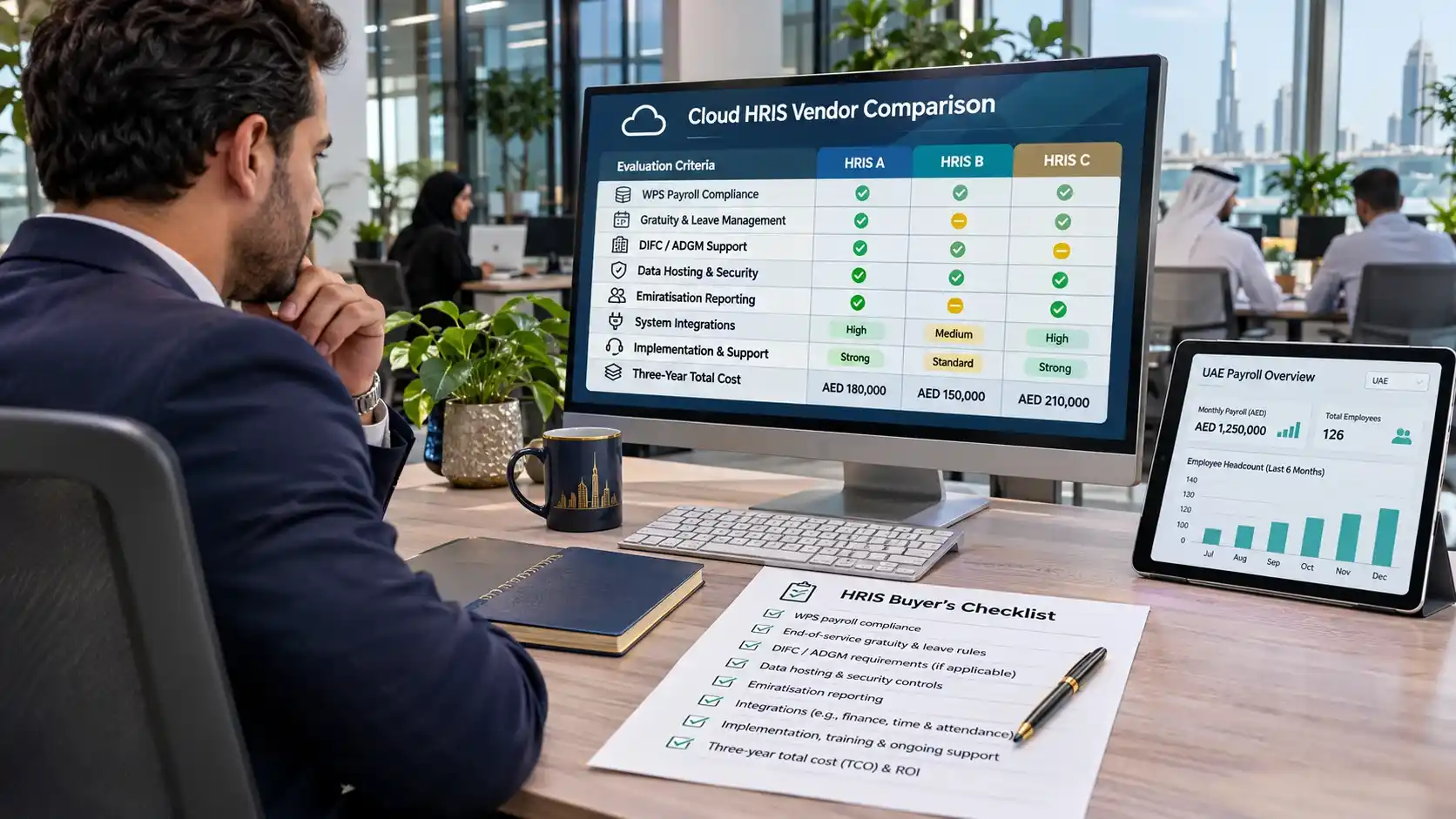
This guide sets out eight vendor-neutral comparison points, shows how to test UAE compliance in a live demo, and explains how to judge total cost over three years.
|
QUICK ANSWER Compare a cloud HRIS in the UAE on eight points beyond price: WPS file generation, gratuity and leave logic, free-zone rules, data hosting under Federal Decree-Law No. 45 of 2021, Emiratisation reporting, integrations, implementation support and three-year cost. |
What a Cloud HRIS UAE Buyers Actually Need
Define scope first. A core HRIS holds records, leave, documents, and self-service. Payroll, recruitment tracking, and performance may be separate modules or separate products. Many SMEs need compliant payroll first, so decide whether the system must run pay or only feed it.
Timing matters. ReapHR's guide to AI in Middle East recruitment cites People Connect Global research that 68% of GCC HR decision-makers say legacy systems cannot keep pace with regulatory change. Central rule updates help, provided the vendor actually ships them.
Involve end users early. Payroll staff, line managers, and employees all touch the platform, so include each group in the demo. If finance likes a system but managers avoid it, leave requests and appraisals end up in email.
|
Factor |
Ask the vendor |
Red flag |
|
WPS |
Does the payroll run create the bank file? |
Export, then edit by hand |
|
Gratuity and leave |
Is accrual based on basic wage and your policy? |
One global formula |
|
Free-zone rules |
Can it handle DEWS and DIFC or ADGM contracts? |
Mainland only |
|
Data hosting |
Where are servers, and who are sub-processors? |
No clear answer |
|
Emiratisation |
Can it report skilled headcount and ratios? |
Manual counting |
|
Integrations |
Which banks, attendance, and accounting tools are native? |
CSV files only |
|
Implementation |
Who migrates data and trains staff locally? |
Self-service only |
|
Total cost |
What is the three-year price with all modules? |
Quote omits payroll |
Score each vendor from one to five on every row, then weight the rows by your risk. A free-zone company might double the weight on DEWS support, while a 60-person mainland firm may care most about WPS and Emiratisation.
Compliance Checks That Separate UAE-Ready Systems
Start with wages. Mainland private-sector employers pay through the Wage Protection System, so the platform should produce the salary file from the payroll run itself. The official payment of wages rules explain what must be paid and when.
Then test gratuity with your own data. Under Article 51, the government end-of-service guide sets 21 days of basic wage for each of the first five years and 30 days after. At an AED 8,000 basic wage, four years should return about AED 22,400. If the demo disagrees, ask why.
Include awkward cases: an employee with unpaid leave, one with a part year of service, and one in DIFC under DEWS. Our guide to gratuity versus savings schemes explains why free-zone and mainland logic differ, and a good system handles both.
Check leave rules too. The platform should accrue annual leave from your policy, not a fixed global default. Align it with your documented leave policies before configuration, so employees see the same balances in the system and the handbook.
Confirm it tracks compliance documents with alerts before expiry: Emirates ID, residence visa, labour card, and health insurance. Early warnings prevent lapsed documents, which are far cheaper to avoid than to fix.
Data Residency, Security and the PDPL
HR data is personal data. Federal Decree-Law No. 45 of 2021 restricts transfers of personal data outside the UAE unless conditions are met, as the UAE government data protection page outlines. DIFC and ADGM employers follow their own regimes, so ask where servers sit.
Look beyond location. Check role-based access, audit logs showing who viewed salary data, encryption, backup practices, and breach notification terms. Finance should see payroll totals without seeing medical or family details.
Read the exit terms as well. You should be able to export complete records in a usable format and require deletion when the contract ends. Vendors that hold data hostage make later switching costly.
Reporting, Integrations and Emiratisation Tracking
Reporting is where cheap systems often fall short. You need headcount, turnover, leave liability, and gratuity accrual without exporting everything to a spreadsheet. If you plan to use HR data for retention decisions, confirm you can split results by manager and tenure.
Emiratisation needs specific support. Firms with 50 or more employees must raise Emiratis in skilled roles by 1% each half-year, so the system should track skilled headcount, national ratios, and pension contributions for UAE nationals. Check current rules with MOHRE services before shortlisting.
Ask which integrations are native: banks, attendance devices, accounting software and insurers. CSV-only links push work onto your team. Approval workflows should mirror your reporting lines, which a clear organisation design makes easy to configure.
Check mobile and Arabic support. Frontline teams often work from phones, and some staff prefer Arabic. A self-service app that works well in both languages cuts routine HR queries and lifts adoption.
Total Cost, Implementation and Vendor Risk
Compare cost over three years, not per month. Entry-level cloud tools are often advertised at under AED 50 per employee monthly, but payroll modules, extra users, setup, integrations and support add up. Ask every vendor for one all-in quote.
Data migration is the hidden project. Separate basic wage from allowances, standardise job titles, and check contract dates before import. Reviewing your employment contracts first prevents wrong gratuity balances from day one.
Plan go-live carefully. Vendors quote anywhere from a few weeks to a couple of months, so ask for references from companies of your size and avoid switching mid-payroll cycle. Run one parallel payroll before retiring the old process.
Ask about support hours and escalation. UAE payroll deadlines are fixed, so a vendor in another time zone with a weekday-only helpline can leave you stranded. Confirm local support, response times, and who handles regulatory changes.
Give every vendor the same demo script: your three awkward employees, a WPS file in your bank's format, an Emiratisation report and a full data export. Score what they show live, not what the slides promise.
Final Thoughts on Choosing a Cloud HRIS
The right cloud HRIS is the one that gets UAE payroll, gratuity, and reporting right on your own data. Price matters, but a low monthly fee cannot offset manual workarounds, compliance gaps, or a painful exit.
Shortlist three vendors, run the same scripted demo, and weight the scores by your risk. Then negotiate on total cost, data export rights and local support rather than on discounts alone.
|
NEED A HAND? ReapHR can review your HR processes, clean your records before migration, and support your system selection. |
Frequently Asked Questions
What is the difference between an HRIS and payroll software in the UAE?
An HRIS stores and manages employee records, leave, documents, and self-service requests, while payroll software calculates pay and produces WPS files. Many UAE platforms combine both. Buying them separately works only if the integration passes salary, leave, and gratuity data automatically, because manual re-keying is where errors and late wage payments start.
Does an HRIS need to generate WPS files for UAE employers?
For mainland private-sector employers paying wages through the Wage Protection System, yes, it should produce the bank-ready salary file directly from the payroll run. If you must export data and edit a spreadsheet by hand, the system adds work and risk. Ask for a live demonstration using your own bank format.
Where should a UAE employer's HR data be hosted?
Federal Decree-Law No. 45 of 2021 restricts transfers of personal data outside the UAE unless specific conditions are met, and DIFC and ADGM run their own regimes, so hosting location matters. Ask every vendor where servers sit, which sub-processors access data, and how you can export or delete records.
How much does a cloud HRIS cost in the UAE?
Entry-level tools for startups are often advertised at under AED 50 per employee per month, but payroll modules, extra users, implementation, and integrations can raise the total. Compare quotes on a three-year basis, including setup, support, add-ons and exit costs, rather than the headline monthly rate.
How long does HRIS implementation take for a UAE SME?
Vendors quote anything from a couple of weeks to a few months, depending on data quality, payroll complexity, and the number of integrations. Clean employee records, with basic wage separated from allowances, shorten the project. Avoid going live mid-payroll cycle, and ask for references from companies of similar size.