



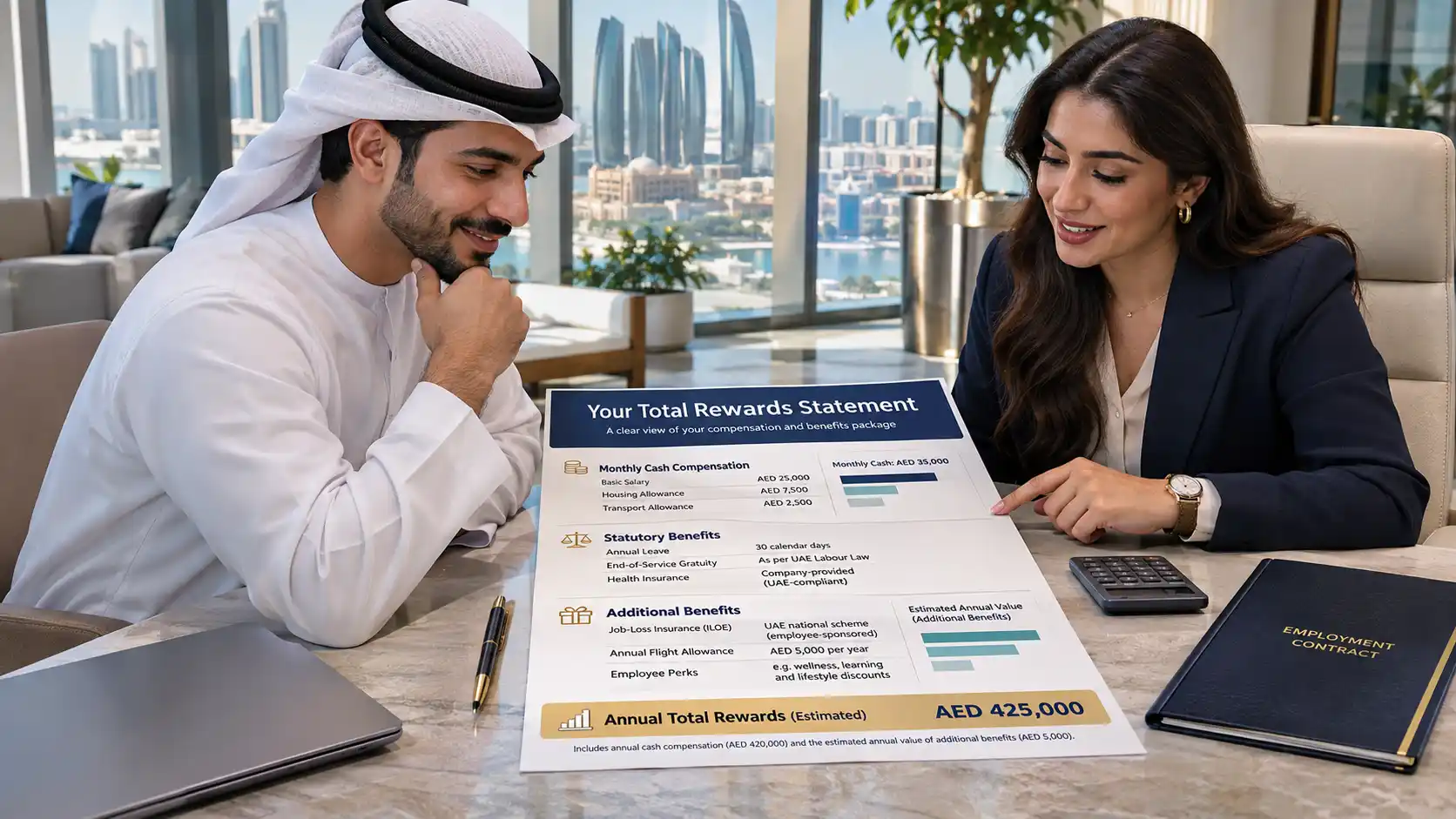
A facilities supervisor at an Abu Dhabi logistics firm resigned for a rival offer of AED 11,500 a month. He had never seen what his package included: employer-paid health insurance, 30 days of leave, return flights, and a growing gratuity. A clear total rewards statement, designed with ReapHR's HR strategy team, would have shown him the real gap.
A total rewards statement is a personalised page showing everything an employee receives, from cash pay to statutory entitlements, insurance and perks, each valued in dirhams. UAE law does not require one, so its value lies in clarity, provided every figure matches the contract.
This guide explains what to include, how to value gratuity, leave, ILOE and health cover honestly, how to lay the page out, and which mistakes erode employee trust.
|
QUICK ANSWER A total rewards statement UAE employees understand lists every pay element in AED on one or two pages, separates basic wage from allowances, values statutory items using official rules, and states that the employment contract prevails. |
What a Total Rewards Statement Covers in the UAE
Split rewards into three groups: monthly cash, entitlements protected by Federal Decree-Law No. 33 of 2021, and discretionary extras. Employees usually see only the first group, so the other two are where the statement earns its keep.
Start with an audit. Pull the contracts, benefit policies, and insurance schedules, and note where they disagree. Fixing those conflicts first stops the statement from publishing the same mistake to every employee.
|
Component |
Basis |
How to show it |
|
Basic wage and allowances |
Employment contract |
Monthly and annual AED, listed separately |
|
Annual leave |
30 calendar days after one year |
Days and estimated AED value |
|
Gratuity |
21 days per year, then 30, on basic wage |
Amount accrued to date |
|
Health insurance |
Emirate law, employer-funded |
Annual premium per insured person |
|
ILOE cover |
AED 5 or 10 monthly premium |
Premium paid and maximum payout |
|
Perks and flights |
Contract or policy |
Annual value, with conditions |
Keep discretionary items honest. A car allowance or school fee support belongs on the page only if the contract or policy promises it, and conditions should sit beside the figure. Our guide to company car and travel allowance rules shows how to word such perks safely.
Basic Wage, Allowances and the Gratuity Trap
The most common misunderstanding is that gratuity grows with total pay. Under Article 51, it is calculated on basic wage only, at 21 days per year for the first five years and 30 days for each year after. The UAE government guide to end-of-service benefits confirms the formula.
Show the arithmetic. On a basic wage of AED 8,000, the daily rate is AED 266.67, so 21 days earns about AED 5,600 per completed year, or roughly AED 22,400 after four years. Total pay of AED 13,000 does not change that figure.
Be candid about limits. Gratuity applies to full-time employees with at least one year of service; unpaid leave days are excluded, and the total is capped at two years' wage. DIFC employers may use the DEWS savings scheme instead, so state which regime applies.
The wage split on the statement must mirror the signed offer. If staff spot a mismatch, trust drops fast, so review outdated employment contracts before publishing any figures.
Valuing Leave, ILOE and Health Insurance Honestly
Annual leave is 30 calendar days after one year of service, and two days a month between six months and one year, under the official annual leave rules. Convert days into dirhams using the daily rate payroll already applies, and align the wording with your leave policies.
ILOE is the hardest item to explain. Employees pay AED 5 monthly up to AED 16,000 basic wage and AED 10 above it. After involuntary job loss, it pays 60% of average basic wage for up to three months, capped at AED 10,000 or AED 20,000 monthly, as the Dubai government ILOE page sets out.
Health insurance often carries the largest hidden value. Abu Dhabi Law No. 23 of 2005 and Dubai Law No. 11 of 2013 place the cover obligation on employers, though rules on dependants differ. Show the annual premium, the insurer, and the plan tier.
Do not forget time-based protections. Public holidays, sick leave and parental leave are statutory, and a short line listing them reminds staff that protection exists even when no cash changes hands.
Designing a Total Rewards Statement Employees Will Read
Layout and plain-language wording
Aim for one page, lead with the annual total in AED, and group items under the three headings above. Use labels staff already see on payslips, and add Arabic or other workforce languages for frontline teams.
|
Instead of |
Write |
|
Statutory end-of-service accrual |
Gratuity you have earned so far |
|
Fixed allowances |
Housing and transport pay (not used for gratuity) |
|
Group medical contribution |
Health insurance paid by the company |
|
ILOE subscription |
Job-loss cover (you pay AED 5 or 10 a month) |
Add a footnote giving the date of the figures, the assumptions used, and a line saying the employment contract prevails. Estimates should be labelled as estimates.
Delivery, timing and data protection
Issue statements at offer stage, at each annual review and at promotion. Send them through a secure portal or password-protected PDF, because pay data is personal data under Federal Decree-Law No. 45 of 2021. Brief line managers first so questions get consistent answers.
Track the response. A short survey after the first release, asking which section was clearest and which raised questions, shows where the wording still fails. Adjust labels before the next cycle rather than adding more explanation.
Mistakes That Undermine a Total Rewards Statement
Three errors recur. Employers present their own costs, such as visa fees, as employee value; they show conditional gratuity as cash in hand; and they publish figures that differ from payroll. Figures should reconcile with the official payment of wages rules.
Over-promising is costlier still. Describe perks exactly as policy words them, including eligibility and repayment terms, and avoid the word guaranteed for anything discretionary.
Finally, test the draft with five employees from different grades. If they cannot say what their basic wage is and why it matters for gratuity, simplify the page before rollout.
Employers weighing a switch away from gratuity should first read our guide to gratuity versus savings schemes for mainland employers, since the statement design changes if the scheme does.
Final Thoughts on Total Rewards Statements
A total rewards statement works when it shows employees, in plain dirhams, what the company already gives them. UAE rules on gratuity, leave, ILOE and health cover supply the framework, while clear wording and accurate figures supply the trust.
Start with one pilot team, check every number against the contract and payroll, then roll the format out company-wide. An annual refresh keeps the statement credible as wages and entitlements change.
|
NEED A HAND? ReapHR can review your pay structure, benchmark salaries, and draft clear statements for your teams. |
If your statements need defined pay bands behind them, ReapHR's grading system service is a practical starting point.
Frequently Asked Questions
Is a total rewards statement mandatory in the UAE?
No. Federal Decree-Law No. 33 of 2021 does not require employers to issue one, so it is a voluntary communication tool. Employers must still honour contract terms and statutory entitlements, which means every figure on the statement should match the signed contract and payroll records exactly, because those documents prevail if anything conflicts.
What should a total rewards statement include for UAE employees?
It should show basic wage, allowances, annual leave, accrued gratuity, health insurance, ILOE cover, and any contractual perks, each in AED with its basis. Group them as monthly cash, protected entitlements, and discretionary extras, add the date of the figures, and state that the employment contract prevails over the statement.
Is gratuity calculated on basic salary or total salary?
Basic wage only. Under Article 51, gratuity is 21 days of basic wage for each of the first five years and 30 days for each year after that, for employees with at least one year of service. Allowances such as housing and transport are excluded, so a statement should show the split clearly.
How often should UAE employers issue a total rewards statement?
Issue one at offer stage, once a year at the pay review, and again after any promotion or salary change. Annual issue keeps the gratuity accrual and insurance figures current, while event-based issue prevents staff from relying on outdated numbers when they compare offers or plan their finances.
Should the statement show ILOE and health insurance?
Yes, with accurate labels. Health insurance is usually employer-funded, so show the annual premium as a company-paid value. ILOE is different: employees pay AED 5 or AED 10 monthly, so present it as job-loss protection they hold, with the 60% payout and three-month limit, rather than an employer cost.