



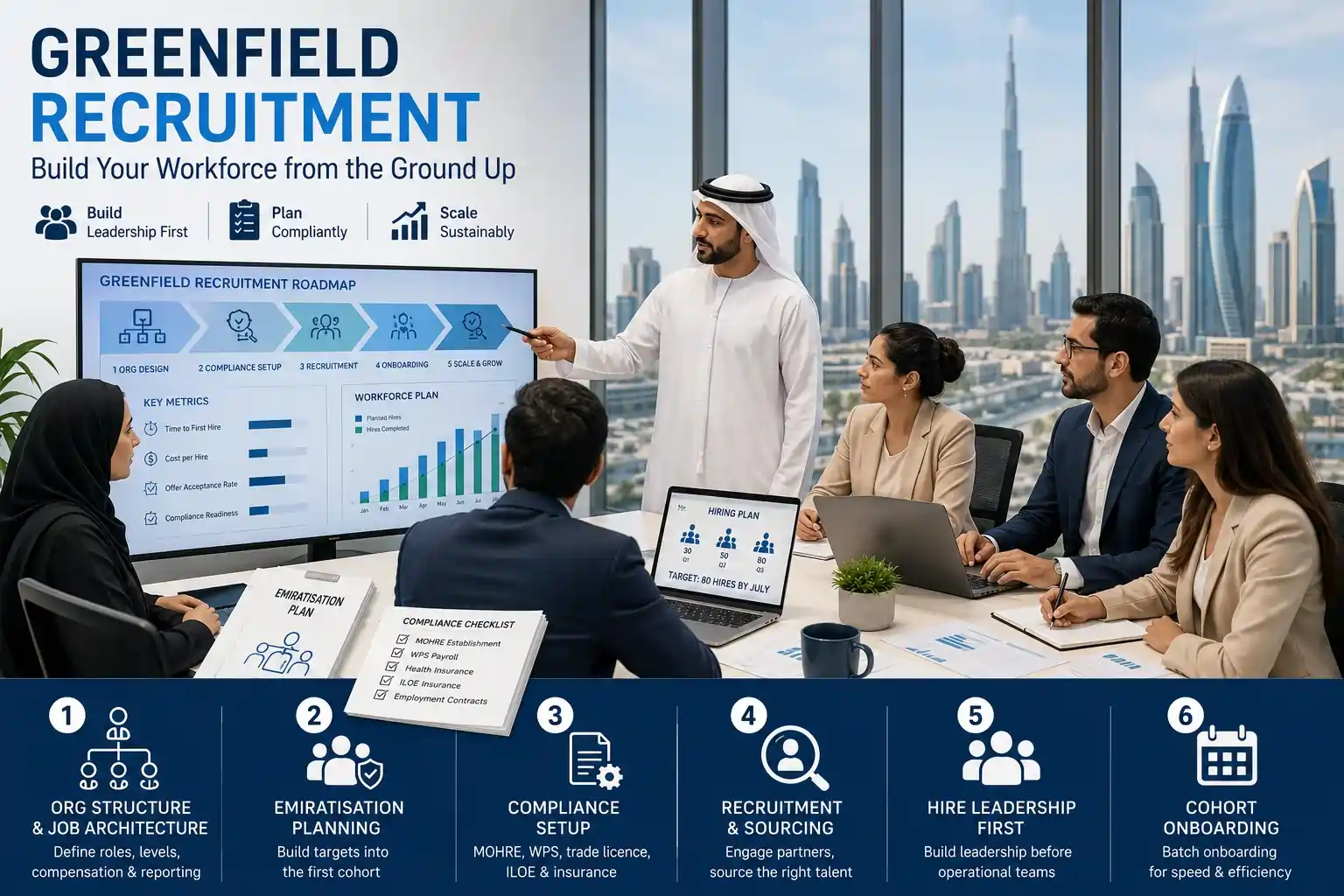
An Abu Dhabi logistics company won a government contract in Q1 2026 requiring 80 staff by a July start date. They briefed an agency and started sourcing. Three months in, they had 40 candidates at offer stage and no MOHRE establishment card, no WPS infrastructure, and no Emiratisation plan. The start date passed. ReapHR employer services include greenfield compliance setup as the first stage, not an afterthought.
Greenfield recruitment is not a faster version of normal hiring. It is a structurally different challenge: building a workforce where none exists, in a market where compliance infrastructure must be in place before the first employment contract is signed. Every hire in a greenfield programme is the first hire from a legal, compliance, and operational standpoint. The mistakes that most companies make happen because they treat greenfield as a volume hiring problem rather than an organisation design and compliance problem.
This guide covers what greenfield recruitment means, when it applies, how it differs from standard high-volume hiring, and the six-step process UAE companies should follow to execute a greenfield programme correctly, from org design through to cohort onboarding.
|
Quick Answer: What Is Greenfield Recruitment? |
|
Greenfield recruitment means building an entirely new workforce where no team, process, or compliance history exists. It applies when a company enters a new market, launches a new business unit, opens a new facility, or wins a contract requiring a standalone team. Unlike backfill or volume hiring, greenfield requires designing the org structure, employment compliance framework, and Emiratisation plan before any candidate is sourced. |
Greenfield vs Volume Hiring: A Critical Distinction
The most common failure in greenfield programmes is treating them as volume hiring. Volume hiring accelerates an existing process: the org structure exists, the employment entity is registered, WPS is live, and the task is simply to hire more people faster. Greenfield hiring has none of these prerequisites in place. Every element of the employment infrastructure must be built before sourcing begins.
|
Dimension |
Volume Hiring |
Greenfield Recruitment |
|
Existing org structure |
Yes, expanding an existing one |
No, must be designed from scratch |
|
MOHRE establishment |
Already registered |
Must be obtained before first hire |
|
WPS payroll |
Already live |
Must be set up before first salary payment |
|
Emiratisation quota |
Already tracked; adding hires |
Triggers at 50 employees; must plan from Day 1 |
|
Recruitment brief |
Exists, roles well defined |
Must be created; levels, grades, and compensation not yet set |
|
First hire priority |
Any open role |
Leadership layer first; operations follow |
|
Timeline risk |
Speed and quality |
Compliance setup, then speed and quality |
This distinction matters because the two scenarios require different resources, different timelines, and a different sequencing of activities. A company that applies a volume hiring approach to a greenfield situation will typically reach the offer stage with candidates before the legal infrastructure can absorb them, exactly the situation the Abu Dhabi logistics company in this guide's opening scenario found itself in.
When Does a Company Need Greenfield Recruitment?
Four situations reliably trigger the need for a greenfield recruitment approach. The first is new market entry, a company establishing a UAE presence for the first time with no existing UAE employees or entity. The second is new business unit launch, a company already operating in the UAE that creates an entirely new division or subsidiary with its own standalone headcount. The third is new facility or campus opening, a logistics hub, manufacturing plant, school, or hospital that requires a complete operational workforce. The fourth is contract-driven workforce creation, winning a government or commercial contract that requires the contractor to staff and operate a project team from zero.
Each of these triggers shares the same characteristic: there is no existing team, no established reporting structure, no employment entity infrastructure, and no Emiratisation history. The workforce does not grow; it is created. UAE welcomed 337 new FDI projects in 2025, a 22 percent year-on-year increase, and each project requiring 50 or more UAE-based hires represents a greenfield recruitment event of some kind.
|
Best Practice: Identify Greenfield Status at Contract Award, Not at First Hire |
|
The biggest greenfield timeline errors come from companies that start the org design and compliance setup process after the hiring brief has been issued. MOHRE establishment card issuance, WPS infrastructure setup, and bank account opening for salary payment take four to eight weeks. These must run in parallel with org design, not after it. Identify greenfield status at the point of contract award or market entry decision, and begin compliance setup the same week. |
Step 1: Org Structure and Job Architecture
A greenfield programme cannot produce a useful recruitment brief without first answering three questions: what does the organisation look like at full operating capacity, what is the phased build plan (which roles are needed by month three versus month twelve), and how are roles levelled and compensated. These are not HR process questions; they are business design decisions, and they must be made by leadership before any job description is written.
Job architecture for a greenfield UAE company includes defining role families, job grades linked to a salary band framework, and the management span at each level. This framework is the foundation for salary benchmarking, Emiratisation role targeting, and the recruitment brief. Companies that build job architecture after hiring begins end up with inconsistent grades, salary equity problems, and roles that do not fit the compensation structure they have agreed with their recruitment partner. For salary benchmarking to inform the compensation framework, see salary benchmarking UAE.
Step 2: Building the Emiratisation Plan Into the First Cohort
Emiratisation quotas under MOHRE apply as soon as a company reaches 50 employees. For a greenfield programme with a target headcount of 50 or more, this means the Emiratisation obligation will be triggered during the programme itself, not at some future point after the company is fully operational. The Emiratisation plan must therefore be embedded in the first hiring cohort, not treated as a second phase once the expat workforce is in place.
A company that hires 50 expat staff before onboarding any UAE nationals will face an immediate quota gap on Day 51. MOHRE fines of AED 6,000 per month per unfilled quota position begin immediately. For a greenfield programme in sectors where profession-specific quotas apply, banking, insurance, retail, technology, the quota calculation is even more granular, applying at the role level rather than just to total headcount. For the official Emiratisation framework, see Emiratis in private sector. For sector-specific Emiratisation hiring guidance, see the Emiratisation recruitment guide in this series.
Step 3: Compliance Infrastructure Before Hire One
Three compliance elements must be in place before a UAE company can legally employ its first staff member: a MOHRE establishment card (registering the company as a licensed employer), an active WPS payroll channel through an approved bank or payment provider, and a trade licence or free zone registration confirming the entity is authorised to conduct the relevant activity. None of these can be obtained after the employment relationship begins; they are prerequisites, not parallel workstreams.
|
Compliance Element |
What It Is |
When Required |
Typical Timeline |
|
MOHRE establishment card |
Registers the company as a UAE employer |
Before any work permit can be applied for |
1-2 weeks |
|
WPS payroll account |
Salary must be paid via WPS from Day 1 |
Before first salary payment |
2-4 weeks (bank account dependent) |
|
Trade licence / free zone registration |
Authorises the commercial activity |
Before an MOHRE establishment card can be issued |
4-8 weeks (new entity) |
|
ILOE insurance (since Jan 2023) |
Involuntary Loss of Employment; mandatory for all staff |
From start of employment |
Set up during onboarding |
|
Employment contract (FDL 33/2021 compliant) |
MOHRE-registered contract for each employee |
Before work commences |
Issue at offer stage |
For the full UAE employment law framework that governs greenfield employment contracts, see UAE employment laws. For contract structure guidance specific to UAE limited and unlimited contracts, see UAE employment contracts.
Step 4: The Recruitment Brief and Agency Engagement
A greenfield recruitment brief is more detailed than a standard hiring brief because the agency must understand the full architecture of the organisation being built, not just the specification for one role. The brief must include: the full org chart (or phased build plan), the compensation framework by grade, the Emiratisation targets by function, the timeline for each cohort, and any constraints on candidate source markets (visa processing times vary significantly by nationality and country of residence).
International candidates, the majority of most UAE greenfield programmes, require 12 to 20 weeks from initial outreach to UAE start date when credential attestation, embassy visa processing, MOHRE work permit, and onboarding are all factored in. A recruitment partner must be briefed at least 12 to 16 weeks before the intended start date for international hires. Domestic UAE-based candidates can be placed in two to four weeks, and prioritising them for roles that do not require specific international credentials reduces timeline risk for the critical path. For programmes requiring significant volume, see the volume hiring UAE guide for additional strategies.
Step 5: Hire Sequence - Leadership Before Operations
The single most consequential sequencing decision in any greenfield programme is the order of hire. Leadership roles- CEO, COO, department heads, and functional directors- must be hired before their operational teams. This principle holds regardless of schedule pressure. Leaders define the culture, set the hiring standards for roles below them, make decisions about team structure, and manage the performance of every subsequent hire. Operational staff hired before leadership are being managed by nobody, and they will be the first to leave when leadership eventually joins and changes things.
The practical sequencing rule for UAE greenfield programmes is: hire leaders, then hire leads, then hire individual contributors. Within each layer, Emiratisation targets should be met proportionally, not deferred to the final cohort. A programme that hires all Emirati staff at the end, in a rush to meet the quota before the 50-employee threshold triggers, produces poor quality Emirati hires in roles that were designed for expat candidates and organisations that cannot satisfy Nafis quality-employment criteria.
Step 6: Cohort Onboarding - Batch, Not Sequential
Onboarding 30 to 80 people individually, processing each visa, medical test, MOHRE registration, and WPS enrolment one at a time, is the slowest and most expensive approach. For greenfield programmes, the default should be cohort onboarding: batching candidates into weekly or fortnightly groups who go through visa processing, medical tests, Emirates ID registration, and WPS enrolment together. The logistics are more complex but the time savings are significant: a 50-person cohort can be onboarded in four to six weeks through batch processing versus sixteen to twenty weeks if handled individually.
Cohort onboarding also produces more consistent start dates, which matters for team integration. New joiners who start in the same week build relationships faster and require less individualised induction. For HR compliance support across the full onboarding process, HR audit services include a greenfield compliance checklist review.
Conclusion
Greenfield recruitment is one of the most demanding hiring challenges a UAE company can face, and one of the most consequential when done poorly. The distinction between greenfield and volume hiring is not semantic: it determines whether compliance infrastructure, org design, and Emiratisation planning are treated as prerequisites or afterthoughts. Companies that design the organisation before sourcing begins, build Emiratisation into the first cohort, hire leadership before operations, and batch onboarding into cohorts consistently build their greenfield workforce on time and inside compliance. Companies that start with sourcing and circle back to the rest consistently do not.
The UAE's growing FDI pipeline, 337 new projects in 2025, a 22 percent year-on-year increase, means greenfield recruitment is not an edge case. It is the hiring model for a significant and growing share of UAE employer activity. Building the capability to execute it correctly, or partnering with a team that already has, is a genuine competitive advantage for companies operating in a market where the pace of new entity creation is accelerating every year.
|
Run Your Greenfield Programme With ReapHR |
|
ReapHR manages greenfield recruitment programmes across Abu Dhabi and Dubai, from org design and Emiratisation planning through to cohort onboarding. For employer services, visit ReapHR employer services. For HR compliance audit and greenfield compliance setup, visit HR audit services. |
Frequently Asked Questions
What is greenfield recruitment?
Greenfield recruitment means building an entirely new workforce for an organisation or business unit that has no existing employees, typically for a new market entry, a new facility, or a company launch. Unlike backfill or growth hiring, greenfield recruitment requires designing the org structure, job architecture, Emiratisation plan, and compliance framework before the first hire is made.
When should a UAE company use a greenfield recruitment approach?
A greenfield approach suits companies entering the UAE for the first time, launching a new business unit with no inherited headcount, opening a new facility, or winning a contract requiring a standalone workforce. Any situation where there is no existing team, process, or compliance history calls for a greenfield hiring plan rather than incremental hiring.
What are the main steps in a greenfield recruitment programme in the UAE?
The core steps are: define org structure and role architecture, set the Emiratisation target for the first cohort, register with MOHRE and set up WPS payroll, brief recruitment partners with a full specification, and sequence hires so leadership roles are filled before operational ones. The sequence matters; greenfield programmes that hire operations before leadership stall.
How does Emiratisation apply to greenfield recruitment in the UAE?
Emiratisation quotas apply once a company reaches 50 employees. For greenfield programmes targeting 50 or more hires, the Emiratisation plan must be built into the first cohort. Companies that reach 50 expat hires before any UAE nationals face an immediate quota gap and AED 6,000 per month per position in monthly fines from MOHRE.
How long does a greenfield recruitment programme typically take in the UAE?
For a greenfield programme targeting 30 to 50 hires, the full timeline from org design to operational team is typically 16 to 26 weeks. The first four to six weeks cover structure and compliance setup. Sourcing and hiring run weeks six to eighteen. Visa processing, onboarding, and WPS enrolment for the full cohort add four to eight further weeks.