



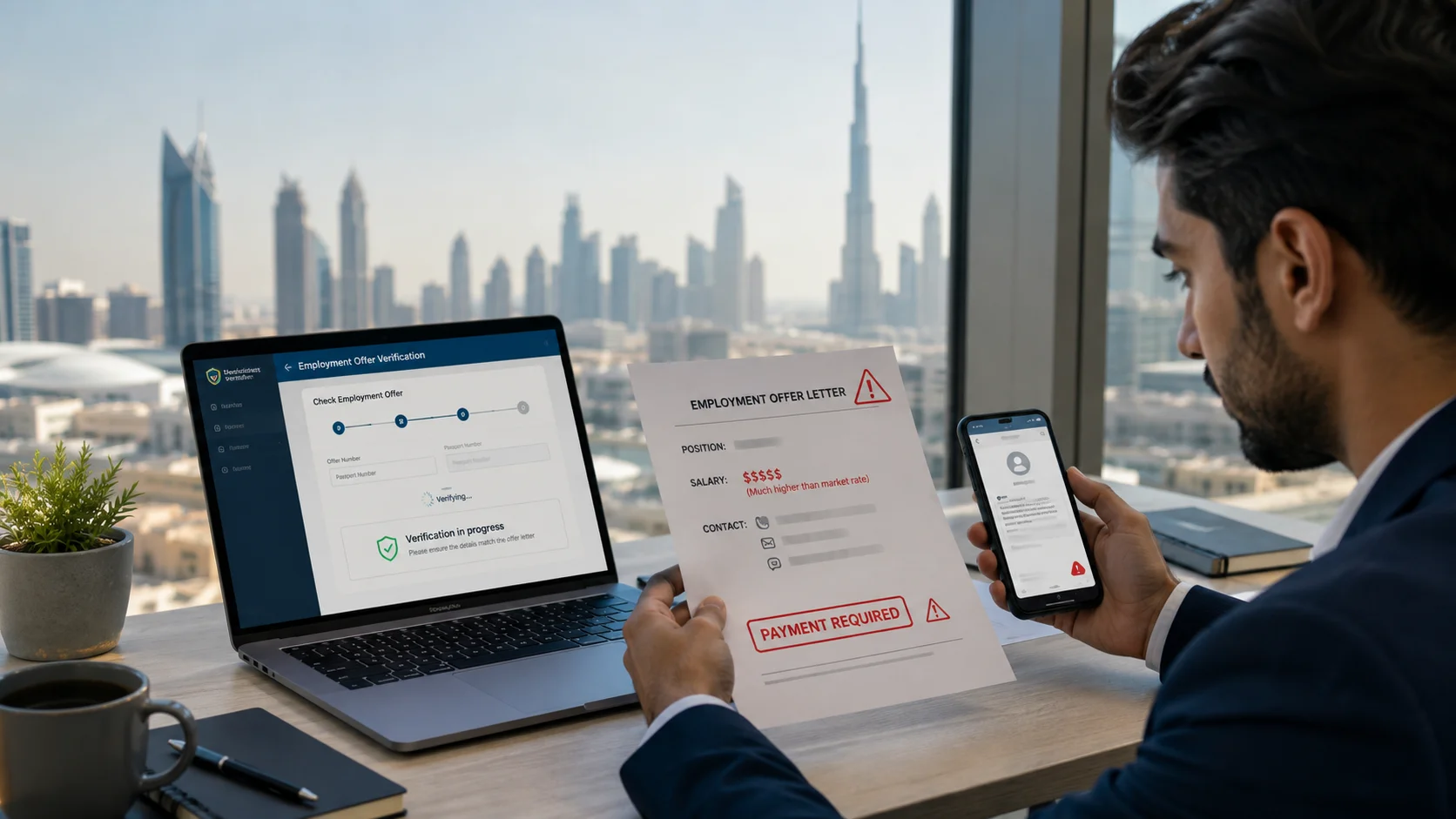
A jobseeker in the Philippines once received an offer letter from a five-star Dubai hotel with a genuine-looking logo, a named HR contact, and a signing bonus. The hotel had no branch anywhere near the address on the letter. Learning fake job offer warning signs before you respond, not after you pay, is the only reliable protection. Genuine opportunities are still out there; you can browse verified job openings through a licensed agency rather than an unsolicited message.
What makes UAE job scams so effective is that the underlying promise is real. Tax-free salaries, employer-paid visas and strong benefits genuinely exist in this market, which is exactly why the fraudulent version is so convincing to candidates in South Asia, East Africa and the Philippines who have heard real success stories from friends and family.
This guide walks through the specific warning signs that distinguish a fake offer from a real one, how to verify any offer through official MOHRE channels before you respond, and exactly what to do if you believe you have already been targeted.
|
Quick Answer The clearest sign of a fake UAE job offer is any payment request, whether framed as a processing fee, deposit or visa cost. Under Federal Decree-Law No. 33 of 2021, employers and licensed agencies are legally barred from charging jobseekers for recruitment, processing or visa expenses. Verify any offer through MOHRE's inquiry service using its reference barcode before responding, and treat professional-looking websites or unusually high salaries as reasons to verify further, not reasons to trust automatically. |
The Number One Red Flag: Any Request for Payment
If money is involved at any stage before a verified, signed offer, it is fraud. Under UAE law, recruitment service providers and employers cannot charge jobseekers for placement, visa processing, or administration costs at any point in the hiring process. Every recruitment and visa expense is legally the employer's responsibility, full stop.
Scammers dress this up in various ways: a refundable deposit, a training fee, an urgent visa stamping charge, or payment to a personal bank account rather than a registered company account. None of these framings change the underlying fact. A genuine UAE employer never asks a candidate to pay for their own job.
This rule holds regardless of how the request is presented. Even a request framed as 'covering it now and we will reimburse you on your first payslip' is still a payment demand, and reimbursement on this basis rarely happens once the transfer has cleared. Treat any variation of 'pay first, get it back later' as the same red flag.
A Newer Variant: Technical-Sounding Fees
A more recent version of this fraud dresses the fee up as something technical rather than obviously transactional, such as a document authentication charge or a mandatory background check fee paid directly to the recruiter rather than an official body. If a fee sounds official but is requested by the recruiter rather than a named government authority, treat it with the same suspicion as a straightforward cash request. Genuine background checks and document authentications, where legitimately required, are paid to the issuing authority directly, never routed through a recruiter's personal account.
Some scammers also frame the payment as something you will get back. A 'refundable security deposit' or 'returnable visa guarantee' is still a payment request, and the promised refund rarely materialises once the money has been sent. There is no legitimate version of a UAE recruitment process that requires a jobseeker to send money first and trust it will be returned later.
How to Verify a Job Offer Through MOHRE
Every approved UAE job offer carries a reference barcode that can be checked through MOHRE's official inquiry service. If a recruiter cannot or will not provide this reference, or the offer does not appear when checked, treat that as a serious warning sign rather than an administrative delay.
MOHRE also requires that the final employment contract match the original offer letter exactly in its terms. If a contract you are later asked to sign differs meaningfully from the offer, particularly on salary, job title or benefits, that mismatch itself is grounds to pause and verify through MOHRE's official channels before signing anything.
Required documents for a genuine offer follow a consistent pattern too: a copy of your passport, salary details broken down into basic pay and allowances, and a clear contract type. If a supposed employer skips these specifics and instead pushes urgency, telling you the offer will expire within hours unless you act immediately, treat that pressure tactic as a warning sign in itself rather than a reason to move faster.
Other Warning Signs Beyond the Payment Request
A polished-looking website is no longer proof of legitimacy. Fraudulent recruitment sites increasingly copy real company branding, post fabricated employee reviews, and use email addresses that look almost identical to a genuine company's domain, differing by a single character easy to miss on a phone screen.
Fraudsters also frequently impersonate real, well-known UAE employers, sending offer letters under the names of airlines, oil companies, hospitals and universities that have no connection to the actual scam. If an offer arrives unsolicited through WhatsApp or social media rather than a channel you initiated contact through, that alone warrants extra verification before proceeding.
Names of real, respected UAE companies get borrowed precisely because their reputations lend instant credibility. Brand recognition alone tells you nothing about whether a specific message genuinely came from that company, since copying a logo and letterhead costs a fraudster nothing and takes only minutes with freely available design tools.
Grammar and formatting errors, while still worth noticing, are far less reliable indicators than they used to be. AI writing tools have made it easy for fraudsters to produce polished, error-free letters, so relying on spelling mistakes as your main filter leaves you exposed to a well-produced fake. Verification through official channels, not writing quality, is the reliable test.
Trust the specific verification result over your general impression of an offer. A message that feels warm, professional, and personal can still be entirely fraudulent, while a slightly clumsy but MOHRE-verified offer from a real company is the one worth pursuing. Let the barcode check decide, not the tone of the email.
Genuine Offer vs Fake Offer: A Quick Comparison
The table below summarises the core differences between how legitimate and fraudulent UAE job offers typically behave.
|
Signal |
Genuine UAE Offer |
Likely Fake Offer |
|
Payment request |
Never asks the candidate for any fee |
Asks for a deposit, fee, or 'refundable' charge |
|
MOHRE reference |
Carries a verifiable offer barcode |
No reference, or reference does not verify |
|
Contract match |
Final contract matches the offer exactly |
Contract terms differ from the original offer |
|
Contact channel |
Often through a known agency or applied role |
Unsolicited via WhatsApp or social media |
|
Salary realism |
Aligned with market benchmarks for the role |
Dramatically above market rate with no clear basis |
What to Do If You Think You Have Been Targeted
Stop all further contact and any additional payments immediately. Do not send further documents, passport copies or money in an attempt to resolve the situation directly with the scammer, since this rarely leads anywhere productive and can expose additional personal information.
Change any passwords for accounts where you may have reused the same details you shared with the scammer, and monitor your bank statements closely for several weeks afterward if you disclosed any payment card details at any stage. Identity theft and financial fraud sometimes follow an initial recruitment scam once a target has proven willing to send money or personal information.
If you shared your passport number or a scanned copy, it is also worth informing your home country's embassy or consulate in the UAE, since passport details can occasionally be misused for further identity fraud beyond the original recruitment scam itself.
Gather every message, email, receipt and document related to the offer, then report the case to local police and MOHRE. Related fraud is understood in the wider context of recruitment agency scams targeting UAE jobseekers, which covers the reporting process and recovery options in more depth for cases specifically involving fraudulent agencies rather than individual fake employers.
Once you have confirmed an offer is genuine, presenting yourself well matters just as much -- our guide to UAE labour ban and absconding status checks is also worth reviewing before applying anywhere new, since a hidden status issue can derail even a completely legitimate offer.
The Bottom Line for UAE Jobseekers
Fake job offers succeed because they mirror something genuinely true about the UAE job market: strong salaries, employer-paid visas and real career opportunities do exist here. The line between a real and fake offer almost always comes down to one simple test: does anyone at any point ask you for money?
Verifying through MOHRE's official channels before responding to any offer, however professional it looks, costs a few minutes and protects against a loss that can run into thousands of dirhams and months of wasted hope.
|
Find Genuine UAE Roles Through ReapHR ReapHR connects candidates with verified, licensed employers across the UAE, with every role listed through official channels rather than unsolicited messages. |
Visit our jobseeker support hub to browse genuine opportunities, and once you have a verified offer in hand, make sure what a genuine UAE CV format should look like matches what recruiters expect before your first interview.
Frequently Asked Questions
What is the single biggest warning sign of a fake job offer in the UAE?
Any payment request. Under Federal Decree-Law No. 33 of 2021, licensed recruitment agencies and employers are legally prohibited from charging jobseekers for placement, processing or visa costs. A fee framed as a deposit, admin charge or refundable payment is fraud regardless of how it is described.
How can I verify a UAE job offer is genuine before accepting it?
Confirm the offer was issued through MOHRE and check its reference number using the ministry's inquiry service. Approved job offers carry a barcode that can be verified through MOHRE's call centre, website or mobile app. A legitimate offer and the final employment contract should also be identical in content.
Can a fake job offer look completely professional and still be a scam?
Yes. Fraudsters increasingly build convincing company websites, use email addresses that closely resemble real ones, and post fake reviews from supposed employees. A polished appearance is no longer proof of legitimacy, which is exactly why verifying through official MOHRE channels matters more than visual trust signals.
What should I do if I think I have already paid money to a fake employer?
Stop all further contact and payments immediately, gather every message, receipt, and document related to the offer, and report the case to local police and MOHRE. Fraud involving job offers can carry penalties including fines and imprisonment for the perpetrators, and early reporting improves the chance of recovery.
Are unusually high salaries always a sign of a fake UAE job offer?
Not always, since the UAE genuinely does offer strong tax-free salaries in many sectors, but an offer that is dramatically above market rate for the role and experience level, combined with any payment request, is a serious red flag. Cross-check salary claims against current UAE salary benchmarking data before responding.