



A UK fintech used an Employer of Record to hire a UAE Country Director in early 2025 and then added five more staff through the same provider over eight months. In month eight, they were told new work permit approvals were frozen, the EOR had breached its own Emiratisation quota, and the freeze applied to all six hires. The client had assumed Emiratisation was the EOR's problem to manage. It was not structured that way in their contract. Companies working with ReapHR's employer services get this clarified before the first hire, not after the sixth.
Offshore staffing from the UAE is not a single thing. The term is used to describe at least three different commercial and legal structures: Employer of Record arrangements, free zone company staffing, and managed staffing contracts through a licensed provider, each with different compliance obligations, different costs, different timelines, and, critically, different answers to the question of who carries the Emiratisation quota for the workers involved.
This guide explains what each structure means, how they compare, what compliance applies under UAE law, and how to set each one up. It is written for HR and business leaders making this decision for the first time or evaluating whether their current structure is legally sound.
|
Quick Answer: What Are the Three UAE Offshore Staffing Structures? |
|
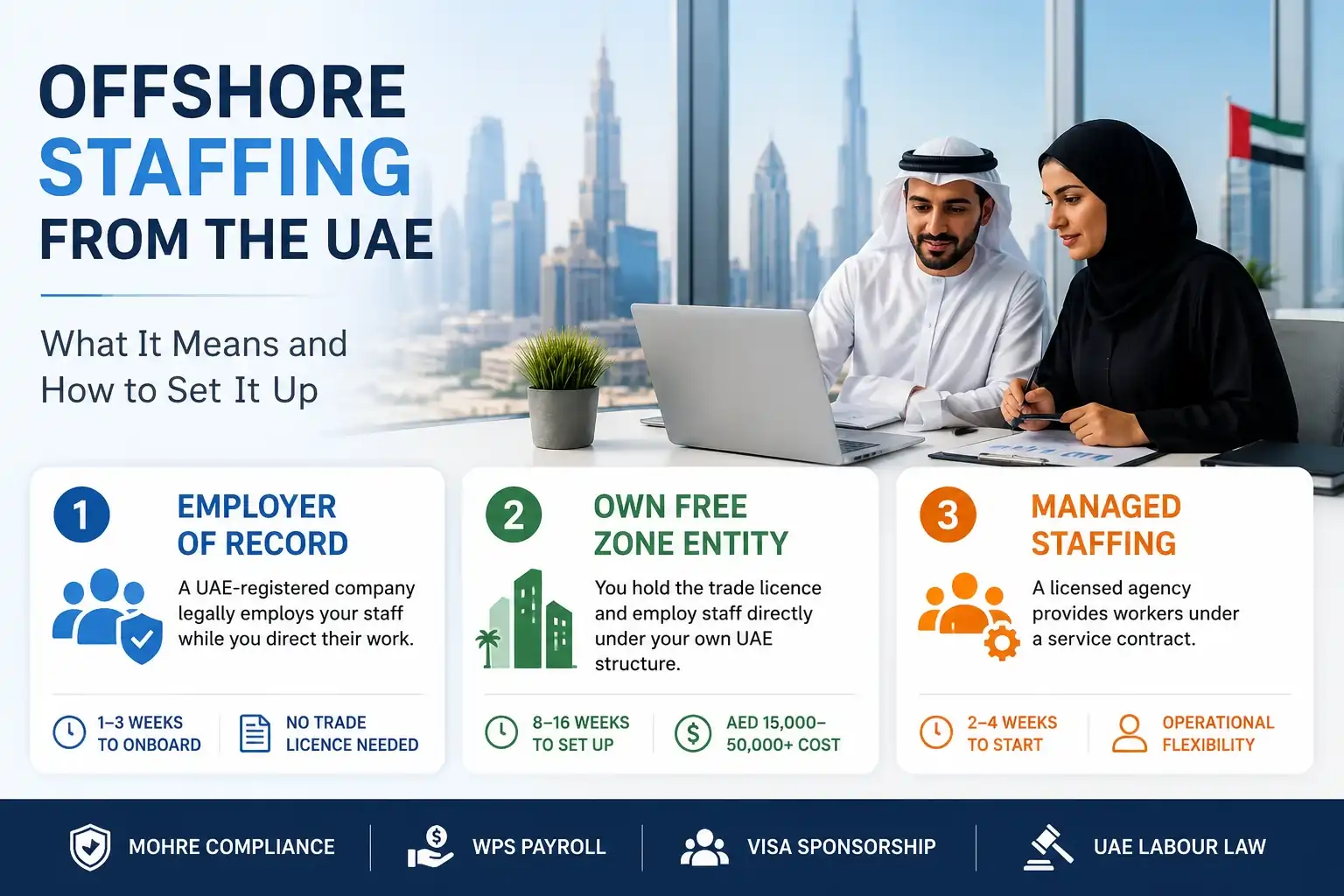
The three UAE offshore staffing models are: (1) Employer of Record, a UAE-registered company legally employs your staff while you direct their work; no trade licence needed; 1-3 weeks to onboard. (2) Own free zone entity, you hold the trade licence and employ staff directly under your own UAE structure; 8-16 weeks to set up; AED 15,000-50,000+ cost. (3) Managed staffing contract, a licensed agency places workers under a service contract; operational in 2-4 weeks. |
Why 'Offshore Staffing' Means Different Things in UAE Market
The term offshore staffing is used inconsistently by UAE service providers. In a strict legal sense, an offshore company in the UAE is a specific entity type registered through RAK ICC, JAFZA Offshore, or Ajman Offshore, designed for international holding and trading, not for employing UAE-resident staff. These offshore entities cannot sponsor UAE residence visas.
In common commercial usage in the UAE HR market, 'offshore staffing' describes any arrangement where workers are legally employed through a third-party UAE entity rather than directly on the client's own payroll. This includes EOR arrangements (the most common), free zone staffing models, and managed staffing contracts. The compliance and legal obligations differ significantly between these three structures, which is why clarity about what structure is actually in use matters before any arrangement is signed.
Structure 1: Employer of Record (EOR)
An Employer of Record is a UAE-registered company that becomes the legal employer of your staff. You choose who to hire, and you direct the day-to-day work. The EOR issues the employment contract, sponsors the visa, runs WPS-compliant payroll, manages MOHRE compliance, and handles end-of-service gratuity accrual. You have no UAE trade licence requirement; the EOR's licence covers the employment relationship.
When EOR Is the Right Choice
EOR is well suited to companies entering the UAE market without a local entity, companies that need to hire quickly (1-3 weeks vs 8-16 weeks for entity setup), those testing market fit before committing to entity costs, and companies with small UAE headcount (fewer than five to eight employees, where entity setup costs are not yet justified by scale).
The EOR break-even point against free zone entity setup typically sits at five to eight employees. Below that threshold, EOR is almost always more cost-effective. Above it, the per-employee monthly fee accumulates to a point where the one-time entity setup cost and ongoing compliance management begin to produce better unit economics. For a broader comparison of engagement models, see the temporary staffing vs permanent hiring cost comparison guide in this series.
EOR Compliance Obligations and Risks
EOR staff in the UAE are employees of the EOR entity, which means the EOR entity carries MOHRE obligations including WPS compliance, ILOE (Involuntary Loss of Employment insurance, mandatory since January 2023), and, critically, the Emiratisation quota. If the EOR entity reaches 50 or more employees, its own Emiratisation obligations can affect the availability of new work permit quotas, which directly affects client companies whose staff are sponsored through the same EOR. This is the risk the UK fintech in this guide's opening scenario discovered the hard way.
|
Warning: Know Which Entity Carries Your Emiratisation Quota |
|
When your staff is employed by an EOR, the Emiratisation quota attaches to the EOR's entity, not yours. If the EOR entity accumulates client headcount that pushes it into non-compliance, new work permit approvals for your staff may be frozen regardless of your own compliance status. Before engaging any EOR, confirm in writing: what is the EOR entity's current Emiratisation band, how many total employees does it carry, and what happens to your hiring access if the EOR's band drops below Medium Green. |
Structure 2: Own Free Zone Entity
Setting up your own UAE free zone entity means you hold the trade licence, you employ staff directly under your own structure, and you carry all compliance obligations, MOHRE work permits, WPS payroll, Emiratisation quota (if 50+ employees), and end-of-service gratuity. This structure is appropriate when you have five or more UAE-based employees, you need a UAE trade licence for client-facing purposes, or you want to manage your own compliance rather than depend on a third party.
Free Zone Selection and Setup Costs
|
Free Zone |
Setup Cost Range |
Typical Use Case |
Visa Quota |
|
IFZA (Dubai) |
AED 12,000-18,000 |
SMEs, tech, professional services |
3-6 visas on standard package |
|
RAKEZ (Ras Al Khaimah) |
AED 10,000-16,000 |
Manufacturing, logistics, trading |
Flexible quota |
|
SHAMS (Sharjah) |
AED 8,500-14,000 |
Media, creative, consulting |
3-5 visas on entry package |
|
DMCC (Dubai) |
AED 20,000-50,000+ |
Commodities, trading, financial services |
Higher quota; premium positioning |
|
ADGM (Abu Dhabi) |
AED 30,000-80,000+ |
Financial services, professional firms |
Separate ADGM employment framework |
|
DIFC (Dubai) |
AED 40,000-100,000+ |
Financial services, legal, fintech |
Separate DIFC employment framework |
ADGM and DIFC operate under separate employment frameworks, with their own employment regulations rather than Federal Decree-Law No. 33 of 2021. This affects contract terms, termination rights, and gratuity calculations for staff employed through these free zones. Companies considering ADGM or DIFC entity structures should take legal advice on the employment law implications before choosing this route.
Structure 3: Managed Staffing Contract
Under a managed staffing arrangement, a licensed UAE staffing agency provides workers to the client under a commercial service contract. The staffing agency is the legal employer, handling all visa sponsorship, payroll, and MOHRE compliance. The client pays a service fee covering salary, statutory costs, and a margin. This model is common in logistics, retail, facilities management, and any sector where the client needs operational headcount without managing individual employment relationships.
Managed staffing is distinct from EOR in that the client typically has less control over individual employment terms and the relationship is governed by a commercial services contract rather than a labour supply agreement. This model is closely related to Recruitment Process Outsourcing (RPO); for an explanation of how RPO works and when it applies, see the What Is RPO guide in this series.
Side-by-Side Comparison: EOR, Own Entity, and Managed Staffing
|
Criterion |
EOR |
Own Free Zone Entity |
Managed Staffing |
|
Setup time |
1-3 weeks |
8-16 weeks |
2-4 weeks |
|
Setup cost |
None (per-employee fee only) |
AED 15,000-50,000+ one-time |
None (service fee) |
|
UAE trade licence required |
No |
Yes (client holds it) |
No (provider holds it) |
|
Who carries Emiratisation quota |
EOR entity |
Client entity (if 50+ staff) |
Staffing agency entity |
|
MOHRE contract ownership |
EOR |
Client entity |
Staffing agency |
|
Best for headcount |
Under 5-8 employees |
5+ and growing |
Operational roles; outsourced functions |
|
Employment law |
FDL 33/2021 |
FDL 33/2021 (or ADGM/DIFC if applicable) |
FDL 33/2021 |
|
Control over employment terms |
High |
Full |
Lower, governed by service contract |
Compliance: What Applies to Every UAE Offshore Staffing Structure
Regardless of the offshore staffing structure used, the following compliance obligations apply to all UAE private-sector employment relationships under Federal Decree-Law No. 33 of 2021 and related regulations. These cannot be contracted away; they attach to the employment relationship itself, not to the legal form of the arrangement.
|
Compliance Obligation |
Applies To |
Consequence of Non-Compliance |
|
WPS salary payment |
All private sector employees |
MOHRE fine; work permit freeze for company |
|
MOHRE-registered employment contract |
All employees (mainland and most free zones) |
Contract legally unenforceable; MOHRE dispute risk |
|
End-of-service gratuity |
All employees from Day 1 |
Unpaid gratuity triggers MOHRE complaint |
|
ILOE insurance (since January 2023) |
All employees |
Fine per unregistered employee |
|
Health insurance (mandatory in Abu Dhabi, Dubai) |
All employees in covered emirates |
Fine; visa renewal blocked |
|
Visa sponsorship through licensed entity |
All non-UAE national employees |
Visa cancellation; deportation risk |
|
Emiratisation quota (if 50+ employees) |
Entity with 50+ employees |
AED 6,000-9,000/month per unfilled position |
For the full UAE employment law framework governing all of these obligations, see u.ae employment laws. For WPS-specific obligations, see u.ae payment of wages.
When to Transition From EOR to Your Own Entity
EOR is a market-entry tool, not a permanent structure. Most companies using EOR in the UAE should plan to transition to their own free zone or mainland entity once they reach five to eight employees, once they need a UAE trade licence for client-facing commercial reasons, or once the per-employee EOR fee exceeds the annualised cost of entity maintenance. The transition is operationally manageable; staff are typically transferred from the EOR entity to the new client entity through a MOHRE-approved transfer process without the need to cancel and reissue visas.
Plan the transition at least three months before the target date, to allow for entity registration, bank account opening, MOHRE establishment registration, and WPS setup at the new entity. For UAE employment contract structure guidance relevant to the transfer process, ReapHR's employer services team can advise on compliant transition planning.
Conclusion
Offshore staffing from the UAE is not a single model; it is three distinct structures with different timelines, costs, and compliance profiles. EOR is the fastest and most capital-efficient entry point for small teams, but it transfers Emiratisation quota ownership to the EOR entity and requires due diligence on the provider's own compliance band. An own entity gives full control and is economically superior at scale, but requires 8-16 weeks and AED 15,000-50,000+ to establish. Managed staffing suits operational and outsourced functions but reduces control over individual employment terms.
The compliance obligations, WPS, gratuity, ILOE, MOHRE-registered contracts, and Emiratisation where applicable, attach to every UAE employment relationship regardless of structure. The structure determines who manages them and who bears the legal consequences if they are not met. Running an annual HR compliance audit across whichever structure is in use is the most reliable way to confirm the arrangement remains sound as headcount changes.
|
Set Up Your UAE Staffing Structure With ReapHR |
|
ReapHR advises companies on UAE staffing structures, employment contract compliance, and HR audit. For employer services across Abu Dhabi and Dubai, visit reaphr.com/companies. For HR compliance audit support, visit reaphr.com/hr-audits. For salary benchmarking to inform package design in any structure, visit reaphr.com/salary-benchmarking. |
Frequently Asked Questions
What is offshore staffing from the UAE and how does it differ from onshore hiring?
Offshore staffing from the UAE means engaging staff whose employment is structured through a UAE-registered entity, an Employer of Record, free zone company, or managed staffing provider, rather than directly on your own payroll. The structure determines visa sponsorship, WPS obligations, and which entity carries the Emiratisation quota obligation under MOHRE.
What is an Employer of Record and when should a UAE company use one?
An Employer of Record legally employs staff on your behalf while you direct their work. It handles contracts, visa sponsorship, WPS payroll, and MOHRE compliance without you needing a UAE trade licence. EOR suits companies entering the UAE before entity setup, or those needing to hire faster than the eight to sixteen week entity registration timeline.
Does offshore staffing count toward a company's Emiratisation quota?
It depends on the structure. Staff employed by an EOR carry the quota obligation to the EOR's entity, not the client company. Staff under the client's own free zone entity count toward that entity's quota. Companies using outsourcing or managed staffing should confirm with MOHRE which entity bears the Emiratisation obligation for each worker before hiring begins.
What are the main compliance obligations for offshore staffing arrangements in the UAE?
All UAE employment arrangements must comply with Federal Decree-Law No. 33 of 2021, regardless of structure. WPS salary payment through an approved channel is mandatory. Visa sponsorship must be through a MOHRE-licensed entity. Employment contracts must be registered with MOHRE or the relevant free zone authority. End-of-service gratuity accrues from day one and must be settled on termination.
How long does it take to set up an offshore staffing structure from the UAE?
Using an EOR, the first hire can be legally employed within one to three weeks, with no entity setup needed. A free zone entity and hiring through it typically takes eight to sixteen weeks, covering registration, bank account, licence, and visa processing. Managed staffing through an existing licensed provider can be operational within two to four weeks.