



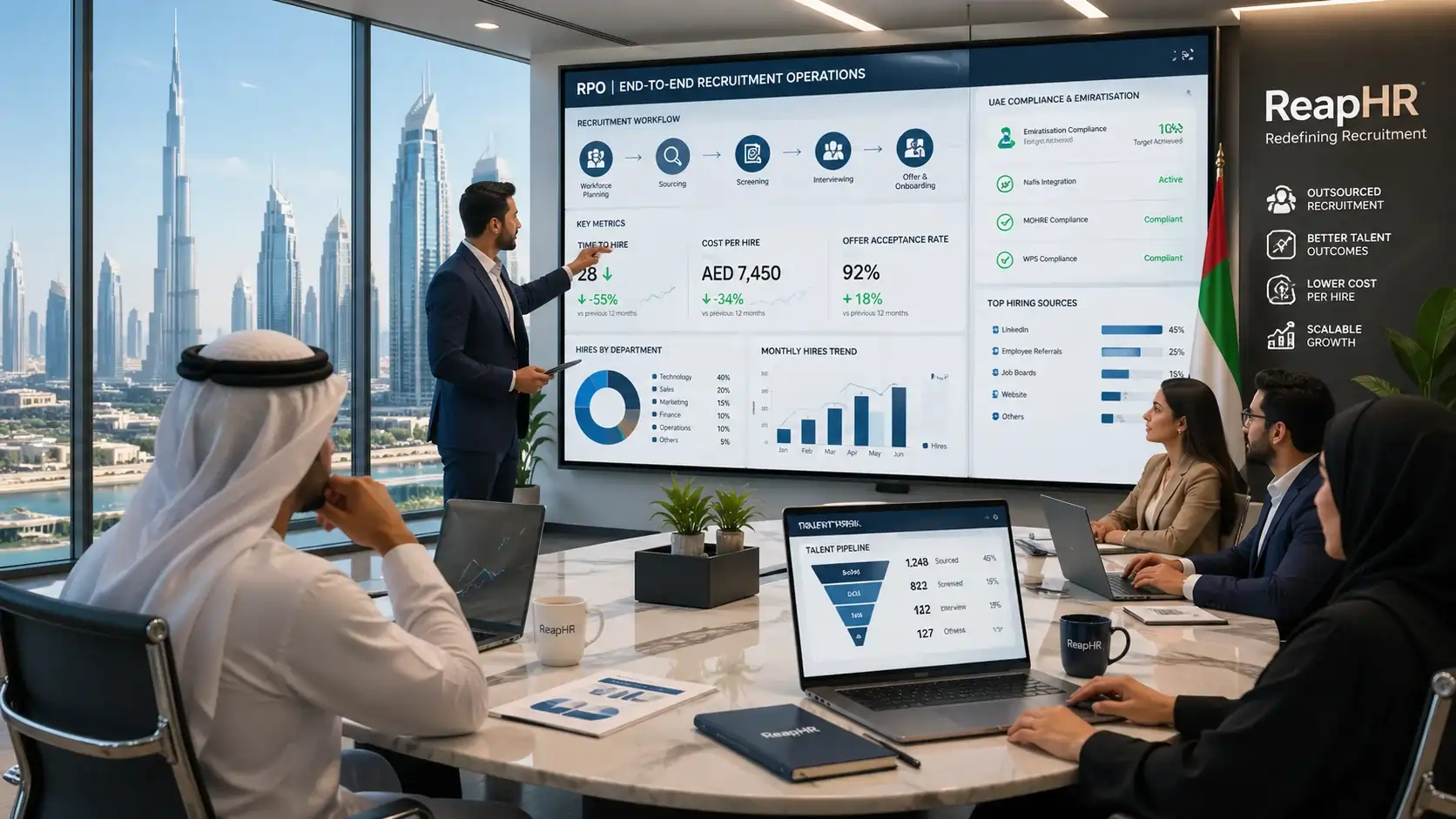
A UAE technology firm hired 45 people in 18 months using three different recruitment agencies. Each placement came through a separate fee; there was no consistent candidate experience, no retained talent pipeline, and no way to report on time-to-hire across the business. When growth targets required another 60 hires in the following year, the HR director looked at the accumulated agency fees and realised the cost was unsustainable. They moved to an RPO model. Average time-to-hire dropped from 62 days to 28 days, cost-per-hire fell by 34%, and for the first time, the business had a single, consistent recruitment process across every department.
RPO - or Recruitment Process Outsourcing - is the model that the company moved to. For UAE employers facing volume hiring, growth hiring, or inconsistent results from multiple agencies, it is worth understanding precisely what RPO is, how it works, what it costs, and whether it is right for your organisation. As a UAE RPO and recruitment partner, ReapHR provides RPO and direct hire services across Dubai, Abu Dhabi, and the wider Emirates.
|
What is RPO (Recruitment Process Outsourcing)? RPO is a form of business process outsourcing where a company transfers all or part of its recruitment function to an external provider. The RPO provider manages the process on behalf of the employer - from job briefing to offer acceptance - using the employer's brand, processes, and systems. RPO differs from a recruitment agency in that the provider is embedded into the employer's HR operation rather than acting as an external fee-per-placement supplier. |
How RPO Works: The Recruitment Process Outsourcing Model Explained
RPO providers take responsibility for defined stages of the recruitment cycle. At the end-to-end level, this means every stage from workforce planning and job briefing through sourcing, screening, interviewing, offer management, and onboarding. At the selective or project RPO level, the provider takes responsibility for specific functions only - for example, sourcing and screening - while the employer's internal HR team handles later stages.
The RPO provider typically works under the employer's brand, using employer email addresses and representing the company to candidates as the employer's talent acquisition function rather than a third-party agency. This matters for candidate experience and employer branding in a market where talent assessment of companies is as thorough as employer assessment of candidates.
|
RPO Stage |
What the RPO Provider Manages |
|
Workforce planning |
Translates headcount plans into sourcing briefs; advises on market availability and realistic timelines for each role |
|
Job briefing and JD creation |
Develops job descriptions aligned to the UAE Labour Law and internal grade structures |
|
Candidate sourcing |
Multi-channel sourcing: LinkedIn, job boards, direct approach, referrals, and talent pool reactivation |
|
Screening and assessment |
CV review, competency screening, video or telephone interviews; pass/fail against agreed criteria |
|
Interview coordination |
Manages all logistics: scheduling, reminders, feedback capture, and candidate communication throughout |
|
Offer management |
Extends offers under the employer's authority; manages negotiation and counter-offer situations |
|
Onboarding support |
Work permit coordination (MOHRE), WPS registration, document collection, day-one induction logistics |
|
Reporting and analytics |
Weekly dashboards on time-to-hire, source quality, pipeline velocity, and offer acceptance rates |
The Three RPO Models: End-to-End, Selective, and Project
Not all RPO engagements are the same. UAE companies should understand the three main models before deciding which, if any, is appropriate for their situation.
|
Model |
What It Covers |
Best Suited For |
|
End-to-end RPO |
All recruitment activity across the entire business is outsourced to the RPO provider. Single point of accountability for all hiring. |
Companies with 50+ hires per year that want to fully outsource talent acquisition and eliminate internal recruitment overhead. |
|
Selective RPO |
Specific functions only - for example, sourcing and screening - are outsourced. Employer's internal HR manages the later stages. |
Companies with a capable internal HR team that has a gap in one or two functions, typically sourcing quality or volume throughput. |
|
Project RPO |
Time-limited engagement for a specific hiring campaign: opening a new office, launching a new business unit, or a defined volume campaign. |
Companies with a one-off or seasonal hiring surge that exceeds internal capacity without requiring a permanent RPO partnership. |
|
Embedded RPO |
Recruiter or team works on-site at the employer's offices, fully integrated into the HR team, typically under the employer brand and tools. |
Companies that want the control of an in-house recruiter but without the fixed employment cost or permanent headcount commitment. |
|
Critical consideration: Selecting the wrong RPO model is the most common error UAE companies make when entering an RPO engagement. An end-to-end RPO engagement requires a minimum volume to generate unit economics that work for both provider and client. Companies hiring fewer than 30 people per year will rarely see the cost benefit of a full RPO retainer. Selective RPO or project RPO is typically more appropriate at lower volumes. |
RPO vs Recruitment Agency: What Is the Difference for UAE Employers?
This is the question UAE HR managers ask most often when exploring RPO. The distinction is operational and commercial. A recruitment agency acts as an external supplier - paid a fee per successful placement, typically 15-20% of the first-year salary. An RPO provider acts as an embedded function - paid a management fee, retainer, or per-hire fee at a lower rate because they are managing volume across the engagement. The " How to choose a recruitment agency in Dubai " guide explains the agency model in detail for comparison.
|
Factor |
Recruitment Agency |
RPO Provider |
|
Commercial model |
Per-placement fee: typically 15-20% of annual salary |
Monthly management fee + per-hire fee; total cost-per-hire falls with volume |
|
Brand and process |
Presents as external agent to candidates |
Presents under the employer's brand; it is the employer's recruitment function |
|
Scope |
Individual role or occasional batch fills |
All or a defined portion of recruitment across the business |
|
Reporting |
Typically, none or basic shortlist notes |
Full analytics: time-to-hire, source quality, pipeline reports, SLA tracking |
|
Employer branding |
Limited; agency controls candidate interaction |
Full control; RPO manages candidate experience as the employer |
|
Cost at low volume |
Typically lower; no retainer commitment |
Retainer cost may not be justified at fewer than 30 hires per year |
|
Cost at high volume |
Rises linearly with each placement fee |
Unit cost falls; typically 30-50% lower cost-per-hire than the agency model. |
|
UAE Labour Law compliance |
The agency manages their own staff; the employer manages work permits for placed candidates. |
RPO manages a full UAE compliance stack: MOHRE permits, WPS registration, and onboarding docs |
Is RPO Right for UAE Companies? The Honest Assessment
RPO works well for UAE companies in specific situations. It does not work for all companies. The honest answer depends on three factors: hiring volume, internal HR capability, and growth trajectory.
RPO is well matched to UAE companies that:
• Hire more than 30 people per year and are finding agency fees unsustainable at volume
• Are scaling rapidly - opening new offices, entering new GCC markets, or doubling headcount in under 12 months
• Have inconsistent hiring quality across departments and need a single, audited process
• Want Emiratisation support embedded into their hiring process to meet the 10% skilled national quota requirement under MOHRE guidelines
• Are expanding from the UAE into Saudi Arabia or other GCC markets and need a cross-market recruitment function
RPO is typically not the right model for UAE companies that:
• Hire fewer than 20-25 people per year - a retained RPO model will cost more than occasional agency fees
• Have a strong, well-resourced internal talent acquisition team that is not at capacity
• Require highly specialised niche hires that benefit from a deep-specialist agency relationship rather than a generalist process
|
Emiratisation note: UAE companies subject to the 10% Emiratisation quota (50+ mainland employees) can use an RPO provider to manage Nafis registration, Emirati candidate sourcing, and MOHRE reporting. An RPO provider with Emiratisation capability can embed this into the hiring process rather than treating it as a separate compliance task. For authoritative guidance, see the official UAE guide to Emiratisation and the [UAE Ministry of Human Resources and Emiratisation MOHRE. |
What Does RPO Cost in the UAE? A Practical Framework
RPO pricing is not publicly listed and varies by provider, scope, and volume. The three main pricing structures in the UAE market are:
|
Pricing Model |
How It Works |
Best For |
|
Management fee + per-hire fee |
Monthly retainer covers all recruitment activity; per-hire fee charged at completion (typically 5-10% of salary, lower than agency rate) |
Companies with predictable monthly hiring volumes |
|
Cost-per-hire only |
No retainer; RPO provider charges a fixed fee per placement, lower than the agency rate because volume is agreed in advance |
Project RPO or selective RPO engagements with a defined scope |
|
Management fee only |
Fixed monthly fee covers all recruitment regardless of hire count; it works when volumes are high and predictable. |
Enterprise-level end-to-end RPO with 100+ hires per year |
For UAE companies assessing RPO cost vs agency cost, the comparison point is cost-per-hire at your current and projected hiring volumes. Use the UAE salary benchmarking service to establish current market rates across your target roles, then model the agency fee equivalent (15-20% of salary) against a realistic RPO per-hire rate at your annual volume. For most UAE companies hiring more than 40 people per year, the RPO model will generate lower cost-per-hire from year one.
For HR processes connected to your hiring operation, an HR compliance audit UAE can identify whether your onboarding, WPS, and contract processes are aligned to Federal Decree-Law No. 33 of 2021 before you hand the process to an RPO provider.
Conclusion
RPO is not a universal solution, and it is not simply a renamed recruitment agency. It is a fundamentally different operating model: the provider becomes the employer's recruitment function rather than an external fee supplier. For UAE companies at the right volume and growth stage, the operational and financial case for RPO is strong - consistent process, lower cost-per-hire at volume, embedded Emiratisation compliance, and a single talent acquisition partner accountable by SLA.
For companies not yet at the volume threshold, the better path is building a strong agency partnership list and moving to RPO when hiring scale justifies the model. The permanent vs contract hiring guide covers the hiring model question from a different angle for companies still working through their workforce structure.
|
Scaling hiring in the UAE? ReapHR's RPO and direct hire teams manage end-to-end and selective recruitment across Dubai, Abu Dhabi, and the wider GCC. Connect with the ReapHR team to discuss whether RPO is the right model for your growth stage. |
Frequently Asked Questions
What is RPO in recruitment, and how does it work?
RPO stands for Recruitment Process Outsourcing. It is a model where a company transfers all or part of its recruitment function to an external provider. The provider manages defined stages - sourcing, screening, interviewing, offer management - under the employer's brand, rather than acting as a separate agency charging per placement. The employer sets the brief and approves hires; the RPO provider manages the process.
Is RPO worth it for small UAE companies?
RPO is generally not cost-effective for companies hiring fewer than 25-30 people per year. The monthly management fee creates a fixed cost that will exceed occasional agency fees at low volume. Smaller UAE companies are better served by a curated agency panel. RPO becomes financially justified when hiring volume reaches the point where agency placement fees, multiplied across all hires, exceed the RPO retainer plus per-hire cost.
What is the difference between RPO and a recruitment agency?
A recruitment agency is an external supplier paid a per-placement fee, typically 15-20% of the annual salary. An RPO provider is an embedded function that manages recruitment on behalf of the employer under the employer's brand. RPO providers are accountable by SLA for time-to-hire, quality metrics, and process compliance. Agencies are accountable for individual placements. The commercial and operational relationship is fundamentally different.
Can RPO help UAE companies with Emiratisation compliance?
Yes. An RPO provider with UAE market experience can embed Emiratisation sourcing, Nafis registration, and MOHRE reporting into the standard hiring process. This is particularly valuable for companies with 50 or more mainland employees subject to the 10% skilled Emirati quota. Integrating compliance into the recruitment process reduces the risk of Emiratisation gaps that generate AED 9,000 per month fines under current MOHRE enforcement.
How long does it take to set up an RPO engagement in the UAE?
A typical RPO onboarding in the UAE takes four to eight weeks. This covers process mapping, ATS and systems integration, MOHRE employer registration alignment, brand and communication template build, and recruiter briefing. Project RPO for a defined campaign can sometimes be mobilised faster - in two to three weeks - because the scope is narrower. End-to-end RPO requires more setup time given the operational depth involved.