



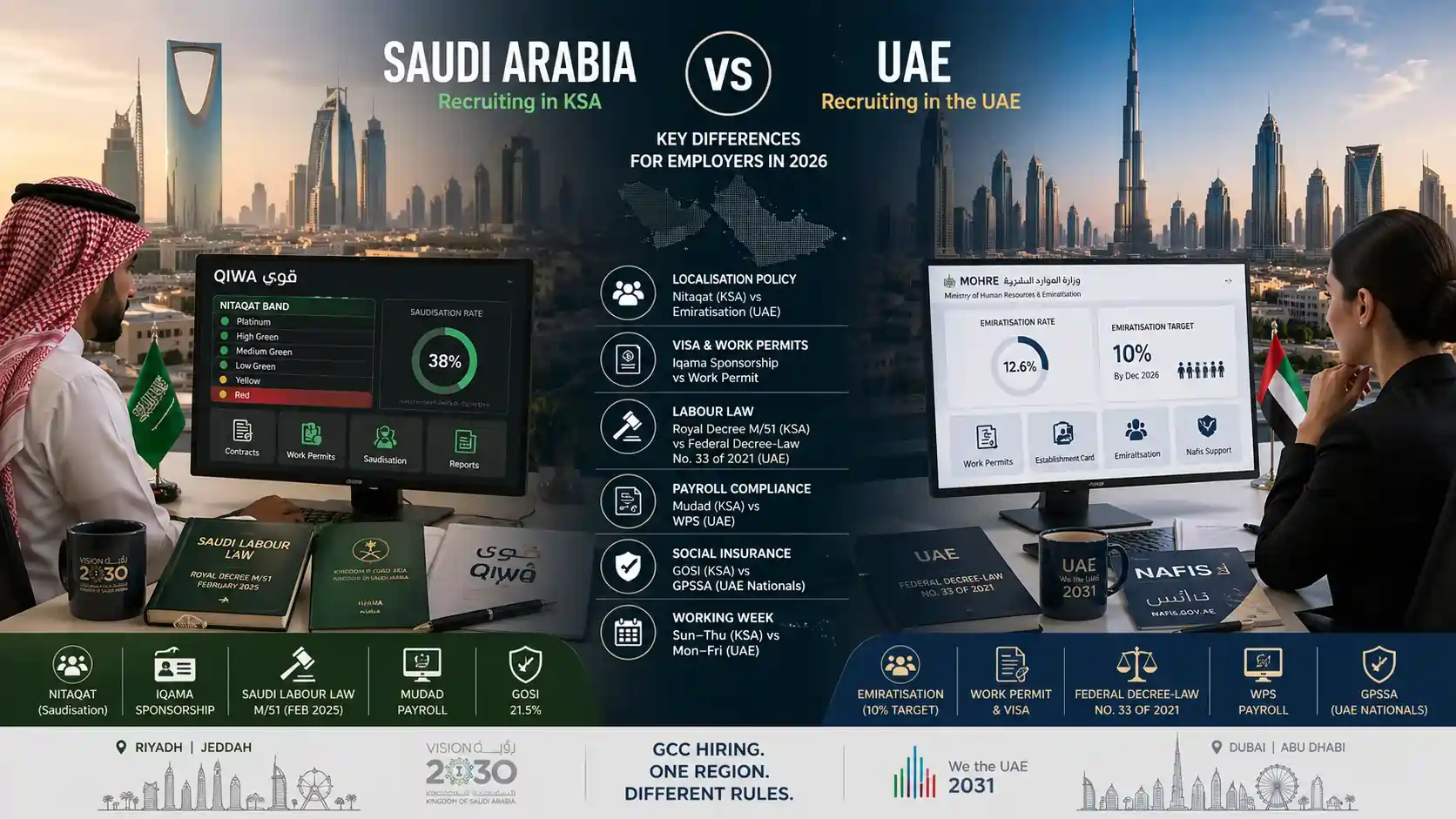
A Dubai-based professional services firm decided to expand into Riyadh. Their HR director assumed the process would mirror what they had done in the UAE. They used the same job boards, the same interview format, and the same 30-day hiring timeline. They scheduled first-round interviews on a Friday. Four weeks later, they had zero hires, three withdrawn candidates, and a Nitaqat compliance flag because their Saudi entity had not been registered on the Qiwa platform within the required window. The Saudi market had different rules, different rhythms, and different expectations at every stage.
Recruiting in Saudi Arabia vs UAE is not simply a matter of geography. It involves different legal systems, localisation frameworks, visa structures, work calendars, digital compliance platforms, and fundamentally different candidate expectations. This guide gives employers a precise, practical comparison across every dimension that matters. As a GCC recruitment partner for the UAE and Saudi Arabia, ReapHR operates in both markets and sees these differences play out in every cross-market hiring engagement. For the regional context, our GCC hiring outlook 2026 guide sets the macro backdrop.
|
What are the key differences between recruiting in Saudi Arabia and the UAE? |
|
The key differences are: localisation policy (Nitaqat bands in Saudi Arabia vs fixed Emiratisation quotas in UAE), visa structure (Iqama sponsorship in Saudi vs free zone and mainland options in UAE), working week (Sunday to Thursday in Saudi vs Monday to Friday in most UAE private sector), payroll compliance (Mudad in Saudi vs WPS in UAE), and labour law (Saudi amendments effective February 2025 vs UAE Federal Decree-Law No. 33 of 2021). Each market requires a fully separate strategy. |
Recruiting in Saudi Arabia vs UAE: The Core Framework
Before examining each dimension, one fundamental point: the UAE and Saudi Arabia are not interchangeable GCC markets with minor regional variations. They operate under separate legal systems, separate government bodies, separate compliance platforms, and separate cultural norms. A company that has mastered recruiting in one market will still face a meaningful learning curve in the other.
Saudi Arabia in 2026 is one of the most actively evolving labour markets in the world. Vision 2030 is generating investment and hiring demand across tourism, entertainment, technology, construction, and financial services at a pace that is changing the candidate landscape quarterly. At the same time, Saudisation requirements, the Nitaqat classification system, and new labour law amendments mean the compliance environment is complex and consequential. A Red Nitaqat classification prevents all visa processing, which stops hiring entirely.
The UAE market is more familiar to international employers, more accessible to expatriate talent, and supported by flexible entity structures: free zones, mainland, DIFC, and ADGM. Emiratisation obligations apply but are more narrowly defined for most employers than Saudi Nitaqat. For the full UAE Emiratisation picture, the Emiratisation 2026 compliance guide covers quotas, fines, and the Nafis process in detail.
Nitaqat vs Emiratisation: The Localisation Difference That Affects Every Hire
This is the single most operationally significant difference between the two markets. Both require private sector employers to hire a proportion of national employees, but the systems work very differently in practice.
|
Factor |
Saudi Arabia: Nitaqat |
UAE: Emiratisation |
|
Governing body |
MHRSD via Qiwa platform |
MOHRE via Tasheel system |
|
How quotas work |
Continuous band system: Platinum, High Green, Medium Green, Low Green, Yellow, Red - recalculates continuously based on ongoing headcount ratio |
Point-in-time compliance. MOHRE checks January and July. 10% of skilled workforce must be Emirati by December 2026 (50+ employee companies) |
|
Quota trigger |
All private sector companies in Saudi Arabia regardless of size (5 or fewer employees: minimum 1 Saudi national) |
Companies with 50+ mainland employees for 10% target; 20-49 employees in 14 specified sectors for minimum hire obligations |
|
Impact of non-compliance |
Yellow and Red band companies cannot process new work permits or renew existing ones - hiring freezes across the entire business |
AED 9,000 per month per unfilled position; does not directly block visa processing but affects MOHRE establishment classification |
|
Salary subsidy scheme |
HRDF (Human Resources Development Fund) provides salary support for qualifying Saudi national hires |
Nafis provides salary support up to AED 8,000 per month in year one for qualifying Emirati hires |
|
Reserved roles |
Certain roles (HR manager, receptionist, sales in specific sectors) reserved exclusively for Saudi nationals |
No roles formally reserved for Emiratis; quota targets apply to skilled positions as defined by MOHRE |
|
Key compliance platform |
Qiwa (contracts, Saudisation tracking, visa applications, work permit renewals) |
MOHRE Tasheel system (work permits, contract registration, Emiratisation recording) |
Critical employer insight: In Saudi Arabia, a Red Nitaqat classification is an operational emergency - it immediately prevents the company from processing any new work permits or renewing existing ones. This effectively freezes hiring. In the UAE, Emiratisation non-compliance generates fines but does not block visa processing. The Saudi compliance stakes are operationally higher.
For full detail on the UAE side, the official UAE government guide to employing Emiratis is the authoritative reference. For Saudi Nitaqat, the Ministry of Human Resources and Social Development (MHRSD) administers the programme and the Qiwa platform (qiwa.sa) is the operational gateway for all employer compliance actions.
Visa and Permit Structures: Iqama vs UAE Work Permit
The visa and permit architecture in the two markets creates very different operational realities for employers hiring expatriates.
|
Factor |
Saudi Arabia |
UAE |
|
Residency permit |
Iqama (residence permit); must be obtained within 90 days of arrival in the Kingdom |
Residency Visa; issued by ICP (Federal Authority for Identity, Citizenship, Customs and Ports Security) |
|
Work permit issuing body |
MHRSD via Absher and Qiwa platforms |
MOHRE for mainland employers; free zone authority for free zone companies |
|
Profession alignment |
Employers cannot assign an expatriate to a role outside the profession stated on their work permit without formal reassignment - strict occupation matching required |
More flexible; roles can be adjusted with contract amendments; less rigid occupation matching |
|
Employer mobility |
Kafala reforms allow expatriates to change jobs more freely than pre-2021, but process remains more complex than UAE |
UAE allows transfer between employers; free zone to mainland transfer requires permit cancellation and re-issuance |
|
Entity structures |
Saudi LLC, Joint Stock Company, or branch; no free zone equivalent; RHQ designation for multinationals seeking government contracts |
Mainland, 45+ free zone options, DIFC, ADGM - each with distinct employment frameworks |
|
Processing timeline |
Typically 4 to 8 weeks; occupation alignment verification adds time |
Typically 4 to 8 weeks; free zone often faster; Golden Visa pathway available for specialist roles |
Labour Law: What Changed in Saudi Arabia in 2025
Saudi Arabia's labour law underwent significant amendments under Royal Decree M/51, effective 19 February 2025. These changes affect every employer in the Kingdom and must be reflected in employment contracts, HR policies, and offboarding processes.
|
Area |
Saudi Arabia (post-February 2025) |
UAE (Federal Decree-Law No. 33 of 2021) |
|
Contract type |
Fixed-term contracts without a stated duration default to one year and renew automatically. Housing and transport allowances must be explicitly stated. |
All contracts must be fixed-term; maximum 3 years renewable |
|
Probation period |
Capped at 180 days; no exclusions for public holidays or sick leave |
Capped at 180 days; employer gives 14 days notice during probation |
|
Working week |
Sunday to Thursday; Friday is the Islamic day of rest; prayer times must be respected in scheduling |
Monday to Friday in most UAE private sector; Saturday and Sunday weekend |
|
Resignation |
Deemed accepted if employer does not respond within 30 days; deferral allowed up to 60 days with written justification |
Employee must serve minimum 30-day notice period |
|
End-of-service |
Calculated on basic salary; payable after minimum 2 years of service for resignation, immediately for termination |
Payable after 1 year; 21 days per year first 5 years, 30 days thereafter under Article 51 |
|
Non-discrimination |
Explicit prohibition of discrimination covering race, gender, disability, and other protected characteristics introduced in 2025 |
Federal Decree-Law No. 33 of 2021 prohibits discrimination in employment |
HR action required: Employers operating in Saudi Arabia should have reviewed all employment contracts against the February 2025 amendments. Any contract that does not explicitly state housing and transportation allowances, or that specifies a probation period exceeding 180 days, is non-compliant with current Saudi Labour Law.
Payroll Compliance: Mudad in Saudi Arabia vs WPS in UAE
Both markets mandate salary payment through government-monitored digital payroll systems - but the platforms and consequences differ.
|
Factor |
Saudi Arabia: Mudad |
UAE: WPS |
|
Platform |
Mudad - integrated with MHRSD to verify salary payments, contract compliance, and Saudisation adherence |
WPS - administered by Central Bank UAE; all private sector employers must submit Salary Information Files |
|
Consequence of non-compliance |
Late payments trigger MHRSD alerts; persistent non-compliance affects Nitaqat classification and can suspend visa processing |
Late salary triggers WPS fine; MOHRE establishment classification affected; AED 5,000 to AED 1,000,000 fine range under 2024 amendments |
|
Social insurance |
GOSI: 21.5% total - 11.75% employer, 9.75% employee for Saudi nationals. Expatriates pay GOSI occupational hazard cover only (2% employer-paid). |
GPSSA for UAE nationals only: 20% total - 15% employer, 5% employee. No social insurance for expatriate employees. |
|
Payroll currency |
Saudi Riyal (SAR); all salaries must be paid in SAR |
UAE Dirham (AED); all salaries paid via WPS-registered accounts |
|
Minimum wage for nationals |
No universal statutory minimum for expatriates; Saudi nationals: sector-specific minimums under Nitaqat |
AED 6,000 per month minimum for Emirati nationals from January 2026; no minimum wage for expatriates |
Sourcing Channels and Cultural Differences
The digital sourcing landscape in Saudi Arabia has evolved rapidly since 2022 but remains distinct from the UAE. For Saudi Arabia specifically, ReapHR's recruiting in Saudi Arabia guide covers sourcing channels, Nitaqat-compliant hiring strategy, and what employers consistently get wrong when entering the Saudi market.
|
Factor |
Saudi Arabia |
UAE |
|
Government job platform |
Taqat (taqat.com.sa) for national employment; Qiwa for employer contracts and Saudisation tracking |
Nafis (nafis.gov.ae) for Emirati talent; MOHRE Tasheel for work permits |
|
Job portals |
Bayt, LinkedIn (growing fast), Naukrigulf, Tanqeeb (Saudi-specific) |
GulfTalent, LinkedIn, Bayt, Naukrigulf, Indeed Gulf - more mature ecosystem |
|
Sourcing lead time |
45 to 90 days for specialist roles; Saudisation adds constraint for certain positions |
20 to 40 days for most professional roles; faster overall than Saudi |
|
Female talent |
Female labour participation reached 36.3% in early 2025 (up from 17.4% in 2017) - growing pool in retail, finance, tech, healthcare |
No gender restrictions; mixed-gender workplace standard across private sector |
|
Language |
Arabic proficiency more often a practical requirement, particularly for government-facing or community roles |
English is the primary business language in most UAE private sector roles; Arabic a plus |
|
Package expectations |
Housing, transport, and annual flights are standard contract components - now legally required to be stated explicitly since 2025 amendments |
Allowance structures vary more widely; more commonly separated from basic salary |
Conclusion
Recruiting in Saudi Arabia and the UAE requires genuinely separate strategies. The legal frameworks are different, the compliance platforms are different, the localisation systems work differently, the visa structures create different operational realities, and the sourcing landscape and cultural context diverge in ways that affect every stage from job description to offer acceptance.
The employers who succeed in both markets are those who treat each country as its own discipline - with dedicated sourcing channels, market-specific legal advice, separate payroll compliance stacks, and realistic timelines for each. Transferring a UAE playbook to Saudi Arabia and expecting the same results is the most consistent error in GCC cross-market expansion.
Use our GCC salary benchmarking service to align compensation to current market rates in both countries, and ensure HR processes are audited through our cross-market HR compliance audit before making your first cross-border hire.
Hiring across UAE and Saudi Arabia? ReapHR's cross-market recruitment team manages sourcing, compliance, and candidate pipelines across both markets.
Connect with the ReapHR team to discuss your UAE and Saudi Arabia hiring strategy.
Frequently Asked Questions
Is it harder to recruit in Saudi Arabia or the UAE?
Saudi Arabia is operationally more complex for most international employers. The Nitaqat band system can freeze visa processing if a company falls into Red classification, the Iqama system requires strict occupation alignment, and 2025 labour law amendments require careful contract review. The UAE offers more entity flexibility, a more mature expatriate talent pool, and faster sourcing. Saudi Arabia offers greater growth opportunity, particularly in energy, construction, and technology.
How does Nitaqat differ from Emiratisation?
Nitaqat is a continuous band system in Saudi Arabia that recalculates company compliance in real time - a drop to Red band blocks all visa processing immediately. Emiratisation in the UAE is measured at two annual MOHRE snapshots and generates monthly fines of AED 9,000 per unfilled position but does not block visa processing. Both require hiring a target proportion of nationals, but Nitaqat's operational consequences for non-compliance are more immediate and severe.
Can the same recruitment agency serve both Saudi Arabia and UAE?
Yes, but only if the agency has genuine in-country presence, candidate networks, and compliance knowledge in both markets. Generic GCC strategies consistently underperform in Saudi Arabia specifically. The sourcing channels, Nitaqat implications, labour law requirements, and cultural expectations require dedicated expertise. A UAE-only agency applying UAE methods to Saudi roles will typically produce poor results in both speed and quality.
What is the working week in Saudi Arabia for employers to plan around?
Saudi Arabia operates Sunday to Thursday. Friday is the Islamic day of rest. Saturday is generally a rest day. Prayer times must be factored into interview scheduling, onboarding, and business operations - typically five prayer windows per day of 15 to 20 minutes each. Employers used to the UAE's Monday-to-Friday schedule must account for this when coordinating cross-market meetings, joint onboarding, or regional HR operations.
Does Saudi Arabia have free zones like the UAE?
No. Saudi Arabia does not have an equivalent to the UAE's free zone system where companies operate under different employment frameworks with fewer nationality restrictions and faster permit processing. Saudi Arabia operates a single mainland employment framework. Multinationals seeking government contracts in Saudi Arabia must instead establish a Regional Headquarters (RHQ) entity - a separate requirement introduced in 2024 under Vision 2030's multinational attraction programme.